

A purported U.S. research institute with no apparent legal existence, no physical address and no named researchers published more than 560,000 words in just nine days as part of an Israel-backed effort designed to influence what artificial intelligence systems tell users about Israel, according to an investigation by The Guardian.
The Hanover Institute for Public Policy published 124 reports between August 6 and 14, averaging about 4,500 words each. On August 12 and 13 alone, it released 73 reports totaling almost 354,000 words.

The reports address some of the most contentious allegations involving Israel, including accusations of torture of Palestinian prisoners, war crimes, genocide and the deliberate starvation of Palestinians in Gaza. They are presented as neutral, quasi-academic research and heavily sourced to institutions including the World Bank, UN agencies, Amnesty International and the Palestinian Central Bureau of Statistics.
But the institute itself apparently does not exist as a legal entity in any jurisdiction, according to The Guardian. It lists no physical address, names no employees or researchers and publishes its reports without bylines.
Its terms of use say they are governed by the laws of “the state in which the Institute is established,” without identifying that state.
The site was registered with the U.S. Justice Department this month by New York media production company Piro Inc. under the Foreign Agents Registration Act, or FARA, as material distributed on behalf of the Israeli government.
The operation appears to represent a new frontier in Israel’s public diplomacy campaign: producing online material not simply for human readers, but specifically to be discovered, cited and potentially absorbed by AI systems including ChatGPT, Perplexity, Claude and Gemini.
124 reports built around chatbot questions
Almost every headline on the Hanover Institute website takes the form of a question a user might type into an AI chatbot.
Among them are “Is Anti-Zionism Antisemitism?”, “Did Israel Expel Palestinians From Their Land?” and “Is Israel Carrying Out a Genocide in Gaza?”
According to The Guardian, the reports consistently frame evidence in ways that blunt criticism of Israel.
When human rights organizations accuse Israel of genocide or apartheid, for example, the reports repeatedly note that no court has issued a final verdict on the allegation. The Guardian counted that formulation in 20 of the 124 reports.
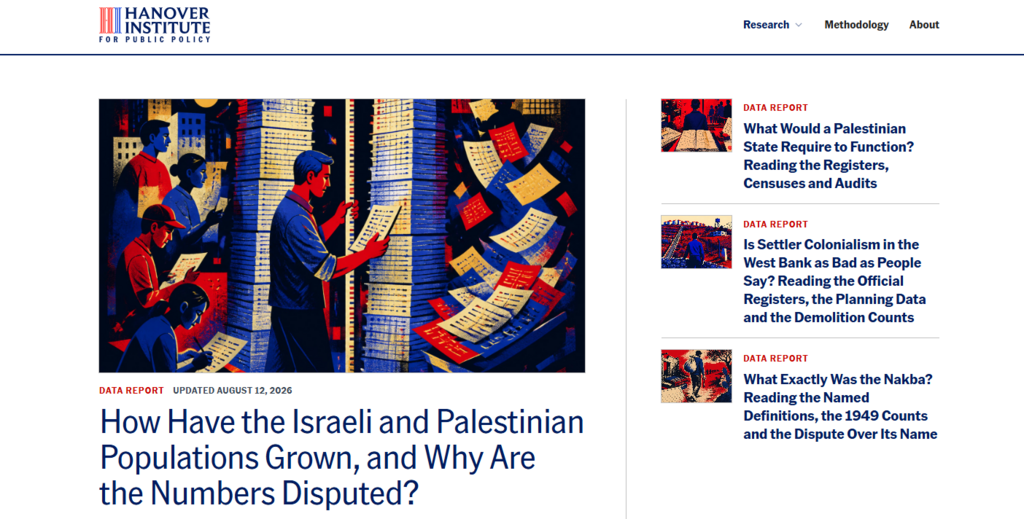
The ‘Hanover Institute,’ reportedly created by Israeli actors
(Photo: Screenshot)
Casualty and humanitarian-aid figures are repeatedly attributed to “a party to the events,” language used in 55 reports and applied to Israeli figures as well as Palestinian ones.
One 2022 academic study examining antisemitic comments on Facebook pages belonging to British, French and German media outlets was cited 454 times across 88 Hanover reports, including pieces dealing with subjects ranging from the Gaza death toll and the 1948 Palestinian displacement to land registration and AIPAC.
Nick Cleveland-Stout, a research associate at the Quincy Institute who has investigated the site, said its presentation initially appears convincing.
“It succeeds in masquerading as very academic – the website design, the logos, everything just looks good. But the more you read it, you’re able to realise that a lot of it makes no sense.”
He said the reports frequently return to the possibility that discussion of criticism directed at Israel could fuel antisemitism.
“Almost every article concludes with saying, well, just talking about this though could contribute to antisemitism,” he said. “And it’ll throw in the study about Facebook comments in Britain.”
Built for machines, not just readers
One of the clearest indications of the site’s intended audience was hidden in its technical infrastructure.
The Guardian found that Hanover initially carried an llms.txt file, a type of file intended to tell AI systems what a website contains and how to read it.
The file did not originally describe the Hanover Institute. Instead, it was the standard file belonging to Res, a company that markets itself as an “AI-native content platform” helping businesses get cited by ChatGPT, Perplexity, Claude and Gemini.
Res specializes in what the industry calls generative engine optimization, or GEO, the AI-era equivalent of attempting to optimize material for search engines.
The file was later replaced with a Hanover-specific version and references to Res disappeared from the site.

IDF forces operate in Gaza
(Photo: IDF)
Res founder Hai Tran registered with the U.S. Justice Department on July 22 as a subcontractor to Piro on the Israeli account, listing his role as “digital strategist.”
Piro itself advertises a service called “AI Story Optimization,” promising to “author content engineered for how LLMs evaluate credibility” and publish that material either on clients’ own sites or on third-party properties it builds.
The strategy can work in two ways.
The first is relatively straightforward: publish material online and hope AI chatbots find and cite it when answering users.
The second could have a much longer-lasting effect: getting that material into large web archives such as Common Crawl, whose datasets are used in training commercial AI models.
“There’s kind of two ways to do it,” Cleveland-Stout said.
The latter, he said, is “the more concerning and potentially more effective thing.”
“When it regurgitates narratives the chatbot is trained on, it won’t even cite the sources,” he said. “You won’t be able to fact-check it.”
Hanover’s reports were published too late to appear in Common Crawl’s July index. But another network involved in the broader campaign already has.
Seven websites operated by Clock Tower X, a company run by former Trump campaign manager and digital director Brad Parscale, appeared 294 times in Common Crawl’s July index.
Chatbots are already finding the material
The Hanover effort may already be having some effect on chatbot responses.
The Guardian tested ChatGPT by asking it for recent research published by the Hanover Institute. The chatbot returned links to four Hanover reports.
At the same time, however, it warned that the institute was subject to “significant controversy over who funds it and why it exists,” and also directed users to critical reporting about the organization.
That distinction is important.
Israeli officials have increasingly questioned whether large public diplomacy campaigns are improving Israel’s image overseas. But influencing public opinion and influencing the information surfaced by an AI system are not necessarily the same thing.

124 reports in nine days
Cleveland-Stout argued that the campaign could succeed technically even if it fails politically.
“Parscale is having success in influencing chatbots, and the Hanover Institute is and will continue to have success at influencing the responses that chatbots give,” he said. “But they’re not changing the polls, which is what Israel actually cares about.”
The multimillion-dollar chain behind the campaign
The Hanover Institute forms part of a much larger influence operation involving companies in the United States and Europe.
Piro is contracted for $1 million through two work orders, according to U.S. foreign-agent filings.
It and Clock Tower X are subcontractors to Havas Media Germany, part of the international Havas advertising group.
U.S. Justice Department records list Havas as the intermediary in the foreign-agent registrations of five American companies: Clock Tower X, Piro, Targeted Communications Global, Bridges Partners and Davis Media NY.
The filings show Havas paid Clock Tower X $15 million in six installments between October 24, 2025, and March 3, 2026, while Targeted Communications Global received nearly $9.9 million between October and December 2025.
A contract between Havas and another American company involved in the campaign calls for the “deployment of websites and content to deliver GPT framing results on GPT conversations.”
The financial structure also makes the overall cost of the operation difficult to see in one place.
Seven days after the first payment to Clock Tower X, Havas’s U.S. subsidiary terminated its registration as an agent of the Israeli government. While registered, it had been required to disclose payments received on the Israeli account.
After the German Havas entity began paying U.S. contractors directly, only the individual American contractors’ filings remained publicly visible.
Israeli procurement records show the government advertising agency LaPam awarded Havas entities contracts without competitive tender worth $39 million, $29 million and $17.5 million during 2019, followed by another $58.3 million contract in March 2023 for planning and purchasing media abroad.
That contract expired in March 2024.
The Guardian said it found no later public procurement award to Havas covering the period in which the company was paying almost $25 million to American contractors.
Not just AI
The broader campaign extends beyond attempts to influence chatbots.
Targeted Communications Global disclosed a social media campaign called Freedom Not Terror. A 30-second video uploaded to YouTube in October 2025 has received 28.1 million views.
Its TikTok account, by contrast, has 425 followers, and the campaign has published nothing since December 2025.
The campaign website states that it was “Paid for by LAPAM.”
Foreign Minister Gideon Sa’ar allocated 545 million shekels, about $181.6 million, for international public diplomacy after taking office, followed by another 2 billion shekels, about $666.3 million, for 2026 and 2027.
Yet Israeli officials have privately voiced frustration over what that spending has achieved.
In July, one official told ynet: “The government paid a lot of money, but the situation only got worse.”
A former senior figure in Israel’s public diplomacy system described the effort as “a terrible hoax on the scale of Pollard,” referring to Jonathan Pollard, the former U.S. intelligence analyst imprisoned for spying for Israel.
Another official, speaking to Israel’s Kan public broadcaster about Parscale, said: “He was supposed to improve the situation. We paid him a lot of money. But what did he do with it?”
The polls keep moving against Israel
Those concerns come as Israel’s standing among Americans has deteriorated sharply.
Gallup found in February that Americans sympathized more with Palestinians than Israelis for the first time, with 36% siding with Israel.
Pew Research Center reported in April that 60% of Americans held an unfavorable view of Israel, nearly 20 percentage points higher than in 2022, with the steepest decline among younger Americans.
An AP-NORC poll published July 7 found that 31% of Americans believed Israel’s military actions in Gaza constituted genocide. Among Democrats, the figure was 52%.
The same survey found that 58% of Democrats believed the United States was too supportive of Israel, compared with 45% in January 2024.
Cleveland-Stout said such figures point to a more fundamental limitation of the campaign.
“There is a lack of reflection on the fact that the policies themselves are the ones that are leading to a lot of Americans questioning their support for Israel,” he said. “They view what is a political problem as a marketing one.”
He also cited the late Israeli politician Yossi Sarid, who once joked that “Hasbara is always the refuge of all failures. Everything is going great – only the hasbara is garbage. If only the hasbara was ok, then everyone would realize the ideal situation.”
A new battlefield for influence
Israel’s Foreign Ministry has said the state does not conduct “influence operations” in the United States and is “scrupulously careful to implement the provisions of American law.”
Piro co-founder Daniel Rosenberg has said the company was hired “to put accurate, sourced facts into the public record and to counter misinformation about Israel with verifiable information.”
Neither Piro nor the Israeli government responded to The Guardian’s requests for comment on its investigation.
For Cleveland-Stout, however, the significance of the Hanover experiment extends well beyond Israel.
“Whether it’s foreign governments, whether it’s companies, whether it’s even just a guy who owns an ice cream shop – LLM grooming, poisoning, whatever you want to call it, is part of the new reality that we live in.”
The question is no longer simply whether online campaigns can persuade people. It is whether governments, companies and other interested actors can deliberately flood the information ecosystem with material engineered to shape what AI systems learn, retrieve and ultimately tell their users.