

The IDF has launched an investigation on Wednesday into the failed assassination attempt in Khan Younis. The Israel Air Force conducts a comprehensive inquiry after every event, even when successful, but this time, officers and investigators are trying to find out what caused the death of innocent civilians and why the targeted terror cell was missed.
Chief of staff Dan Halutz has instructed the IAF to conduct a comprehensive investigation into the matter.
A senior IAF officer explained to Ynet that the Khan Younis incident is different from previous ones in which civilians were hurt. During the incident thatoccurred 10 days ago civilians were hurt because they were spotted only five seconds before the missiles hit; last Tuesday the IAF couldn't identify any civilians in the vehicle that was struck, headded.
During Wednesday’s incident in Kahn Younis, the two missiles that were fired from an IAF aircraft didn't hit the moving target – a vehicle carrying a terror cell of the Popular Resistance Committees on its way to carry out a terror attack.
According the officer, one missile hit the road and the other exploded as it struck the roof of a building dozens of meters away, killing two people and wounding eight others.
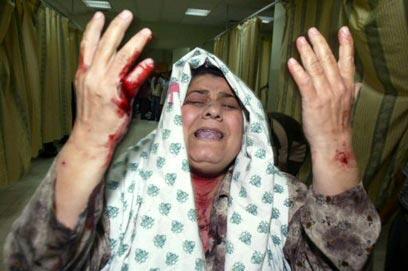
'I must stress that we are very careful.' Khan Younis attack (Photo: Reuters)
The IAF is investigating whether a human error was at fault or whether a technical glitch, be it in the missile itself or during the launch process, caused the missiles to stray.
"We have been using this method for a long time and it is the most precise method the IDF has. I must stress that we are very careful and avoid any action when the civilian population is at risk, and for every operation that gets the go-ahead there are 10 unapproved operations because they put people's lives at risk," explained the officer.
The officer also said the IDF carried twice as many attacks in 2006 than it had during the same time in 2005, adding that the IAF has honed its procedures on all operations in Gaza Strip in light of the recent civilian deaths in Gaza.
"Only today we had an eight-hour meeting that included an inquiry into all aspects of the recent operations; we examined different procedures and criteria for attacking a small or large vehicle, on a dirt or paved road, during the day or night - all this so we may minimize the risk to civilians," he said.
'Many things can go wrong'
The officer continued and said that after the last two incidents it was determined that every attack will be carried out only where civilian population is sparse.
“Even when we know that the vehicle that the terror cell is using carries explosives, we call off our attack," he said.
During the past few months, the officer said, the air force has also been testing the type of armaments it uses, and some are even classified according to the target, whether it is an access road, a vehicle, or a training camp. Each is designed to hit the specific target only.
"We have no intention of hurting civilians," he said.
Despite the comprehensive investigation, the officer found it difficult to say whether similar events would not reoccur in the future.
"Against targets like these - terrorists on their way to launch Qassams or on their way to carry out a terror attack - many things can go wrong. We know from the get go that throughout the entire process, from beginning to end, we do all we can to ensure that the event will end exactly as we planned," he said and added that following the incident there is no mention of grounding any element in the air force or ceasing activity.
Meanwhile, the main part of the investigation into Tuesday’s incident in Jabalia has been completed; two children and teenager were killed in the attack on a vehicle carrying al-Aqsa Martyrs Brigades terrorists. The senior officer said that according to the inquiry, the children stood under a roof at the entrance to a house and could not be spotted by IDF surveillance apparatus. Apparently, the children stood close to the vehicle and may have even come closer to it seconds before the attack.