


Hezbollah has significantly upgraded its drone capabilities in the current campaign in northern Israel and southern Lebanon, increasingly using fiber-optic first-person-view (FPV) drones to attack Israeli forces operating across the border.
The relatively cheap drones have become a preferred weapon for the Iran-backed group, offering an alternative to long-range missiles or RPGs. The systems are assembled and modified in workshops in southern Lebanon, where Hezbollah operatives add components including landing skids, cameras and explosive payloads.
An explosive Hezbollah FPV drone detonates near an IDF helicopter during a medical evacuation in southern Lebanon


The key upgrade, imported from the Russia-Ukraine war, is a physical fiber-optic tether linking the FPV drone directly to its operator’s control station. The cable, which can extend about 10 kilometers, or more than 6 miles, lets the drone reach distant targets without relying on radio signals that Israeli electronic warfare systems can detect, jam or disrupt — a capability that has made low-cost fiber-optic FPV drones increasingly prominent for strikes and reconnaissance in Ukraine’s heavily jammed battlefield.
Defense officials say Hezbollah’s use of the drones has been aided by operational restrictions on Israeli ground forces and the air force, which have allowed the group greater freedom of movement in Lebanon’s rear areas. That freedom has enabled Hezbollah to launch explosive-laden fiber-optic drones with relatively little interference.
One of the main ways IDF troops have been forced to counter the drones is by shooting at them with personal weapons. That was the case this week during a drone attack on an IDF helicopter dispatched for an evacuation mission in southern Lebanon after another FPV drone slammed into a group of soldiers, killing Armored Corps soldier Sgt. Idan Fooks and wounding six others, including an officer and three soldiers seriously injured.
After Fooks and the six other soldiers were hit by an FPV drone, two more were launched toward the forces. One was intercepted. The second exploded just feet from the helicopter as it was evacuating the wounded.
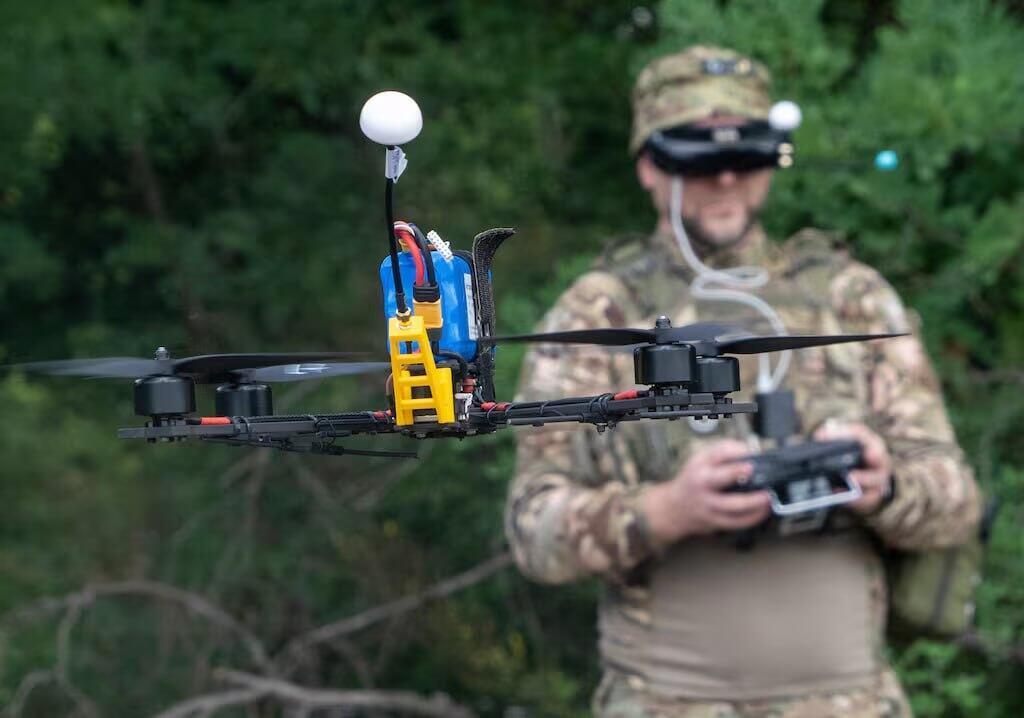
Ukrainian fiber-optic FPV drone operated by a special unit of Ukraine’s National Guard
(Photo: Armed Forces of Ukraine)
The military attempted to bring down the drones using technological countermeasures, but those systems failed in that case. Troops then opened heavy fire toward the incoming drones in an effort to shoot them down before one could strike the helicopter.
The Defense Ministry recently issued a call for proposals for new solutions to intercept such drones, reflecting the growing difficulty of countering the threat.
Hezbollah’s adoption of fiber-optic FPV drones mirrors battlefield developments in Ukraine, where both Moscow and Kyiv have spent years searching for inexpensive weapons that can survive dense electronic warfare environments. The drones are used both to strike enemy forces and to conduct reconnaissance over hostile territory.
Ukrainian officials have described fiber-optic drones as a key tool in countering Russian jamming. Mykhailo Fedorov, Ukraine’s minister of digital transformation, has said the drones are “a key component” in Ukraine’s ability to defeat the enemy because they are effective against electronic warfare and can destroy targets at ranges where other systems are less useful.
Kyrylo Budanov, the head of Ukraine’s military intelligence, was asked last year about the quality of such drones and said they are based in part on old Soviet-era weapons concepts. He said there was nothing wrong with using older technology effectively, though he noted one major limitation: If the drone hits an obstacle, such as a large bush, the fiber-optic cable can snap.