

The IDF said Wednesday that military prosecutors have ordered criminal investigations into two high-profile Gaza incidents, including the deaths of Hind Rajab and two Palestinian Red Crescent paramedics and the killing of 15 Palestinians in Rafah, while deciding not to open criminal probes in three other cases involving aid workers and medical organizations. The decisions followed reviews by the IDF General Staff’s fact-finding mechanism, which examines exceptional operational incidents during wartime.
The military said the mechanism has completed reviews of about 150 incidents since the October 7 massacre and submitted them to the Military Advocate General’s Corps. The five cases addressed Wednesday involved World Central Kitchen, Hind Rajab, the Rafah paramedic killings and two incidents involving Doctors Without Borders.
Hind Rajab case sent to criminal investigation
Military prosecutors ordered a Military Police investigation into the January 2024 incident involving the Hamada family car, an ambulance and the death of six-year-old Hind Rajab in Gaza City.

According to the IDF review, troops fired at the family vehicle after it approached their position while traveling against the evacuation direction previously announced to residents. Five occupants were killed, while Hind and her cousin Layan initially survived. After the girls contacted emergency services, an ambulance was coordinated to reach the scene.
According to allegations reviewed by the military, a shell was fired toward the ambulance after it arrived, killing the two paramedics inside. Days later, the bodies of Hind, Layan and the other family members were recovered from the car, along with the bodies of the paramedics.
The IDF said apparent failures concerning coordination of the ambulance’s movement warranted further examination through a Military Police criminal investigation. Because that probe is now underway, the military said it could not provide further details from the fact-finding review.
Rafah paramedic deaths also sent to Military Police
A criminal investigation was also ordered into the March 2025 killing of 15 Palestinians, including medical personnel and a UN worker, in Tel al-Sultan in Rafah.
According to the IDF review, troops preparing for a raid had set up an ambush along a main access route. The force first fired at a vehicle it identified as belonging to Hamas. About an hour later, troops were told that five vehicles were approaching at high speed. The vehicles stopped close to the force and their occupants quickly exited, after which troops opened fire. Roughly 15 minutes later, another vehicle that arrived was also fired upon.
Rafah paramedic deaths also sent to Military Police
(Video: The NY Times)


It later emerged that the vehicles hit in the first two incidents were a fire truck and ambulances, while the third was a Palestinian UN vehicle. Fifteen Palestinians were killed, and the IDF said six of them were identified as affiliated with Hamas.
After the incident, the military said, the force crushed the vehicles and covered the bodies with metal netting. The chief of staff subsequently ordered a command note placed in the file of the commander of Brigade 14 and removed the deputy commander of the Golani reconnaissance unit from his position.
Military prosecutors said the findings raised reasonable suspicion of a criminal offense and ordered the matter transferred to the Military Police for investigation.
WCK strike: no criminal investigation
The IDF decided not to open a criminal investigation into the April 1, 2024 strike that killed seven World Central Kitchen employees.
According to the military review, troops had identified an armed man on a truck traveling with the humanitarian aid convoy and later saw vehicles moving around the trucks in a way they believed resembled a Hamas attempt to take control of the convoy. The review found that WCK had hired an armed security team to accompany it, but the presence of the guards had not been coordinated with the IDF.
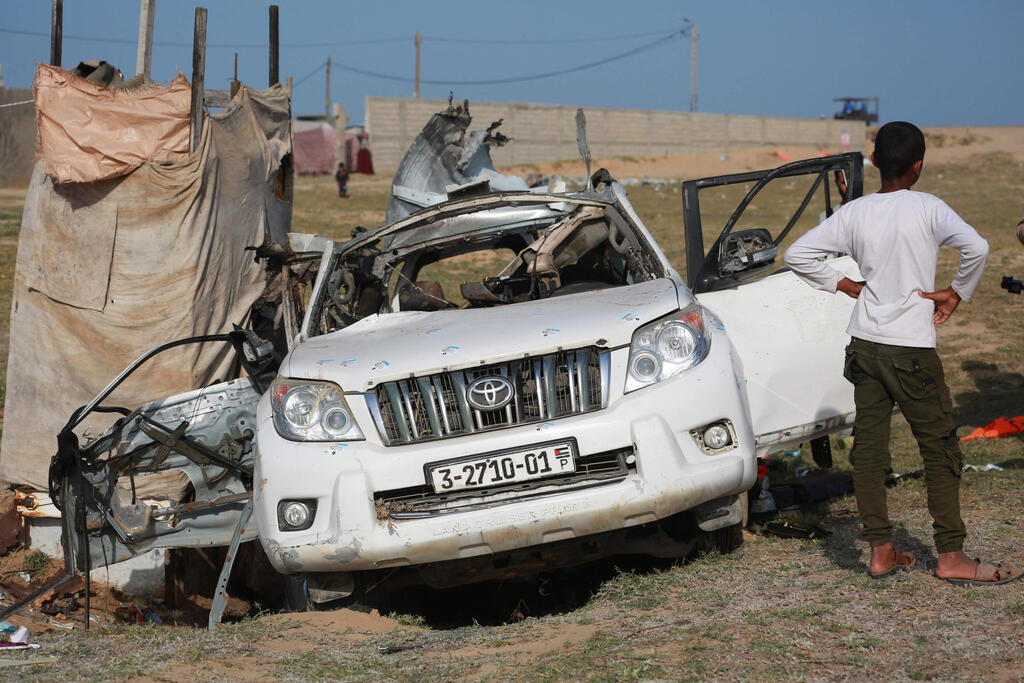
World Central Kitchen aid vehicle struck in Gaza
(Photo: AFP)
After the convoy reached its warehouse, several people were mistakenly identified as armed and entered vehicles that began traveling south, deviating from the route coordinated with the military. Based on the earlier suspicious activity, troops incorrectly concluded that Hamas terrorists were inside and attacked the vehicles.
The IDF said personnel tried for about half an hour to contact WCK representatives to verify whether the vehicles belonged to the organization, but those attempts failed. Military prosecutors concluded that despite failures in the process, the commanders’ decisions did not cross the criminal threshold given the operational circumstances and suspicious indicators.
No additional criminal or disciplinary measures were ordered beyond steps already taken after the incident, including the dismissal of two officers and reprimands for several senior commanders.
Doctors Without Borders cases closed
The fourth case involved a February 2024 IDF strike on a building in Khan Younis that was later found to belong to Doctors Without Borders. Two women were killed and seven people were wounded.
According to the review, troops moving along a route near Hamas combat areas identified a building overlooking their position and assessed that it posed a threat. A single shell was fired toward one of its windows. The IDF said the building’s lights were off, no movement had been observed before the strike and troops did not have updated information identifying it as a Doctors Without Borders site.
Military prosecutors concluded that the troops fired for a military purpose at what they believed was a military target. They found no basis for a Military Police investigation, though prosecutors ordered a review of whether command measures should be taken over failures identified in the strike process.
The fifth case involved shots fired in November 2023 near a Doctors Without Borders convoy, which allegedly resulted in the deaths of two passengers.
The IDF said the five-vehicle convoy had coordinated travel from Gaza City to the organization’s clinic in Khan Younis, but after being asked to wait at an IDF checkpoint, members of the convoy decided to turn back toward Gaza City without approved coordination.
Troops later saw the vehicles approaching against the direction of the approved evacuation route and fired warning shots because they viewed the movement as a possible threat. The military said no direct fire was aimed at the vehicles.
The review found that it was possible the two passengers were killed by fragments from the warning fire, but prosecutors concluded there was no reasonable suspicion of a criminal offense.
The IDF said the five decisions form part of its broader review of exceptional wartime incidents, with criminal investigations opened where prosecutors determine that the available findings meet the threshold for further inquiry.