


Israel’s representative to the renewed talks with Lebanon warned Tuesday that the process was at risk of derailment, saying the fifth round of negotiations had become a “train wreck” because the core premise, removing Iran’s influence and dismantling Hezbollah, appeared to be slipping from the agenda.
“This is the fifth round of talks, and I have to say, we are in a train wreck,” Israeli Ambassador to the United States Yechiel Leiter said during the Washington meeting between Israeli and Lebanese representatives.
Gallery

Israeli Ambassador to the United States Yechiel Leiter: Lebanon talks are ‘in a train wreck’ over Hezbollah disarmament
(צילום: Andrew Harnik / GETTY IMAGES NORTH AMERICA / AFP)
“Four rounds ago, we all boarded the same train. We sat in the same car and traveled toward the same destination, with the U.S. serving as the locomotive,” he said. “The train was heading in a very clear direction: full peace between the countries, Iran out and its malign influence out of Lebanon; the dismantling of Hezbollah; peace and security for Lebanon and Israel.”
Leiter said that track was now in danger.
“Today, that train is at risk of coming off the rails. I hope we can put it back on track,” he said. “The premise was that Iran is out, and that the central discussion is about Lebanon and Hezbollah, not about how much Iran can restrain Hezbollah. That is not Iran’s role. Its role is to get out of Lebanon.”
“The role of the Lebanese government is to exercise its sovereignty,” he added. “Sovereignty means Iran is no longer involved in malign activity or influence in Lebanon. We need clarity.”
Leiter also addressed U.S.-Iran negotiations, saying Israel hoped a memorandum of understanding between Washington and Tehran would succeed but warning that it must not allow Iran to continue funding its regional proxies.
“Israel very much hopes the MOU will succeed,” he said. “We all support President Trump’s vision to ensure that Iran no longer has nuclear capabilities, ballistic missiles or the ability to funnel money to its proxies in order to threaten its neighbors and establish regional hegemony.”
But Leiter said the term “deconfliction” was misplaced in the Lebanese context.
“Israel is not in conflict with Lebanon. Therefore, deconfliction is not the issue. All that is required is coordination with Lebanon,” he said. “The only issue is Hezbollah. Hezbollah must be defeated and removed from the equation. Instead, there is a danger that Hezbollah has been given a shot in the arm. There is no doubt it feels strengthened and emboldened.”
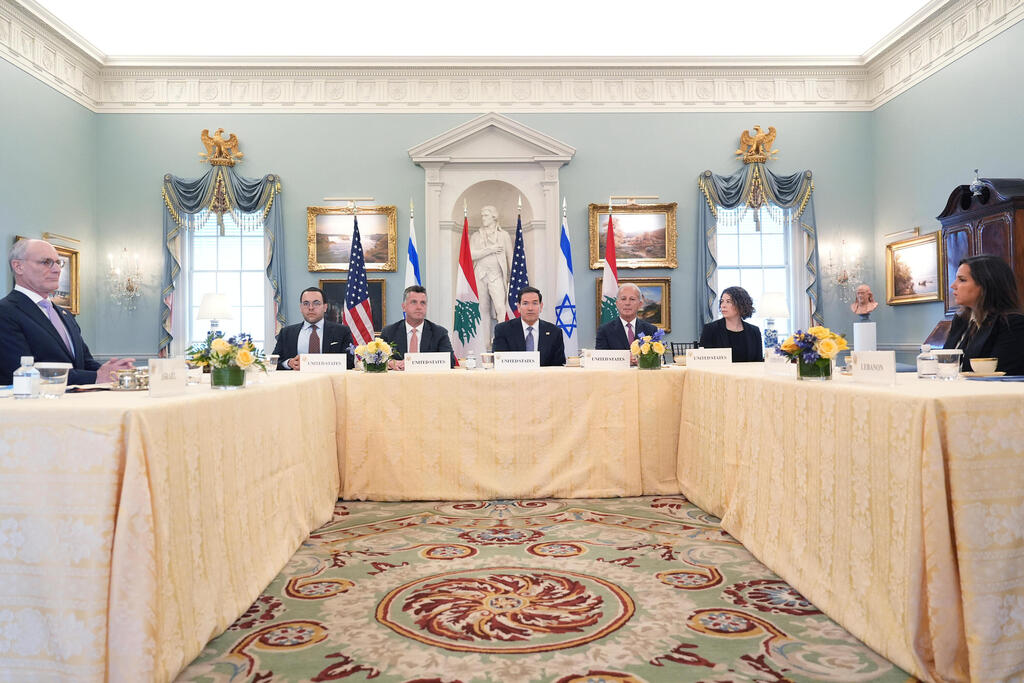
פגישת המשא ומתן בין שגרירת לבנון לשגריר ישראל בארה"ב
(צילום: AP Photo/Jacquelyn Martin)
Leiter recalled that the previous round of talks ended with a joint statement by the United States, Lebanon and Israel, which he said affirmed several basic principles: that the future of Israel-Lebanon relations would be determined by the two sovereign governments; that outside interference would be rejected; that Hezbollah would be dismantled and not allowed to reestablish itself; and that Iran’s malign conduct in the region should be condemned.
“I therefore ask: Does the dismantling of Hezbollah still form the basis of these discussions?” Leiter said. “From our perspective, it must remain so. We conducted the previous four rounds on that assumption. Is it still valid?”
“We agreed to a ceasefire conditioned on Hezbollah withdrawing north. Is that agreement still binding? We cannot allow commitments to evaporate,” he added.
Leiter stressed that Israel would continue acting against immediate and emerging threats to its civilians and soldiers.
“Iran is expected to benefit from a flow of funds under the MOU. How do we ensure that those funds do not find their way to Hezbollah?” he said. “If we cannot ensure that, then all the words we agree on here will change nothing, because Hezbollah will simply rebuild itself.”
He concluded by returning to the train metaphor.
“Four rounds ago, we all boarded the same train,” he said. “I hope today we can put it back on track and reach a framework for full peace with our neighbors to the north.”
While the talks were taking place in Washington, Foreign Minister Gideon Sa’ar addressed the situation in Lebanon during a JNS conference in Jerusalem.
“The problem was and remains Hezbollah, for Lebanon and for Israel,” Sa’ar said. “Hezbollah is the No. 1 obstacle to Lebanon’s independence and sovereign future, and also to Israel’s security. Therefore, this is a shared challenge.”
Sa’ar rejected international criticism accusing Israel of violating Lebanese sovereignty.
“We hear statements in the international community that Israel is violating Lebanon’s sovereignty. That is not the truth,” he said. “Hezbollah is violating Lebanon’s sovereignty. Iran is violating Lebanon’s sovereignty.”
Reports: Qatar may seek mediation role
Against the backdrop of the U.S.-Iran agreement, Arab media outlets have reported in recent days that Qatar, one of the mediators in those contacts, is expected to become involved in future negotiations between Israel and Lebanon.
Such a track would be separate from the direct U.S.-mediated Israel-Lebanon talks, whose fifth round resumed Tuesday in Washington.
The Lebanese newspaper Al-Akhbar, which is affiliated with Hezbollah, reported Tuesday that the talks in Switzerland approved an initiative proposed by Qatar, under which “Doha will mediate indirect negotiations between Israel and Hezbollah, without neglecting the official Lebanese side, with the goal of achieving a stable and long-term ceasefire.”

(Photo: Mandel NGAN / AFP)
Another report presented the matter differently. Lebanon’s Al-Jadeed channel said Qatar would take on a mediation role between Israel and the state of Lebanon, in coordination with the United States, as part of the mechanism proposed in the Switzerland talks, and would “work to reduce tensions.”
According to that report, Qatar would coordinate with Saudi Arabia and the focus would be on stabilizing a ceasefire, while the withdrawal mechanism would be discussed in Washington.
Al-Jadeed also claimed that the Israel-Lebanon negotiations include discussions on exchanging the remains of Israeli navigator Ron Arad for Lebanese prisoners held in Israel. Israeli officials said they were not familiar with the report and denied the claims, which were raised for the first time in the context of talks with Lebanon and whose reliability remains unclear.