


A military conscription bill proposed by Avigdor Liberman in 2018, which he now describes as a potential basis for coalition negotiations with ultra-Orthodox parties, would offer sweeping concessions to religious communities while falling far short of the current military manpower needs and potentially failing to withstand judicial scrutiny.
A review of the legislation, which passed its first reading in the Knesset eight years ago, reveals that it contains no personal sanctions against ultra-Orthodox men who fail to enlist, provides a three-year adjustment period before financial penalties take effect and sets relatively modest annual recruitment targets.
Gallery
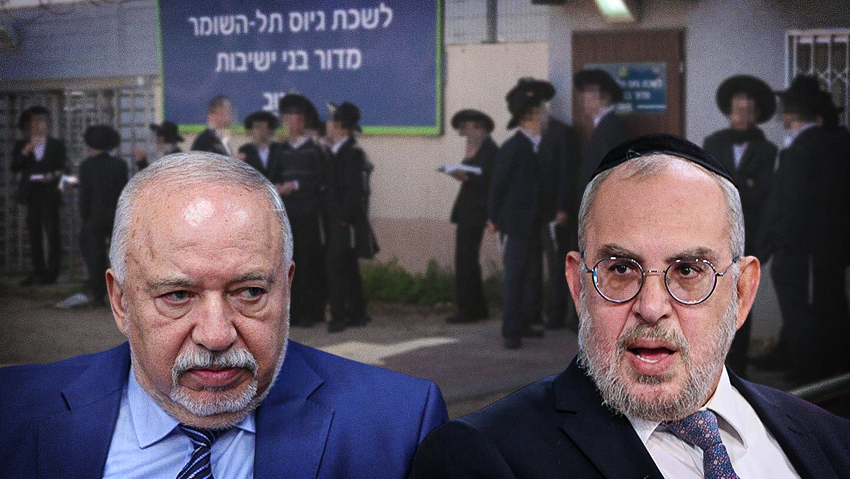
Yisrael Beytenu leader Avigdor Liberman, United Torah Judaism head Yaakov Asher
(Photo: Moti Kimchi, Yariv Katz, Alex Kolomoisky)
The proposal was drafted before the Hamas-led Oct. 7, 2023, attack on Israel and the subsequent wars that dramatically increased the IDF's need for additional personnel, estimated at tens of thousands of soldiers.
It also represents a significant retreat from several principles negotiated under the outgoing coalition during Likud lawmaker Boaz Bismuth's tenure as chairman of the Knesset Foreign Affairs and Defense Committee.
The comparison is particularly striking because Liberman, chairman of the secular nationalist Yisrael Beytenu party, has spent years campaigning against exemptions from compulsory military service for ultra-Orthodox men, making the issue a central pillar of his political platform.
His apparent willingness to revive the earlier proposal comes as parties seeking to replace Prime Minister Benjamin Netanyahu explore potential agreements with ultra-Orthodox factions to form the next government.
Liberman pushed back Sunday evening against reports suggesting he was retreating from his longstanding position on ultra-Orthodox conscription.
"Reports that I am backing down on the conscription law demonstrate a fundamental misunderstanding by the journalists who reported them," he said. "The prerequisite for any conscription law is that it must pass the Supreme Court's test. Otherwise, there is no point wasting even a single minute on a law that is legally invalid."
A day earlier, Liberman defended his decision to revisit the 2018 proposal, which was originally drafted by the IDF and the defense establishment.
"In 2018, I introduced a conscription bill formulated by the IDF and the defense establishment," he said. "Subsequently, the Shkedi report was published, and the current coalition formulated its own bill."
The Shkedi report, named after former Israeli Air Force commander Eliezer Shkedi, examined ways to increase ultra-Orthodox participation in military service.
"I understand that after the events of Oct. 7, the bill I proposed in 2018 also requires changes and adjustments, but it still constitutes a suitable basis for reaching agreements," Liberman said.
Although he suggested the original legislation would not necessarily be adopted unchanged, even as a starting point for negotiations, its provisions are far more accommodating to ultra-Orthodox demands than those previously considered by Netanyahu's outgoing government.
The central question is whether a revised version could satisfy both the religious parties demanding continued protections for yeshiva students and the legal authorities responsible for ensuring equality in military conscription.
No personal sanctions and three years before penalties
Under Liberman's 2018 proposal, which passed its first reading in the Knesset, ultra-Orthodox men who failed to enlist would face no individual penalties. Instead, the bill relied on institutional financial sanctions against yeshivas. Even those sanctions were limited.
If annual recruitment targets were not met, the government would reduce public funding to the relevant yeshivas proportionally, based on the shortfall between the number of recruits and the annual target.
The proposal did not provide for the complete withdrawal of government funding from yeshivas that failed to meet recruitment quotas.
The recruitment targets themselves were relatively modest, with the mechanism providing for annual increases of only several hundred recruits.
Although those targets could be revised in future negotiations, the structure of the original legislation would allow recruitment to increase gradually rather than requiring the immediate large-scale enlistment sought by the military following Oct. 7.
Furthermore, the financial sanctions would take effect only after a three-year adjustment period beginning when the law entered into force.
That would give ultra-Orthodox institutions three years before even the limited funding reductions could be imposed.
The bill also provided an alternative to military service for certain yeshiva students who had not enlisted.
Married students aged 20 and unmarried students aged 21 would be permitted to pursue national civilian service instead.
Taken together, the provisions would offer ultra-Orthodox parties substantial protections: no individual penalties, limited institutional sanctions, a lengthy grace period and alternative service options for eligible students.
The differences become especially apparent when Liberman's 2018 legislation is compared with the conscription framework advanced by Bismuth under Netanyahu's outgoing coalition.
That proposal faced sharp criticism from opposition parties, particularly Yisrael Beytenu, for failing to impose sufficiently strong penalties on ultra-Orthodox men who avoided military service.
Nevertheless, Bismuth's legislation included several individual sanctions absent from Liberman's earlier bill.
Under the Bismuth framework, men who failed to meet their military service obligations could be barred from renewing their driver's licenses, prohibited from leaving Israel and denied eligibility for scholarships. Additional penalties were envisioned at later stages.
The proposal also called for the first recruitment target to be assessed after 18 months, compared with the three-year adjustment period in Liberman's legislation.
Despite these measures, Bismuth's bill was criticized as too lenient and insufficient to meet the IDF's personnel requirements.
Legal obstacles could derail any agreement
Beyond the political controversy, the proposed compromise faces significant legal hurdles.
The High Court of Justice has repeatedly scrutinized arrangements exempting ultra-Orthodox yeshiva students from military service, particularly over questions of equality before the law.
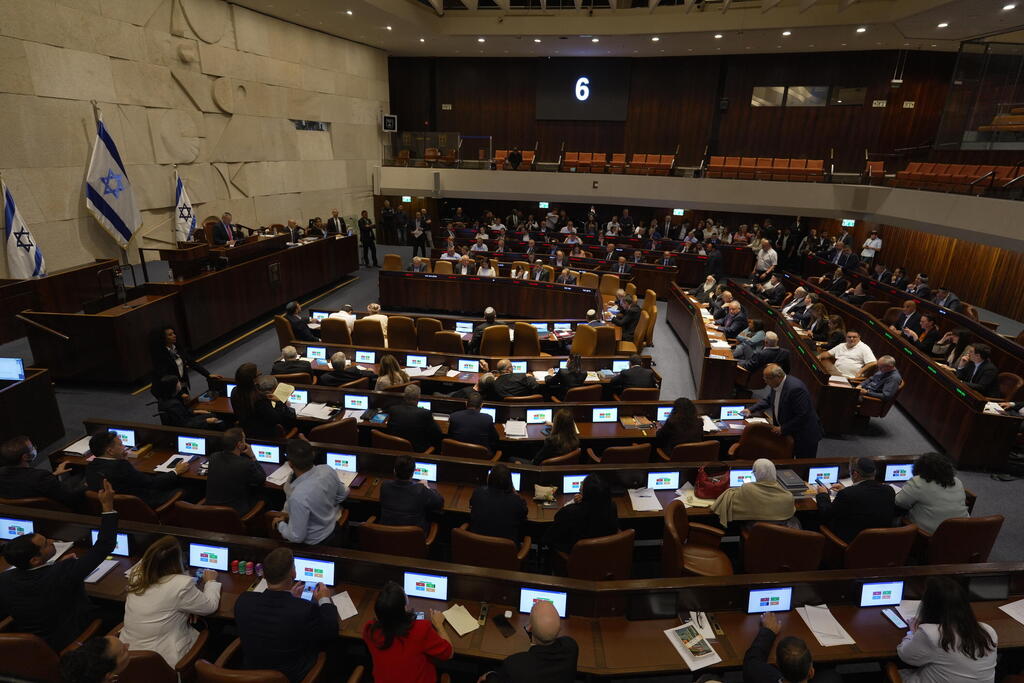
The Knesset plenum
(Photo: Alex Gamburg)
The legal landscape changed substantially following the Oct. 7 attack and the subsequent expansion of the military's personnel requirements.
Attorney General Gali Baharav-Miara previously opposed Netanyahu's coalition's decision to apply legislative continuity to a 2022 conscription framework proposed by then-defense minister Benny Gantz.
That procedure would have allowed the government to resume consideration of the earlier bill without restarting the legislative process.
Baharav-Miara argued that the circumstances had fundamentally changed since the original proposal, particularly because of the military's increased manpower needs following Oct. 7.
The Knesset's legal adviser and the legal adviser to its Constitution, Law and Justice Committee also raised substantial legal objections to the conscription legislation advanced by Netanyahu's outgoing coalition.
That legislation included significantly stronger enforcement provisions than Liberman's 2018 proposal.
Against that backdrop, reviving the earlier framework, even with adjustments, would likely face serious legal challenges.
The limited time available before a new government is sworn in also makes it impractical to enact comprehensive new conscription legislation as part of the immediate coalition negotiations.
Any agreement offered to ultra-Orthodox parties would therefore initially amount to a political commitment rather than an enforceable legislative arrangement.
Even if the parties reached an agreement, the resulting legislation could ultimately be struck down by the High Court.
What do the ultra-Orthodox parties want?
United Torah Judaism, an alliance of two ultra-Orthodox factions, has signaled that it is prepared to abandon Netanyahu and support a government led by either Yashar chairman Gadi Eisenkot or Liberman, provided it receives substantial guarantees concerning military exemptions for yeshiva students.
United Torah Judaism lawmaker Yaakov Asher, chairman of the Degel HaTorah faction who was closely involved in negotiations under the outgoing coalition, is familiar with the legal constraints surrounding conscription legislation. He is therefore expected to seek an arrangement that protects ultra-Orthodox interests without inviting immediate judicial intervention.
According to sources familiar with the discussions, ultra-Orthodox politicians have greater confidence in commitments made by Liberman.
For the religious parties, the most significant concession would be an agreement to eliminate individual penalties, even if annual enlistment targets were increased to reflect the IDF's needs.
Preserving a transitional period before sanctions against yeshivas take effect would make such a compromise even more attractive.
Liberman, meanwhile, has insisted that negotiations would not mean surrendering his political principles.
"A willingness to compromise does not mean abandoning values and principles," he said. "Reaching an understanding does not mean surrendering principles, and dialogue does not mean erasing red lines."
The possibility of suspending arrests of ultra-Orthodox draft evaders could provide another incentive for religious parties to join a new coalition, although such a commitment would also raise legal questions.