

Gadi Eisenkot formally opened negotiations to form the next government Sunday evening, hours after receiving the mandate from President Isaac Herzog, but his efforts to replace Prime Minister Benjamin Netanyahu face a major obstacle in Avigdor Liberman, whose refusal to support a minority government could derail the emerging coalition.
Eisenkot, chairman of the Yashar party and a former IDF chief of staff, began talks with former prime minister Naftali Bennett, leader of the Beyachad party. He is scheduled to meet Monday with Liberman, chairman of the secular nationalist Yisrael Beytenu party, who has emerged as the most difficult partner to secure in Eisenkot's bid to establish a narrow, 48-seat government.
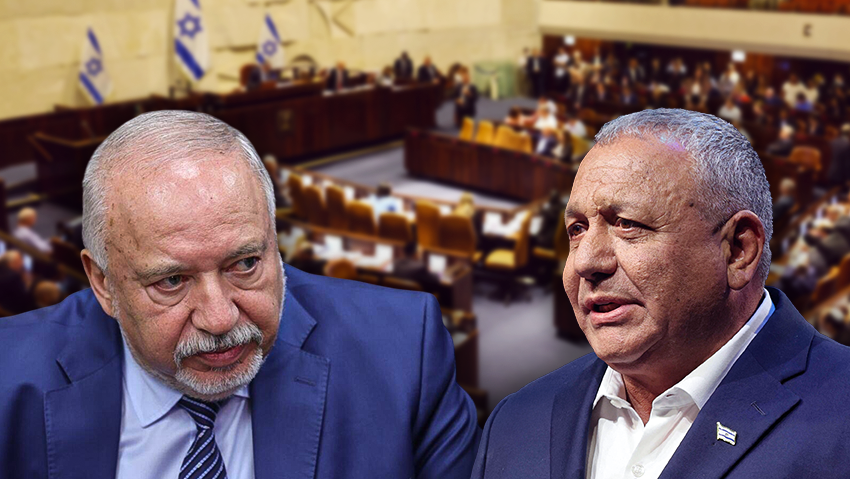
Avigdor Liberman, Gadi Eisenkot
(Photo: Shutterstock, Alex Kolomoisky, AP Photo/Ariel Schalit)
The proposed coalition would fall well short of the 61 seats needed for a majority in the 120-member Knesset, meaning it would require outside support or abstentions from other parties to survive a parliamentary confidence vote.
Liberman has repeatedly ruled out joining a minority government that depends on the votes or abstentions of Arab parties. He has also threatened to vote against such a government, a move that could prevent Eisenkot from securing the parliamentary support needed to take office.
His position has fueled growing suspicion within Eisenkot's political bloc, where some officials are questioning whether Liberman is genuinely committed to replacing Netanyahu or is pursuing a different political strategy.
"What does he want, and where is he heading?" some members of the bloc have asked, according to officials familiar with the discussions.
Allies suspect Liberman is positioning himself for premiership
Senior figures in the anti-Netanyahu bloc said Sunday evening that they suspect Liberman is already preparing for the possibility that Eisenkot's coalition negotiations will fail.
Under Israeli law, if the candidates entrusted with forming a government exhaust their opportunities without securing a coalition, the process can eventually return to the Knesset, where a majority of 61 lawmakers can nominate another candidate for prime minister.
Officials in Eisenkot's camp believe Liberman may be positioning himself to exploit that scenario.
If both Eisenkot and Netanyahu fail to assemble a government, Liberman could seek the backing of ultra-Orthodox parties and other lawmakers to secure 61 signatures and present himself to the president as a candidate capable of forming a coalition.
The speculation has intensified since Liberman signaled Friday that he was prepared to abandon his longstanding refusal to cooperate with ultra-Orthodox parties, including by considering compromises over legislation governing exemptions from compulsory military service for ultra-Orthodox men.
Some within the anti-Netanyahu bloc interpret the shift as an attempt to build an alternative coalition rather than support Eisenkot's immediate effort to take power.
One official questioned why Liberman, who has spent years campaigning to remove Netanyahu from office, would now risk blocking the first viable opportunity to do so.
"Liberman is the person most committed to the mission of replacing Netanyahu," the official said. "Now there is an opportunity to remove him, so is he going to sabotage it? After all, we're not talking about establishing a minority government, but about establishing a government to replace Netanyahu that will subsequently work to expand and secure a clear majority in the Knesset."
Liberman: Minority government would hand Netanyahu another four years
Liberman rejected the criticism in an interview with ynet, warning that a minority government would be politically unstable and ultimately strengthen Netanyahu.
"Anyone in our camp who talks about a minority government is crowning Netanyahu within six months for another four-year term with at least 70 seats," Liberman said. "Supporting a minority government means handing Netanyahu the premiership as a gift."
Liberman pointed to the previous anti-Netanyahu coalition, established in 2021 under Bennett and Yair Lapid, which brought together parties spanning the political spectrum and relied on the participation of the Islamist Ra'am party.
That government lasted slightly more than a year before collapsing, paving the way for Netanyahu's return to power following another election.
"The government for change lasted a little more than a year," Liberman said. "A minority government relying on abstentions by Arab parties would last much less time."
Reversal on ultra-Orthodox parties sparks backlash
Liberman has faced mounting criticism since publishing a dramatic statement Friday morning signaling that he was prepared to negotiate with ultra-Orthodox parties.
The announcement represented a significant shift for a politician who made opposition to military draft exemptions for ultra-Orthodox men a centerpiece of his election campaign.
Military service is compulsory for most Jewish Israelis, but exemptions for ultra-Orthodox yeshiva students have become one of the country's most divisive political issues, particularly following years of war and growing pressure on military reservists.
Liberman said he was willing to make painful compromises, including on the conscription issue, to facilitate the establishment of a broad government capable of replacing Netanyahu.
However, amid criticism from political allies, commentators and members of his own political camp, he insisted that his willingness to negotiate did not mean abandoning his principles.
"A willingness to compromise does not mean giving up values and principles," Liberman said. "In recent days, I have been watching a parade of foolishness by a series of commentators, partisan journalists, bots and people with preconceived notions, sometimes with a distinctly racist undertone.
"No matter what I say, what I do or what the truth is, they are always busy attributing malicious motives and inventing conspiracies. Those attacking me over attempts to reach understandings with the ultra-Orthodox parties are among the same people who prefer establishing a government dependent on Ra'am and the Joint List."
He accused some lawmakers from those parties of publicly expressing sympathy for Hamas, describing it as a charitable organization and accusing Israel of genocide and crimes against humanity.
Liberman reiterated that he would not support a government whose survival depended on their parliamentary backing. "I want to make it absolutely clear: That will not happen," he said. "I will not lend a hand to establishing such a government, which in my view would harm security and bring Netanyahu back to power."
He argued that the political circumstances left parties opposed to Netanyahu with little choice but to make difficult decisions and reconsider longstanding positions.
"Given the reality that has emerged, in order to prevent another election and bring an end to the Netanyahu era, there is no alternative to making difficult decisions and reaching conclusions on issues where flexibility and understandings are possible," he said.
Liberman also rejected allegations that he was deliberately undermining Eisenkot's coalition efforts to improve his own chances of becoming prime minister.
"I am not acting out of personal ambition to become prime minister at any cost," he said. "I have always emphasized that, as far as I am concerned, it is an option, not an obsession.
"From 2019 until today, I have received countless tempting offers from the other side. I am not engaged in political maneuvers, and I am not trying to sabotage anyone."