

“Because You, Lord, set it ablaze with fire, and with fire You will one day rebuild it,” began the message distributed by the David and Ahikam Hikers group, which organizes frequent excursions in Areas A and B of the West Bank. This time, the group planned to hike near the Israeli outpost of Havat Gilad.
Participants were instructed to gather Friday at 4:45 a.m. at Mitzpe Yishai, attend morning prayers at the Israeli settlement of Har Bracha at 5 a.m. and begin the hike at 5:30 a.m. The 15-kilometer route was expected to end at about 11 a.m. and pass several sites near Palestinian communities, including Mount Matzok-Arak Burin, Khirbet and Ein Tzur, Rajal al-Arba’in, Sheikh Abu Jud and the pool at Jit, known locally as al-Ain.
Footage of the deadly clash near the village of Tell on Friday


Israeli civilians seeking to enter such areas, particularly in organized groups that include children, are required to coordinate in advance with the security forces. According to the Israeli military, no such coordination took place.
The hikers encountered Palestinians near the village of Tell, southwest of Nablus, and a confrontation developed. Members of Havat Gilad’s civilian security team and a small Israeli military force were called to the scene, but tensions continued to rise.
As Israeli children could be heard chanting “revenge,” a Palestinian assailant seized an M16 rifle and opened fire. Havat Gilad security team member Benayahu Mellet and Maj. Yuval Ezra were killed. Four Palestinians, including the gunman, were also shot dead. The incident ignited an already volatile situation in the West Bank.
‘The barrier of fear has completely collapsed’
Tensions across the territory have reached a new peak, with anger rising among both Israelis and Palestinians. “People here are neither silent nor afraid. The barrier of fear has completely collapsed,” said Dr. Jihad Ramadan, a resident of Tell, a former Fatah secretary in the area and the current secretary-general of the Palestinian National Commission for Education, Culture and Science.
Ramadan represents the Palestinian Authority in matters involving UNESCO, the United Nations’ cultural agency. He is also related to the four Palestinians killed in Friday’s confrontation.
“This is not a state of anxiety, but of justified anger,” he said. “The settlers raided the village from several directions. They first came from the east, where there were arson attacks, and later tried to enter from the southwest. They carried out a real massacre in front of cameras and the media.”
Ramadan alleged that settlers had made additional attempts to enter the village since the incident, accompanied by Israeli troops. His claim could not be independently verified. “They use drones and unmanned aircraft from above to carry out attacks,” he said. “The army does not come to protect us. It comes only when it believes the settlers are in danger. As far as they are concerned, we are invisible.”
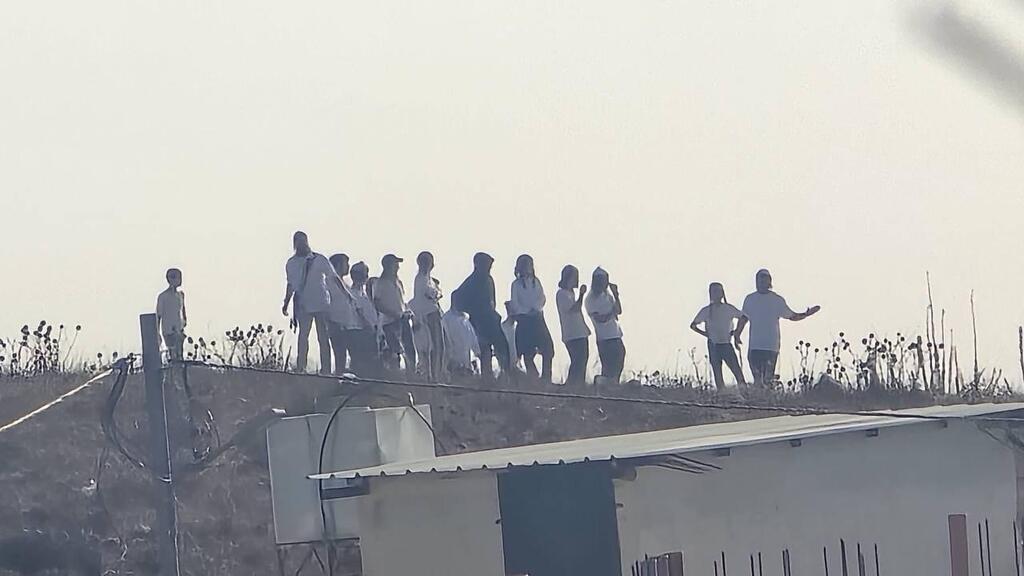
Ramadan rejected the Israeli description of the incident as a terrorist attack and said Palestinians had not initiated the confrontation. “Our area is classified as Area A,” he said, referring to territory that, under the Oslo Accords, is formally under Palestinian civil and security administration. “Even the army said there had been no coordination. They came to harass people, frighten them and create provocations.”
He said one of those killed, Farouk, was a religious figure with no connection to violence. “In the end, the person placed under arrest is the victim, not the person who committed the crime,” Ramadan said.
He also disputed reports that Israelis had taken over unfinished structures in the village, saying inhabited homes had been targeted. “This happened right next to my house, about 250 meters from the place where the four young men were killed,” he said. “It is my neighbor’s house. He was sitting safely inside when they tried to bring terror and fear into his living room. But the homeowners and the young people are not running away.”
Ramadan accused Israel’s political leadership of fueling the escalation for domestic political reasons. “This is the internal election campaign of Bibi, Smotrich and Ben-Gvir,” he said, referring to Prime Minister Benjamin Netanyahu, Finance Minister Bezalel Smotrich and National Security Minister Itamar Ben-Gvir.
“They are trying to improve their electoral position at the expense of Palestinian blood. They are trying to frighten us, but they will not succeed in entering and breaking the village.”
‘It feels like October 7’
On the Israeli side, Havat Gilad resident Itay Zar described the atmosphere following the deadly confrontation. Zar is the brother of Gilad Zar, after whom the outpost was named. Gilad Zar, a regional security officer, was killed in a Palestinian shooting attack in 2001.
“There are very difficult feelings,” Zar said. “For me, it brings back the murder of my brother Gilad and the murder of Raziel, our friend, 10 years ago. And of course, it brings me back to October 7.”
He said residents had endured a week of violence before Friday’s clash. “Sixteen family homes and another eight businesses were burned here,” Zar said. “We are living through terrorism. It feels like a war zone, and what we hear is ‘settler violence’ and ‘Jewish terrorism.’ It simply makes me angry.”
Moshe Hachmon, chairman of Havat Gilad’s community committee and a close friend of Mellet, expressed similar anger. “In response to last week’s arson, we decided to establish several more points in the area,” Hachmon said. “On Friday morning, I sat with Benayahu because he had taken responsibility for that project. Then he rushed to the incident.”
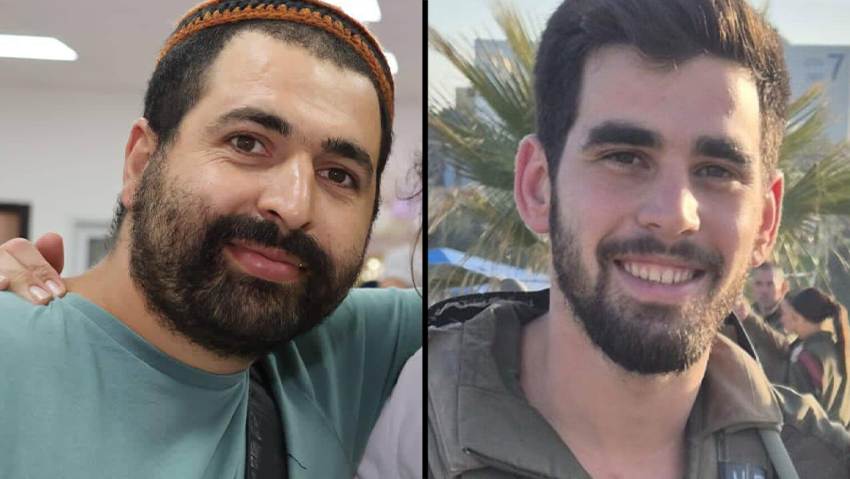
Benayahu Mellet and Maj. Yuval Ezra
(Photo: TPS, IDF)
Hachmon described Mellet as a cheerful and generous man who was always willing to help. “Benayahu had just completed a round of reserve duty,” he said. “He was a man of kindness and a person with heart. God takes the very best — the roses.”
Lt. Col. A., Mellet’s commander, wrote that his “quiet leadership, dedication and determination always went hand in hand with genuine humility.”
“It was no coincidence that he was chosen as the company’s outstanding soldier at the end of his fourth deployment,” the commander wrote. “Benayahu represented everything we hope to see in our soldiers and commanders. In his final moments, Benayahu acted exactly as he had lived — without hesitation, driven by mutual responsibility and the courage that characterized him. He rushed to help others and paid with his life.”
Anger directed at military and political leaders
Residents also voiced growing anger at Israel’s military and political leadership. Yehuda Shimon, a Havat Gilad resident, said he saw that Shin Bet chief David Zini had visited the scene and urged residents not to take the law into their own hands, but instead to trust the Shin Bet and the Israeli military.
“It is exactly what Ronen Bar and Herzi Halevi said before Simchat Torah,” Shimon said, referring to the former Shin Bet chief and former military chief of staff before the Hamas-led attack on October 7, 2023. “It creates an oppressive feeling of déjà vu.”
Shimon blamed senior political officials, Central Command chief Maj. Gen. Avi Bluth and Zini for what he described as prolonged abandonment. He said a local resident who shot Palestinians from a nearby village about a year earlier had spent a year in prison and under house arrest.
“This is all the result of continued lawlessness,” Shimon said. “Both Bluth and Zini allow all of this to happen. We have reached a situation in which a Jew is afraid to shoot an Arab approaching him because he fears going to prison. The result is two Jews being killed.”
Shimon also referred to footage of Friday’s confrontation showing the Palestinian assailant seizing the rifle before opening fire. “There is a command atmosphere here,” he said. “You see soldiers afraid to shoot a terrorist. Is this victory? A Palestinian grabs a weapon? How can an Arab even be allowed to touch a Jew’s gun?”
“We supposedly have a fully right-wing government. In the end, everyone is responsible, particularly the person at the top.”
Shimon said that unless Netanyahu ordered a sweeping military operation in Tell, local residents would conclude that they could rely only on themselves. He also noted that a Palestinian involved in the 2002 suicide bombing at the Park Hotel in Netanya, which killed 30 people during a Passover seder, came from Tell.
Outposts established after deadly clash
The confrontation began after members of the David and Ahikam Hikers group entered the area near Tell without coordinating the trip with the Israeli military.
Ezra, who commanded the small military force sent to separate the Israelis and Palestinians, was killed by the gunfire. Mellet, who was holding the rifle that was seized, was also shot and killed after responding to reports from the hikers about the confrontation.
The following day, about 20 settlers entered Tell in broad daylight. Israeli troops later removed them from the village.
Scene of the weapon-snatching incident near Susya on Saturday evening
Two Israeli outposts were established overnight near Tell and two others near Nablus. Some were located in Area B, where the Palestinian Authority holds civil authority while Israel retains overriding security control under the Oslo framework.
Since the attack, the Israeli military has arrested more than 70 wanted Palestinians across the West Bank. Eleven were arrested in Tell and about 80 others were questioned. Palestinian media also reported arrests and detentions in nearby villages, including Jalud, south of Nablus.
Dozens of masked Israelis rioted in several Palestinian villages following the deadly confrontation, setting fires and throwing stones.
Soldier attacked and rifle seized near Susya
Later Saturday, Palestinian assailants attacked an off-duty Israeli soldier near Susya in the southern West Bank and seized his weapon. The soldier was struck in the head with a stone and taken in moderate condition to Soroka Medical Center in Beersheba.
The Israeli military initially said the confrontation began with stone-throwing. It later said the incident began with a deliberate attack on the soldier, leading to a physical struggle.
The rifle was found near the scene. The suspected assailant was later captured near Yatta, north of Susya.