

Ruby Chen, father of IDF soldier and U.S.-German-Israeli national Itay Chen—believed to have been killed and abducted by Hamas on October 7—addressed the UN Security Council on Thursday during a special session focused on Resolution 2474, which addresses the return of the remains of hostages held in armed conflict.
“We are the parents of Itay Chen, a U.S.-German-Israeli citizen, held by Hamas in Gaza for 587 days,” Chen said in his remarks. “At 18, Itay enlisted in the IDF. On that deadly day, October 7, 2023, he was stationed at the Nahal Oz base on the Gaza border. He and his crew fought Hamas for hours, defending Israeli civilians from rape, immolation and murder. Eventually, Itay’s tank was disabled, and three of the four crew members were taken captive to Gaza.
Gallery
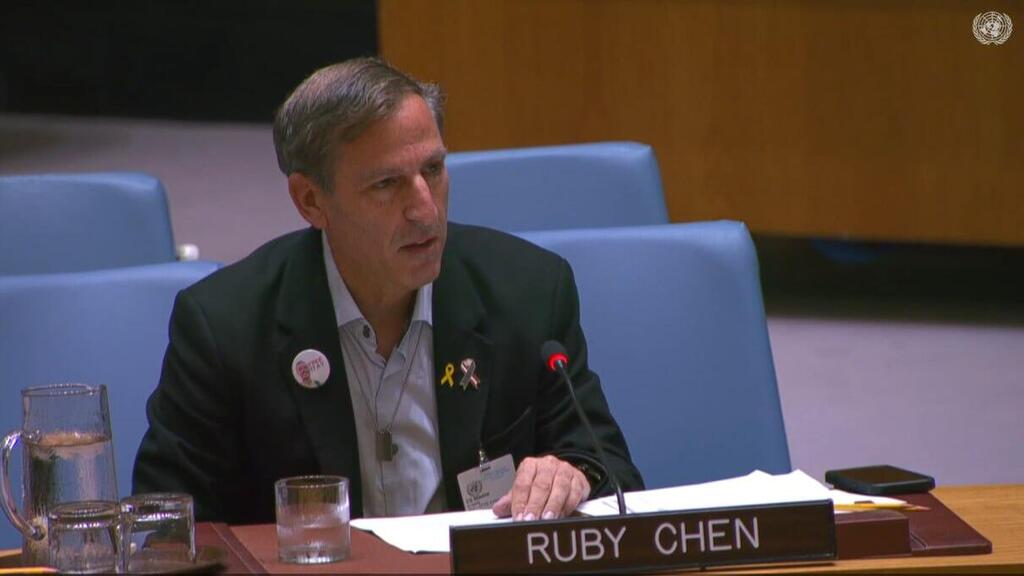
Ruby Chen, father of killed hostage Itai Chen, addresses the United Nations Security Council
(Photo: UN WEB TV)
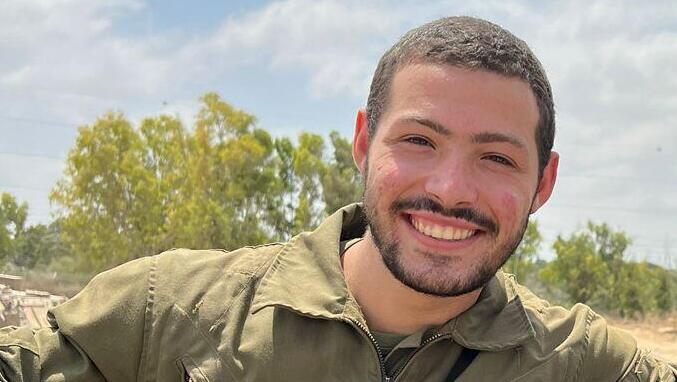
Hamas hostage Itai Chen
(Photo: Courtesy of the family)
“Since then, our family—along with 250 other families whose loved ones were taken by Hamas and Islamic Jihad, from more than 25 nationalities and five religions—have fought to learn the fate of our loved ones and to bring them home.”
In March 2024, the IDF informed the family that Itay likely did not survive the October 7 attack. “But for over 19 months, Hamas has refused to acknowledge that they hold our son or to provide any information about his condition,” Chen said. “This is the most degrading form of psychological terror warfare imaginable. I humbly ask members of the Security Council: What kind of people hold on to corpses as future bargaining chips? I believe only subhuman beings treat human remains as hostages and deny them basic dignity and human rights.”
Chen continued, “What has been forced upon us—the deliberate withholding of information about our son’s fate, the refusal to return him, the silence—is a slow, continuous form of psychological torture. We live every day in agony, unable to grieve, unable to heal. The UN’s Special Rapporteur on Torture, Dr. Alice Edwards, recently recognized in her report that the families of hostages may themselves be victims of torture. She wrote that prolonged uncertainty, denial of the truth, and concealment of fate can constitute cruel, inhuman and degrading treatment. From my experience, this is not a theory. It is our daily reality. We are tortured, re-traumatized again and again, with no relief in sight.”
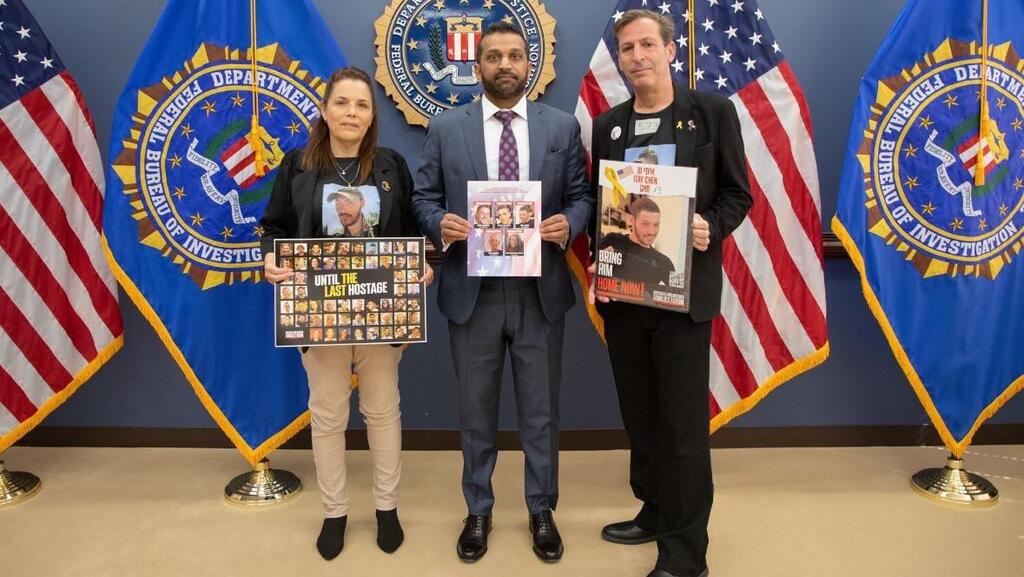
Ruby and Hagit Chen, parents of American-Israeli hostage Itai Chen, met with FBI Director Kash Patel
(Photo: FBI)
“More than 30 families in Israel share our fate,” Chen said. “I want to note that Leah Goldin, mother of Hadar Goldin, is here with us. For 10 and a half years, she has been fighting to retrieve her son’s body from Hamas and played a central role in the adoption of Resolution 2474.”
UNSC Resolution 2474, adopted unanimously by all 15 Security Council members on June 11, 2019, at Kuwait’s initiative, marked a milestone in international humanitarian law by formally recognizing families’ right to know the fate of loved ones missing in conflict. It obligates all parties—state and non-state, including Hamas—to search for the missing and report on them. Hamas’ refusal to provide information, even to neutral organizations such as the International Committee of the Red Cross (ICRC), is a clear violation of the resolution and of international humanitarian law.
The resolution also supports accountability mechanisms for those responsible for enforced disappearances, including when such actions rise to the level of war crimes or crimes against humanity. Hamas’s systematic concealment of hostages meets that threshold, Chen argued.
Leah Goldin in a statement to the media before the start of the discussion at the UN Security Council
(Video: UN WEB TV)


“Resolution 2474 provides the UN and its member states a legal and moral framework to condemn Hamas for its actions and to sanction financial backers like Iran and other Middle Eastern states that enabled Hamas to commit the war crimes attributed to it on October 7. The resolution demands, first and foremost, the release of the deceased hostages held in Gaza. This violation frames the hostage issue not only as a political or military problem, but as a breach of international law under a UN Security Council mandate,” he said.
“We ask and expect the UN to enforce its own resolution—to implement it with real consequences. Responsibility must be assigned to those holding deceased hostages and to those deliberately denying families the right to closure. Resolution 2474 must not remain symbolic—it must become enforceable.”
Concluding his remarks, Chen appealed directly to the UN to act more forcefully both to return the hostages and to hold Hamas accountable. “The UN must act with greater determination, as it bears direct responsibility for enforcing Resolution 2474. I draw the Council’s attention to the abduction of 21-year-old Yonatan Samrano. There is video evidence showing a UNRWA social worker dragging him into a UN vehicle and abducting him to Gaza. Later, Yonatan’s phone was traced to that same worker’s home in Gaza. I ask the UN and all Council members to think of Yonatan and his family when discussing this crisis, and to state clearly that Hamas bears full responsibility for his abduction—and for the abduction of many others from various countries and faiths.”
Israel’s ambassador to the UN, Danny Danon, added: “Before we speak of international law, we must speak of something more basic, more ancient, more human—the moral obligation to return the dead to their families. This is not a political stance, not a Western norm, but a universal duty—rooted in every faith, shared by every nation. All see burial as a sacred ritual. It is etched into every human conscience.
“Hamas not only violates this obligation—it has industrialized it. They steal bodies and use them as bargaining chips. They parade them through the streets, store them in tunnels. They use them for extortion, negotiation, delay and profit. They do not treat the dead as human—but as inventory. To them, the body of a murdered son or daughter is no different from cash. Hamas has created a death economy. It’s a strategy, not a tragedy. Yet so many in this Council—so many so-called ‘righteous nations’—remain silent," Danon said.
“Today, 58 hostages are held in Gaza. Some are alive, some murdered. Their rights and dignity are denied them—when there should be no debate. Where is the response? Where is the demand for compliance with this resolution? Where is the moral outrage? The international community looks away. This is not just a crime against Israel—it is a warning to the world. If this becomes the new norm—if holding bodies becomes a legitimate tactic—then no family, no soldier, no citizen will be safe from a similar fate. Today it is us; tomorrow it could be anyone.”
Get the Ynetnews app on your smartphone: Google Play: https://bit.ly/4eJ37pE | Apple App Store: https://bit.ly/3ZL7iNv
Before the session, Leah Goldin, mother of IDF soldier Hadar Goldin—whose remains have been held by Hamas for over a decade—stated: “The ceasefire on August 1, 2014, was brokered by the U.S. and the UN. For nearly 11 years, my son’s body has been held by a terror group exploiting humanitarian frameworks for political gain. And for nearly 11 years, the international community has turned a blind eye.
“Since the adoption of Resolution 2474, it has been forgotten. The very institution that brokered the ceasefire under which Hadar was taken has not fulfilled its duty to correct this injustice. This is not just a diplomatic failure—it is a moral one. This issue is not political. It is not about negotiations. It is about a mother’s right to bury her son. When the United Nations adopts a resolution, it must mean something. It must be backed with resolve, consistency and action. Instead, we face silence. And in that silence, justice is denied—not just to my family, but to every family that believed in the promises of international law.”
Earlier, Ruby and Hagit Chen met with FBI Director Kash Patel. The parents of the fallen soldier discussed ways the FBI could apply further pressure in support of the hostage negotiations. Patel pledged his personal commitment to securing the release of the four remaining American hostages held in Gaza: Itay Chen, Omer Neutra, and Gadi and Judy Weinstein.