

A day before he was detained for questioning on suspicion of embezzling donated funds intended for his city’s residents, Ashkelon Mayor Tomer Glam addressed a conference of municipal treasurers in Eilat.
Glam, a Likud member and deputy chairman of the Federation of Local Authorities, said from the stage: “My mother always tells me: When it’s your money, do whatever you want with it. With the public’s money, act with great responsibility.”
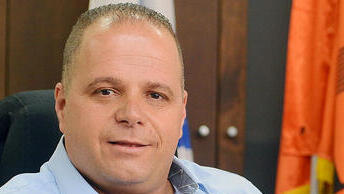
In light of the suspicions against him, the remark now sounds particularly ironic. Investigators with the Israel Police’s National Fraud Investigations Unit at Lahav 433 suspect that Glam acted in exactly the opposite manner of what his mother advised.
After being detained at a hotel in Eilat on Monday morning, Glam was taken to the Lahav headquarters in Lod, where he was questioned until late at night. Police attribute to him offenses including bribery, obtaining property by fraud, theft by an authorized person and money laundering. He was released to his home overnight under restrictive conditions: five days of house arrest, a one-week ban from City Hall and a prohibition on contacting other suspects.
Glam has since been summoned for additional questioning. At the same time, on Monday police raided Ashkelon City Hall and the homes of other suspects, including department heads and division chiefs at the municipality, Glam’s aides and local businesspeople, conducted searches and detained them for questioning. Eleven people were questioned on Monday and three more on Wednesday.
Fictitious orders for services not provided
At the center of the investigation is the suspicion that millions of shekels from donations given by sources in Israel and abroad to the city’s residents during the Iron Swords war and Operation Rising Lion, and transferred to the Ashkelon Foundation — a fund selected by the municipality to manage the donation drive — made their way into the private pockets of Glam and his associates.
The funds were donated for emergency and welfare needs of Ashkelon residents and were transferred from the foundation to a series of private suppliers for services ostensibly provided to residents. Police are investigating whether those suppliers, who are close to Glam, operated as part of an alleged fraudulent scheme that included reporting fictitious orders for services that were not provided or inflated orders for services that were.
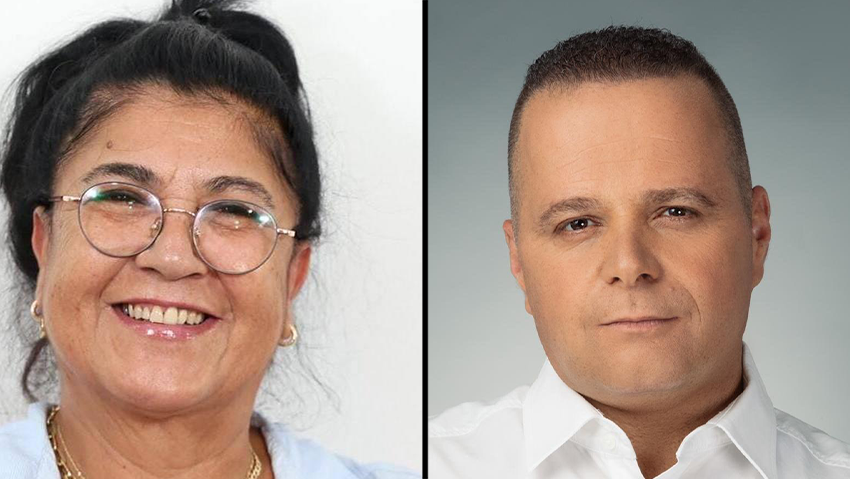
Opposition council member Eva Totai
(Photo: Elad Malkab)
According to the suspicions, the businesspeople submitted invoices and received payment for the services, then transferred part of the funds to Glam and his associates through various benefits. Among other things, investigators are examining suspicions that renovation work was carried out at Ashkelon City Hall and at the Glam family’s private home, while the invoices submitted to the foundation stated that the money was paid for “shelter renovations.”
What raised investigators’ suspicions was that suppliers issued invoices for the installation of parquet flooring and concealed toilet tanks, ostensibly as part of shelter renovations funded by donations. “We have never seen an emergency shelter renovation that includes parquet floors and concealed tanks,” investigators told the suspects.
Other invoices that raised suspicion included large, disproportionate sums that did not align with the services provided, with the suspicion that they were inflated. Also questioned in the case were Glam’s wife, Tali Glam, and another family member who provided “respite workshop” services to Ashkelon residents during the war and was paid from donated funds through the Ashkelon Foundation.
The fraud unit is also investigating another affair linked to Glam, centered on funds transferred to him during an election campaign by businesspeople and interest holders in Ashkelon. One suspicion is that those figures transferred hundreds of thousands of shekels to Glam through a loan that was not repaid, provided by the son of a rabbi close to him who served as a kind of intermediary. Police are examining whether Glam took actions in return to advance the business interests of those figures.
Donation from the Final company to equip shelters
Claims of irregularities surrounding donations to residents during the war had already been at the center of a prolonged struggle led by city opposition council members Eva Totai and Tamar Kedar. As early as 2024, the two demanded that the municipality disclose information about the donated funds and how they were used, as well as answers regarding discrepancies between the amounts received by the foundation and those actually disbursed. Ashkelon City Hall, however, withheld the full information.
As a result, last year, Totai filed a petition with the Be'er Sheva District Court against the municipality, the Ashkelon Foundation and the Interior Ministry, seeking to compel disclosure of the documents. In the petition, Totai stated that, since the start of the war, donations totaling about 26 million shekels had been received for the welfare of city residents, most of them transferred to the Ashkelon Foundation, and demanded full information on the distribution of the funds, decision-making processes, criteria set for their use, the supplier selection process and more.
The petition also included information on the identities of donors, among them Jewish organizations abroad, the Joint Distribution Committee Israel, Keren Hayesod, the Jewish Agency, KKL-JNF and others. One of the donations cited came from an unusual private company: Final Israel algorithmic trading, which donated 80,000 shekels for equipping shelters during the Iranian missile attacks.
In the petition, Tutai demanded “explanations as to how various suppliers receive hundreds of thousands of shekels within a very short period of time” and questioned whether the transfers “were carried out in accordance with the donors’ wishes and for the public good, and based on objective criteria.” After a hearing, the Ashkelon Foundation agreed to transfer the documents. Meanwhile, however, the materials had already reached the police, who had been conducting a covert investigation in recent months. Last month, police raided the offices of the Ashkelon Foundation and seized documents that strengthened suspicions against those involved, prompting the summoning of Glam and the other suspects for cautionary questioning this week.
Glam was first elected mayor in 2017, when he was a member of the Kulanu party. The city council chose him for an interim term after then-mayor Itamar Shimoni was suspended due to his own criminal case, in which he was later convicted. In 2018, Glam won the subsequent election as well. After Kulanu disbanded, Glam joined Likud and ran under its banner in the most recent 2024 municipal election, with the party investing millions of shekels in his campaign for a second term. Glam also headed Likud’s Ashkelon campaign headquarters in the general election, with party ministers frequently visiting him in the city and appearing alongside him, as did Prime Minister Benjamin Netanyahu, who filmed Likud campaign videos with Glam.
Attorneys Esther Bar-Zion and Victor Uzan, who represent Glam and his wife, said: “The mayor of Ashkelon has been questioned by police several times, provided a full account and answered all questions, and in fact has no connection to the allegations attributed to him. The mayor did not take a single shekel unlawfully or illegally for himself, nor did he transfer funds or benefits to associates. He understands that the police must investigate and hopes the investigation will end quickly and it will become clear that this is all sound and fury, signifying nothing of substance. His wife Tali also answered all questions. She is a woman of integrity who has no connection to the suspicions attributed to her.”