


The Board of Peace, chaired by U.S. President Donald Trump, is set to convene Thursday for its first summit in Washington, against the backdrop of heightened alert in Israel over a potential large-scale strike in Iran.
Trump will lead the event at the U.S. Institute of Peace in the capital, alongside Vice President JD Vance and Secretary of State Marco Rubio.
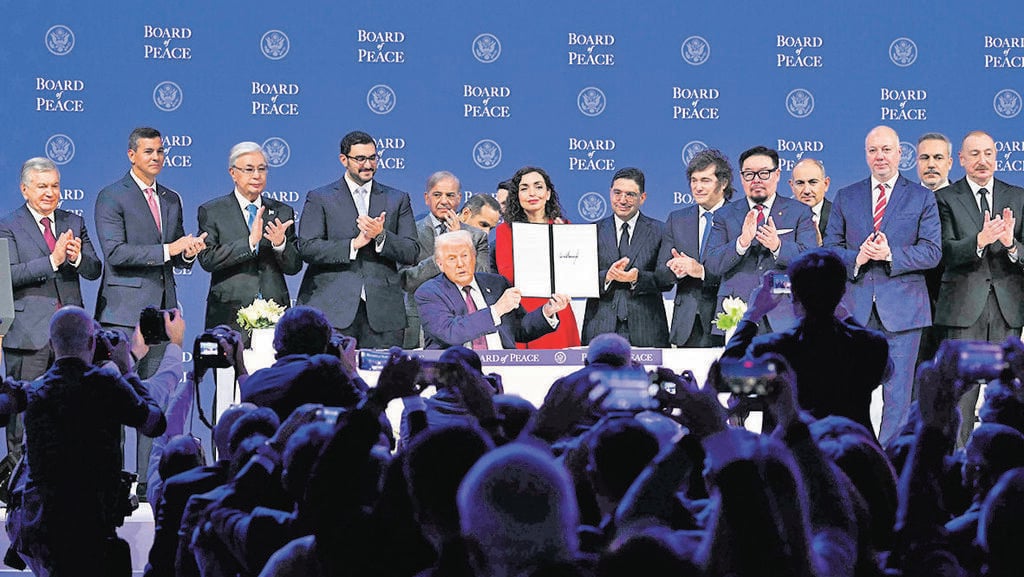
Presentation of the Board of Peace in Davos
(Photo: Fabrice Coffrini/AFP)
The board’s central areas of discussion are economic, logistical and security matters. U.S. officials have expressed optimism about securing the billions of dollars needed to rebuild the destruction in the Gaza Strip and about establishing an international stabilization force.
In Israel, however, officials are convinced that Hamas will not voluntarily disarm and that ultimately the Israel Defense Forces will have to do so. Saar is expected to present that position, among others.
During the discussions, administrative decisions are expected regarding the board’s operations in Gaza, as well as the most significant challenge — the disarmament of Hamas.
Board officials believe Hamas could begin a disarmament process as early as next month. Sources within the board said preparations are being made for voluntary demilitarization of the strip but acknowledged the possibility that the terror organization could be deceiving all parties, leaving the task to Israel.
The decisions Trump is signaling
The United States hopes to reach agreements on the board’s authorities, including regulating the powers of the Board of Peace, the Gaza Executive Council and all subsidiary bodies to open a bank account and investment account designated for carrying out their missions.
If the U.S. proposal is approved by all member states, the executive council would be responsible for oversight of budgetary matters, the bank account, fund allocations and more.
Members will also discuss administrative expenses, to be set by the executive council — if it is granted such authority — and approved by the chair, Trump, and selected Board of Peace members tasked with overseeing administrative objectives. These include establishing and managing an official headquarters, offices and field branches, as well as covering the costs of the Board of Peace and the executive council. In addition, the United States hopes to determine that operational expenses will not be approved until relevant funding is secured and the budget is approved by the chair or the executive council.
Trump at the signing ceremony of the Board of Peace charter
(Video: Reuters )


Under this clause, all Board of Peace expenses would be funded by contributions from member states, other interested countries, organizations or other unspecified sources. It is also expected that the Gaza Executive Council will establish a financial oversight committee.
Trump has already announced that several countries have expressed willingness to contribute $5 billion toward the effort. A board official said there has been “greater-than-expected success, and the momentum is continuing.”
According to the official, Saudi Arabia is “positive” about providing financial assistance but is waiting to see how the disarmament process unfolds. “Qatar has also expressed willingness to contribute,” the official said.
White House press secretary Karoline Leavitt said at a briefing Tuesday that final decisions regarding expenditures will be made by the chair of the Board of Peace — President Trump. “But I believe all member states will have voting rights,” she added.
The next steps
Meanwhile, Israeli officials are awaiting the outcome of the summit to better understand the next stages in Gaza and what will be required of Israel and the IDF.
Security officials have expressed deep skepticism about the establishment of an international stabilization force, saying that aside from Indonesia — which has stated it is prepared to send about 8,000 troops ready by the end of June — “we do not see additional willingness to deploy forces.”
Indonesia has said thousands of its troops would be ready to deploy to Gaza within less than six months as part of a humanitarian peace mission to help rehabilitate the territory. An Indonesian military spokesman said the forces have completed preparations and are awaiting an order from President Prabowo. He added that about 1,000 troops could deploy as early as April if approval is granted.
Morocco, Kazakhstan, Albania, Kosovo, Italy, Greece, Cyprus and Uzbekistan have also said they may send forces but have not provided details.
At the same time, Board of Peace officials expressed particularly high optimism Tuesday. “We are making giant strides. This will happen. Hamas is prepared to disarm,” they said. “We are not naive. If Hamas does not disarm, the IDF will have to act. There is also a long list of countries prepared to send forces to Gaza, but at this stage it has not yet been decided which countries or how many troops. The decision is not urgent at this point, at least until the demilitarization and disarmament process begins, which is the top priority. Overall, we are on a positive track, and there is consensus among all parties committed to the effort’s success.”