

What choice did Spain and its Socialist Prime Minister Pedro Sánchez really have? Spain, along with Norway and Ireland, forms one corner of one of the European Union’s sharpest diplomatic triangles, hovering close to the antisemitic fringe. Ireland has played its part, emerging as currently the most hostile EU country toward Israelis and Jews, to the point that Israel was forced to close its embassy in Dublin. Norway recently withdrew nearly all of its sovereign wealth fund investments from Israeli companies.
What was Spain supposed to do — allow a woman who opened the running of the bulls in Pamplona to shout “Free Palestine” from the platform?

In recent weeks, Spain launched an almost senseless diplomatic offensive that repeatedly crossed the line into overt antisemitism. Sánchez defended and expressed full support for pro-Palestinian activists who protested against the Israeli team competing in the famous Vuelta cycling race. The demonstrations disrupted several stages, including the final race set to finish in Madrid. Later, Spain called for Israel to be excluded from international sports competitions to “stop the barbaric Israeli government and prevent Israel from whitewashing its crimes through popular sports events.”
Because this year’s race route bypassed Catalonia — preventing Barcelona residents from participating in the protest — the city announced it would host the first stage of the Tour de France next year and demand the Israeli team’s exclusion.
In chess competitions, Spanish organizers required Israeli participants to compete without national symbols. When the World Chess Federation intervened, the rule was rescinded, but organizers proceeded to hang only the Palestinian flag in the hall, prompting all seven Israeli participants to withdraw.
Spain’s campaign extended beyond sports. Officials warned Israel against participating in Eurovision, Spanish satirical shows mocked Israeli leaders and massive arms deals with Israeli companies were canceled. Spain blocked ships carrying supplies for Israeli operations in Gaza, with Sánchez arguing that these were the only measures at his disposal — he “doesn’t have a nuclear bomb to stop Israel.” Netanyahu immediately condemned the statement as genocidal, prompting Spain to summon a senior Israeli diplomat for a rebuke. Foreign Minister Gideon Sa’ar canceled entry visas for two Spanish female politicians, while Spain reciprocated by revoking visas for Israeli lawmakers Ben-Gvir and Smotrich.

Spanish satire show
(Screenshot)
'Like Netanyahu, Sánchez is being blackmailed by extremists'
Igual (pseudonym), an Israeli real estate investor living in Madrid for nearly a decade, said, “It’s funny — if you put Netanyahu and Sánchez in the same room for half a day, they’d come out married. They are very similar. Sánchez began his current campaign against Israel at a press conference in the royal palace, with no questions allowed, just a day after prosecutors filed a bribery indictment against his wife. Both are seen by their publics as dangerous, unbounded, willing to do and say anything to keep their seats and power.”
He added that extremists on both sides — Israeli and Spanish — mirror each other in opposition but in reverse: some Israelis push settlement expansion, while Spanish extremists pursue independence. The harshest anti-Israel demonstrations occurred in the Basque region and Catalonia, both areas seeking autonomy and identifying strongly with the Palestinian struggle for freedom.
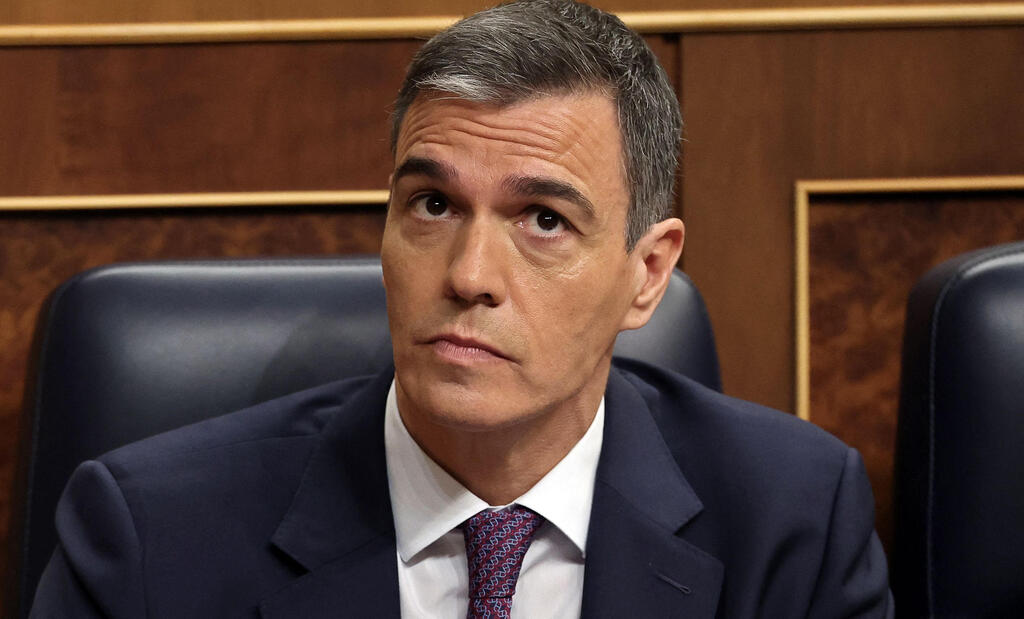
Pedro Sánchez
(Photo: Thomas COEX / AFP)
Madrid residents repeatedly emphasized that their city is distinct from these regions. Conservative, religious and wealthy, Madrid maintains a calm, cosmopolitan environment. Locals expressed criticism of Israeli policies but consistently condemned Hamas and supported Israel’s right to exist. Jewish identity is openly expressed; Hebrew can be spoken in public, and wearing a kippah poses no physical threat. Security at events, such as a Real Madrid match at Santiago Bernabéu Stadium, strictly prohibited Palestinian symbols while allowing normal attendance.
Almost everyone I spoke to in Madrid distanced themselves from Sánchez and his ministers’ rhetoric and support for the pro-Palestinian protests. Many attributed the disruption to anarchist Spaniards who despise their own country and are willing to shame it publicly, even to the point of sabotaging Spain’s most famous sporting events.

Protest at the Port of Barcelona
(Photo: REUTERS/Eva Manez)
Holiday or preparations for war?
Unlike the boisterous, indulgent calm of Madrid over the weekend, by Saturday the barriers were already in place. On Sunday, before sunrise, thousands of police officers deployed from the Spanish security forces’ vehicle fleet filled the city’s main squares, helmets on, rubber bullets in their guns, tear gas in vests, batons at their sides. It was a holiday, but it looked like preparations for war. “We haven’t seen anything like this since hosting the NATO summit in 2022,” a hotel receptionist told me.
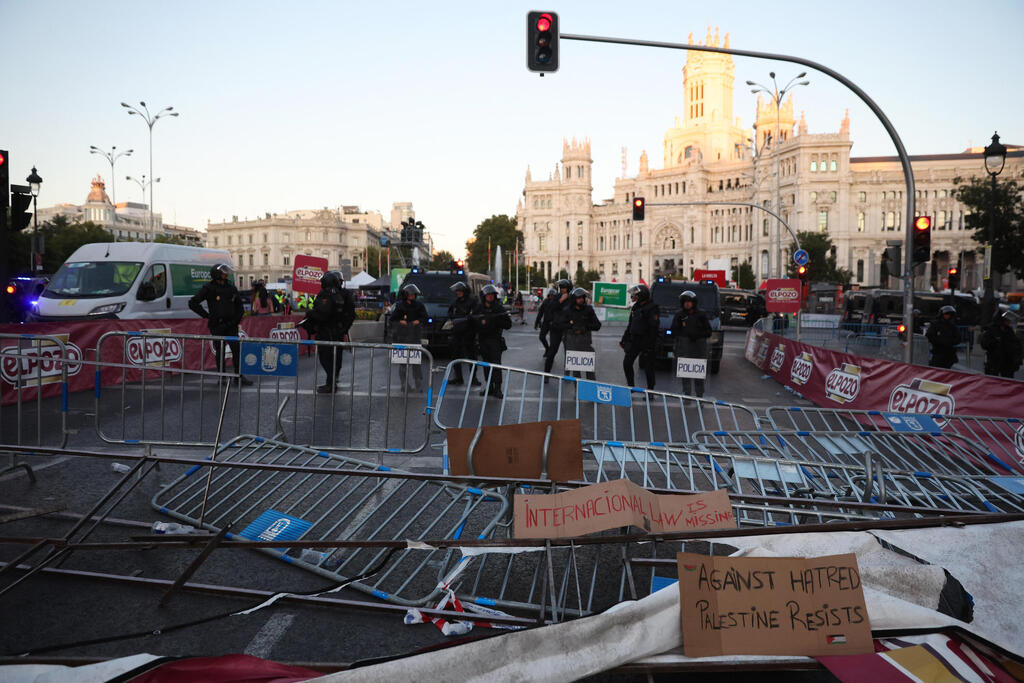
Police forces deployed in Madrid
(Photo: REUTERS/Bruna Casas)
It was not a pleasant weekend to be in Madrid as an Israeli. Clips of extreme violence and anti-Israel sentiment flashed along the race route, while government officials encouraged demonstrators with inflammatory rhetoric. “I want to emphasize — we are not antisemitic, even though we have strong criticism of the Israeli government, Netanyahu and its actions in Gaza,” said José Álvarez, sitting with his wife on a bench near the finish line eating ice cream from a plastic cup. “But we’re glad the Israelis didn’t withdraw. If pro-Palestinian demonstrators had succeeded in forcing their withdrawal, as the government suggested, next year Catalonia would disrupt the race to demand independence.” Like most Spaniards, Álvarez does not speak English, so our conversation was conducted via a mix of gestures, Spanish and Google Translate.
A small Israeli and Jewish group also reached the finish line. They wore clothing, pins, flags and chains proudly displaying their identity, unafraid. They numbered just twenty against tens of thousands of pro-Palestinian protesters (mostly non-Palestinian). They sang “Hatikvah” and “Jerusalem of Gold” until a water bottle was thrown at them. Police quickly escorted them several hundred meters away for their safety. “I’m a Spanish citizen, paying taxes, I have a right to be here. I came only to support and create a positive atmosphere for our national race,” said 19-year-old Yael Streett Tejeda. “In the end, those trying to ruin the race were left in place, while we were moved.”
Pro-Israel protest facing a pro-Palestinian protest in Madrid



'They fight us, and those trying to ruin the race are left in place'
(Photo: Yael Tejeda)
“There are a few other factors to consider in this stew of Israel-Spain relations,” said Carlos Serrano, a Madrid-based tech worker. “First, Spain’s Muslim past is often cited, alongside its Jewish history, which people avoid discussing. Second, the Basque terrorists’ ties to the PLO. Third, Spain’s colonial legacy makes it sensitive to people under oppression. Fourth, we are thirty years past fascism, so we recoil from any violence. Lastly, we’re trying to find our place in the EU. With 35 million people, over 20% want independence. We aren’t a major economic, military or political player. The Prime Minister wants to position himself as the new leftist leader in Europe, a populist appealing to his base, using Israel as a distraction from immigration, housing, corruption and economic inequality. The problem is there are enough people in Barcelona and Bilbao who buy into it, regardless of their real interest in Palestinian rights.”
'I wanted to ask the rabbi for tefillin to place in the restaurant'
Tami and Aviv Mizrahi run “Barganzo,” their Israeli corner restaurant in central Madrid near Gran Vía. With high windows and an exposed interior, Aviv cooks sophisticated, vegetarian Israeli cuisine, while next door “De Madre Pita” offers fast pita food. They relocated to Madrid ten years ago, he an accountant, she a lawyer, and opened their kosher restaurant. Jewish and Israeli customers kept returning, especially before October 7. Ahmad, a Jordanian immigrant managing “De Madre Pita,” came in response to an ad and stayed, inspired by his childhood memories of Jews in Jordan.
Aviv said, “I refuse to be afraid. I put an Israeli flag on the chef uniforms so customers know that maybe we were hit, but we always rise.” They survived the pandemic and became a major success, with three-day waits for tables and media coverage. “My father came to visit and people stopped me on the street to shake my hand,” Aviv said.
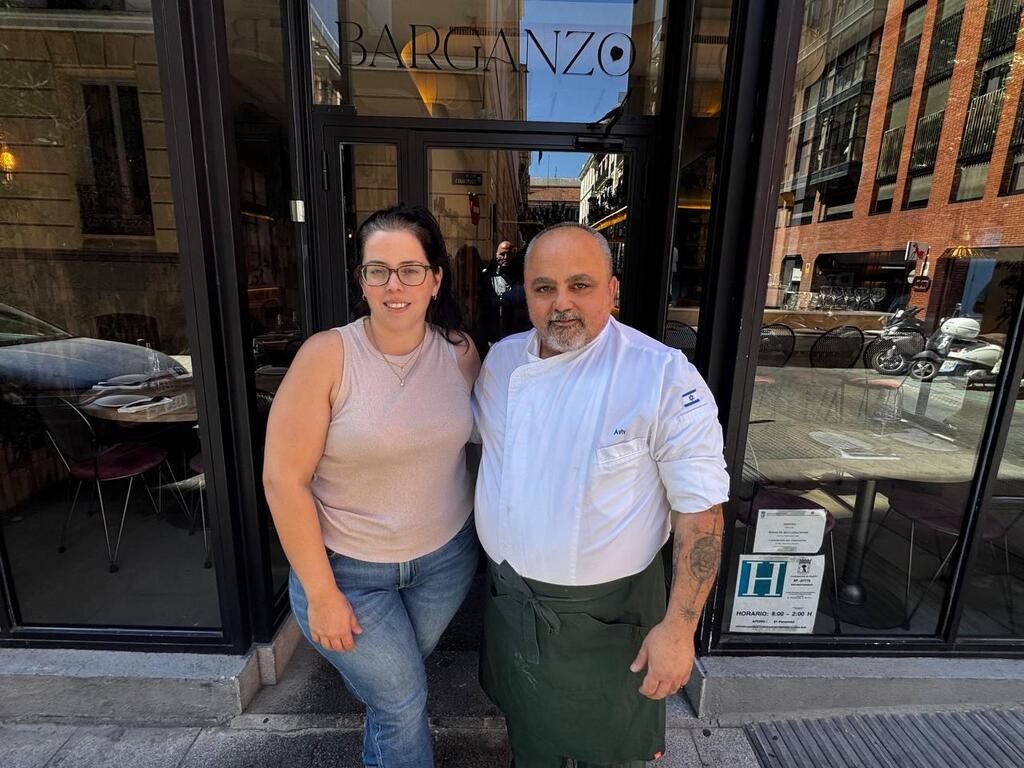
Aviv and Tami Mizrahi outside their restaurant
(Photo: Zeev Avrahami)
After October 7, their restaurant lost 1,500 Instagram followers, left-leaning and LGBTQ+ customers stopped coming and Israeli tourism dried up. Online reviews included accusations of supporting genocide and theft. Google closed their account after thousands of one-star reviews. Their revenue dropped 75%. Employees faced harassment for being associated with Zionism. Aviv spent hours staring at his phone, searching for someone to talk to.
Now, they are making a comeback. Evenings see the restaurant packed again. “The day after the protest was the first time I spoke Spanish with a driver because of his identity,” Aviv said. “But I refuse to be afraid. I put the Israeli flag on the chef uniforms so customers see that maybe we were hit, but we always rise. Fighters. The first thing I thought of yesterday after the protest was to ask the rabbi to bring tefillin to place in the middle of the restaurant, in full view of everyone.”