

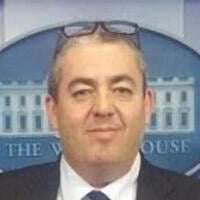
Steve Witkoff, U.S. President Donald Trump’s special Middle East envoy, attended overnight Thursday-to-Friday the annual conference of the Israeli-American Council (IAC) in Miami, where he addressed key policy issues, including tensions with Iran amid the possibility of U.S. military action and efforts related to moving forward in Gaza. He also described President Trump’s emotional response when hostages released in the October deal arrived at the White House with their families.
“When we got the 20 hostages home, the last 20, and their families came to the White House, the president pulled me aside,” Witkoff said. “I saw the tears. He doesn’t like anyone to see tears. And he said to me, ‘This is the greatest day I’ve ever had in the White House.’”
Witkoff says Trump wept during hostages' visit, called it his 'greatest day at the White House'


Addressing Iran, Witkoff said Trump had issued warnings to Tehran and ordered direct communication with Iranian officials amid reports of possible mass executions. “At his direction, we communicated with the Iranians yesterday,” he said. “One of the things we were concerned about were the killings that were rumored to be on the way — hangings, mass hangings — and that’s been shut down.”
Witkoff praised Trump’s leadership, saying, “He’s the only one in the world who has that indomitable strength that can bend people,” and added, “It’s my greatest privilege to work for him.”
Speaking further about Iran and possible next steps, Witkoff said he favored diplomacy over military action. “I hope there’s a diplomatic resolution,” he said. He outlined what he described as four key issues: “Nuclear, enrichment, missiles … and the proxies.”
He said Iran’s internal situation could influence its decisions. “There’s no water, there’s no electric, inflation is probably well north of 50%,” Witkoff said, adding that resolving the issues diplomatically would be preferable to the alternative.
“We were frustrated and discouraged and we didn’t want to show them that”
On the hostage negotiations, Witkoff said the effort was deeply personal for him as well as for the president. “I’m a member of that really bad club that has lost a child,” he said, explaining why the issue resonated strongly with him.
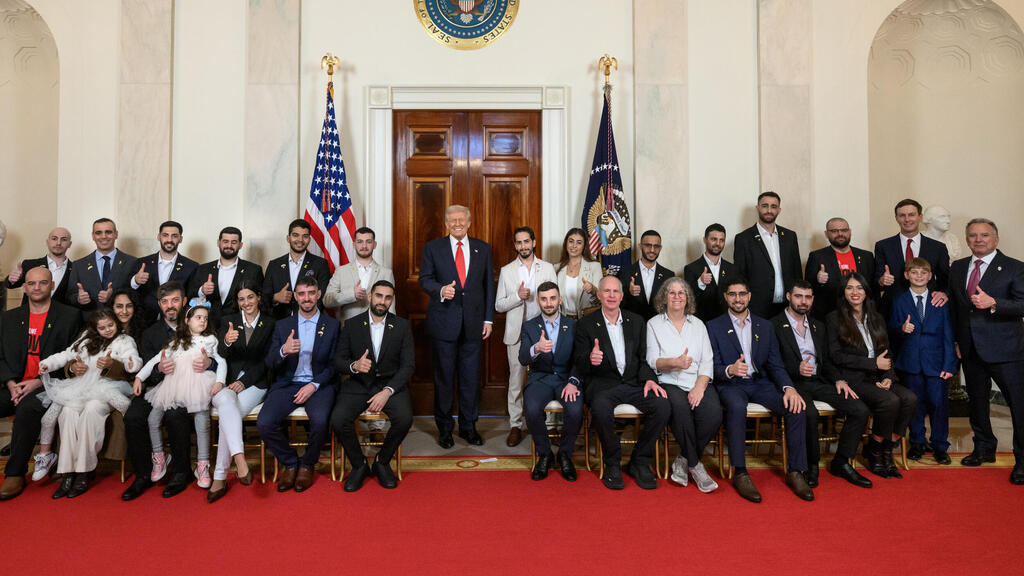
(Photo: Official White House Photo by Molly Riley)
He described sustained contact with hostage families and repeated delays by Hamas during the talks. “We were scared,” Witkoff said. “On the one hand we were negotiating, on the other hand we were trying to make the families understand that we were hopeful. And yet we were frustrated and discouraged and we didn’t want to show them that.”
Witkoff also spoke about Trump’s announcement of a new “Board of Peace,” which he said would play a central role in postwar arrangements. “President Trump dreamt it up,” he said, calling the initiative “a really big deal.”
He said the United States had already made progress toward replacing Hamas’s rule in Gaza. “We actually have succeeded, the United States government has, in standing up a new government that will forever replace Hamas,” Witkoff said.
Asked about Hamas disarmament, Witkoff said the group’s position shifted after the release of the hostages. “When we got the 20 hostages home, things changed for Hamas,” he said. “They stopped seeing the hostages as an asset and started seeing them as a burden. That was the key.”
“I think we can show them that disarmament is the right thing to do in the long run,” he added.