


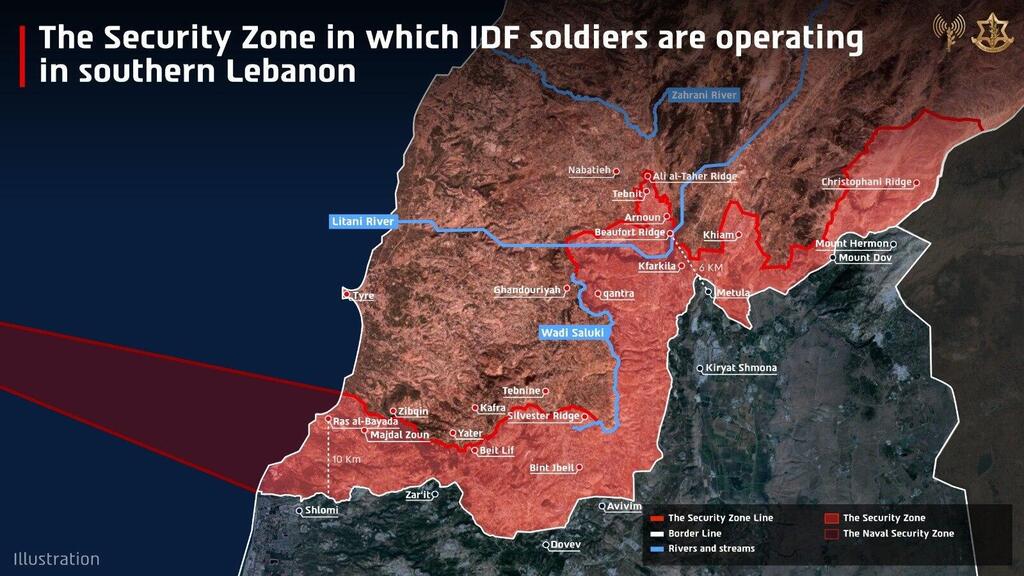
Hours after U.S. President Donald Trump formally signed a memorandum of understanding with Iran, the IDF on Thursday published a map showing where its forces are currently operating in southern Lebanon.
“According to operational needs, the IDF is deployed in the security zone, about 10 kilometers inside Lebanese territory,” the military said. “IDF troops have established themselves in their area of operations in southern Lebanon and continue to act to remove threats and improve the defense of residents of the north.”
The hope in Jerusalem now is that what officials view as a bad agreement being advanced by Trump with Iran will not ultimately be implemented. After the signing overnight, a 60-day negotiation period begins, and the working assumption in Israel is that it will not lead to a final agreement. A second working assumption is that the country must preserve its hold in Lebanon at least until November, after the U.S. midterm elections, when officials believe a new window of opportunity could open for renewed action on Iran.
In practice, IDF forces remain on the Ali Taher ridge, a controlling position in southern Lebanon overlooking the Nabatieh area, a significant Hezbollah center of gravity. The village of Tibnit, where the IDF has operated in recent days, also remains a point of control. The forces are deployed in some areas as far as 10 kilometers inside Lebanese territory, and in other areas about six kilometers deep. In practice, the deployment differs slightly at certain points from the “yellow line.”
The IDF held significant discussions on how forces should be positioned along the border area in a way that translates the terrain’s advantages into observation and fire control. Northern Command analyzed the relevant points and instructed forces to deploy accordingly. For now, residents are not expected to return to the villages in southern Lebanon where the IDF maintains control.
The IDF is expected to continue holding the security zone according to operational needs, removing threats to the forces and building effective defenses for northern communities. The military will also continue to remove threats to troops and civilians that are identified beyond the security zone. The next steps are still being discussed as part of the diplomatic track and direct negotiations between Israel and Lebanon, and the teams are expected to meet again next week.
(Photo: IDF)
From Israel’s perspective, the maritime security zone is a continuation of the land security zone, in accordance with the political leadership’s decision. The IDF stressed that operational activity is continuing and that approaching the security zone is dangerous. The military called on the Red Cross to coordinate with it, and urged Lebanese residents to avoid entering the security zone because of the dangers in the area.
In effect, the IDF has managed to remain in positions it captured, including certain areas beyond the “yellow line.” The military is also preserving its freedom of action against threats beyond the security line, demands that had been set by the chief of staff and Northern Command.