


Trevor Asserson spent years trying to document what he says was systematic anti-Israel bias at the BBC. Now, the British lawyer argues that the consequences have moved beyond journalism and into government policy — with potentially significant implications for Israeli companies, banks and exporters.
Asserson, senior partner at British law firm Asserson, whose largest office is in Tel Aviv, led a 2024 study examining BBC coverage of the Israel-Hamas war. The report analyzed the broadcaster’s English- and Arabic-language output between Oct. 7, 2023, and Feb. 7, 2024, and accused it of repeatedly violating its own editorial standards.
Trevor Asserson at the ynet studio
(Video: Yaron Brener)


“The BBC was a problem because the reputation of Israel was being undermined by the world's most well-respected media organization, the BBC, and it had a huge influence,” Asserson told ynet Global. “So I needed to demonstrate in a proper legal way that it was breaking its own rules and was entirely biased, unfortunately, in its reporting.”
The Asserson Report said it identified 1,553 alleged breaches of BBC editorial guidelines and was particularly critical of BBC Arabic. Its analysis claimed that more than 90% of the Arabic service material it assessed reflected pro-Palestinian or anti-Israel sentiment. The BBC rejected allegations that its reporting was biased and said it would consider the research, while maintaining that its coverage sought to meet its standards of accuracy and due impartiality.
For Asserson, however, the problem was not confined to individual errors.
“The level of anti-Israel feeling within the BBC is such that we, for instance, have been representing employees in the BBC who have been literally persecuted for expressing a view that something was not accurate,” he said. “So it's really become an institutional problem.”
He described BBC Arabic in still harsher terms, saying his research found its performance comparable to Al Jazeera on the measurements used by his team.
“BBC Arabic is essentially the same as Al Jazeera,” he said. “They're both about the same level on an international measure.”
The BBC has faced criticism of its Middle East coverage from opposing directions. Jewish organizations and pro-Israel critics have accused it of hostility toward Israel, while more than 100 BBC employees were among signatories to a 2024 letter alleging that the broadcaster’s Gaza coverage favored Israel. The corporation has repeatedly said it is committed to accurate and impartial reporting.
Resignations and a wider BBC crisis
Asserson believes the debate that followed his report contributed to broader scrutiny of the broadcaster. He pointed to the eventual departures of BBC Director-General Tim Davie and BBC News chief Deborah Turness.
“So the report had some effect,” he said.
Davie and Turness resigned in November 2025 amid a separate controversy over the editing of a Donald Trump speech in a BBC Panorama documentary and broader allegations concerning the corporation’s impartiality, including its reporting on Gaza and transgender issues. Turness rejected claims that BBC News was institutionally biased, while Davie said mistakes had been made and that he had to take ultimate responsibility.
Asserson argued that the Trump controversy reinforced his broader criticism of the broadcaster.
“It literally fakes news in order to try and make Trump look bad, to say things that he didn't say,” he said, referring to the disputed Panorama edit.
BBC Chairman Samir Shah later apologized for what he called an “error of judgment” in the editing of the Trump speech.
‘We have to move on’
Asserson said his attention is now shifting away from the BBC itself toward what he sees as the political consequences of years of damaging coverage of Israel.
“I think that Israel has to move on from the BBC coverage and media coverage,” he said.

He pointed in particular to Britain’s increasingly restrictive policy toward Israeli settlement activity in the West Bank.
The British government announced another package of measures on Sept. 8, including plans to ban imports from Israeli settlements it considers illegal and sanction individuals and companies that support, facilitate or benefit from settlement activity. Earlier in June, London coordinated sanctions with several other governments against individuals and organizations accused of financing or enabling settler violence.
Asserson acknowledged allegations of violence in the West Bank and criticized Israel’s handling of the issue.
“What’s happened, the recent decision by the British government to impose sanctions on Israel is obviously to some extent the result of things which were going on in the West Bank, which clearly are, where the government is failing to deal with it, you know, shameful,” he said.
But he argued that British policy cannot be separated from a broader deterioration in Israel’s public standing.
“What has happened is the reputation of Israel has been so undermined and so damaged by the media coverage for such a long time that you've reached a stage where there's a very general mood within the Labour Party to impose sanctions on Israel,” he said.
Could sanctions spread beyond the settlements?
Although Britain has said its measures are directed at settlement activity rather than Israel as a whole, Asserson warned that the practical distinction could prove difficult to maintain.
“The UK has expressly announced that its sanctions will be aimed at the ‘settlements,’ but not against Israel,” he said. “It remains to be seen if that division will stick.”
He said Israeli businesses that could potentially be affected should begin reviewing their operations before the final rules are published.
Companies, he said, should conduct audits to determine whether any part of their business could fall within the measures and seek legal advice where necessary. Once the precise language is published, which Asserson expects could take several months, companies should reassess any steps they have taken to reduce their exposure.
His firm is already advising some Israeli companies that have been sanctioned, he said.
“We believe that steps to mitigate the dangers can and should be taken,” Asserson said.
He also warned companies against viewing the issue as exclusively British, arguing that they should prepare for the possibility that other European governments and Canada could adopt similar measures.
“That considerably widens the threat Israel faces,” he said.
Could companies inside Israel also be affected?
Asserson said businesses operating within Israel’s pre-1967 boundaries could also face consequences, even if they have no direct activity in West Bank settlements.
He described one danger as “contagion”: Foreign companies, he said, may find it difficult or costly to verify whether an Israeli supplier has any connection to settlement activity and could decide that doing business elsewhere is easier.
“They will go elsewhere for their dates, avocados or semiconductors,” he said. “The fear of a fine imposed by the regulator will have a chilling effect on trade with Israel.”
A second potential problem, he said, stems from modern supply chains. Depending on how the British rules are ultimately drafted and interpreted, questions could arise over products that receive only a small portion of their added value in the West Bank.
“The risk lies, one, with the wording of the sanctions when drafted, and, two, with how the regulators and ultimately the courts choose to interpret those rules,” Asserson said.
He warned that a broad interpretation by regulators or courts could expand the practical reach of the measures beyond what the British government says it intends.
Asserson also expressed concern that officials’ personal views of Israel could influence how discretion is exercised, though he offered no evidence that British regulators had done so.
How would Britain determine where a product comes from?
Much will depend on the final wording of the measures, Asserson said. He expects authorities to draw on existing British or European rules governing the origin of goods, including customs frameworks and principles already used in trade.
Exporters generally certify the origin of their products and make declarations to British customs authorities under rules that vary by category of goods. Customs officials can accept those declarations but also retain the power to investigate them.
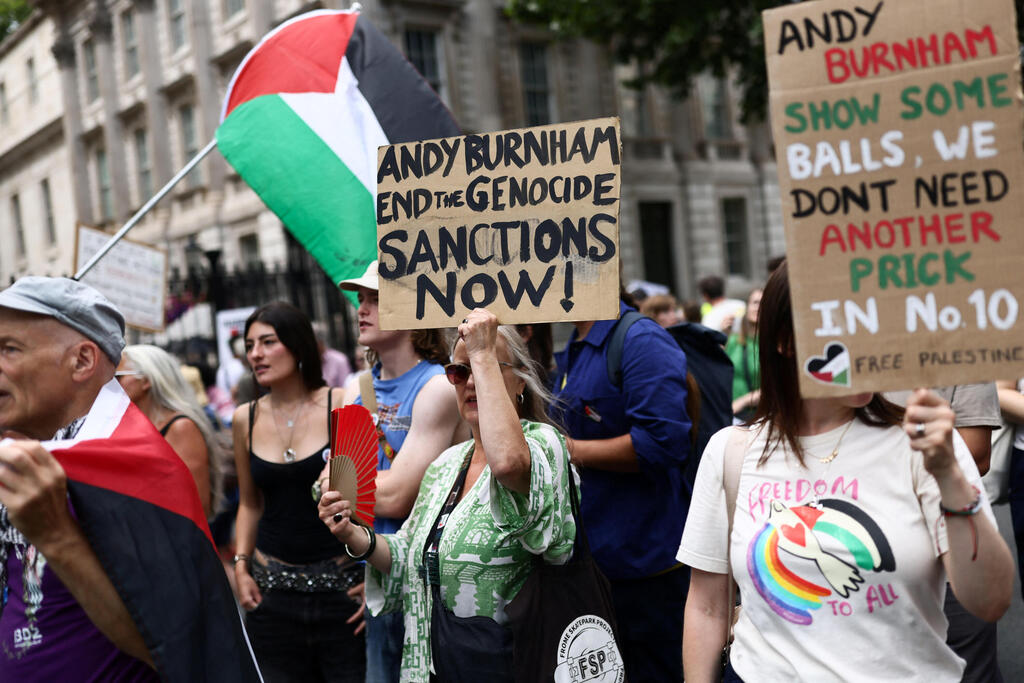
Pro-Palestinian demonstration in London
(Photo: REUTERS/Jack Taylor)
For Asserson, the greater concern is what happens when questions arise.
An intensive customs inspection could lead to lengthy delays even if the Israeli exporter ultimately establishes that its goods are not covered by the measures, he said. A foreign customer could decide that waiting is not worth the trouble and turn to another supplier.
“The fact that the product might eventually be given a green light could be academic if the ultimate customer has lost interest in the meanwhile,” he said.
That, he argued, is another way measures intended to target settlements could have wider effects on Israeli trade.
‘Support, facilitate or profit’ could have broad reach
Asserson said the principal risk is not necessarily limited to physical goods produced in settlements.
He pointed to language targeting companies or individuals that “support, facilitate or profit from settlement activity,” which he said could potentially encompass financial institutions and other service providers depending on how the final measures are written and enforced.
Asserson offered deliberately broad examples to illustrate his concern: an international accounting firm preparing year-end accounts for a grocery store in a West Bank settlement, a plumber providing services in East Jerusalem or a supermarket chain with one outlet in a settlement.
Whether such examples would actually fall within the British measures would depend on their final wording and subsequent regulatory or judicial interpretation.
For Asserson, however, the uncertainty itself presents a commercial risk.
“Rather than supply an Israeli company, a UK manufacturer might be overwhelmed by the risk that the Israeli purchaser might have some minor relationship with the West Bank,” he said. “The UK supplier might choose to find customers elsewhere.”
Why Israeli banks are a particular concern
Asserson sees the banking sector as the most serious potential vulnerability because international commerce depends on access to financial institutions.
“If Israeli banks are frozen out of international banking, the effect could be catastrophic,” he said.
He outlined a worst-case scenario in which Israeli companies could struggle to receive payments from foreign customers, Israeli banks could encounter difficulty borrowing on international markets and routine transactions involving Israeli accounts could become harder to process.
Britain has said it does not intend to isolate Israel’s banking system, but Asserson worries that a bank could potentially expose itself to sanctions through even limited business connected to settlements.
He cited the hypothetical example of an Israeli bank changing the interest rate on a mortgage for a West Bank household. If regulators interpreted such an action as prohibited support for settlement activity and sanctioned the bank, he argued, other financial institutions could become reluctant to deal with it.
“The danger is acute,” he said.
What is driving Britain’s tougher approach?
Asserson attributes the British government’s policy partly to domestic politics, an interpretation that reflects his own political assessment.
He pointed to Labour’s losses in recent local elections to the Green Party and independent pro-Palestinian candidates and argued that taking a tougher line toward Israel offers the government an electoral incentive.
“Hitting Israel hard is a cheap electoral card for Labour to play,” he said.
Asserson also accused Labour’s progressive wing of longstanding hostility toward Israel and invoked the antisemitism crisis under former party leader Jeremy Corbyn. His firm represented a principal complainant in proceedings involving the Equality and Human Rights Commission, which found in 2020 that Labour had committed unlawful acts of harassment and discrimination related to antisemitism.
But Asserson said responsibility did not lie solely with Britain.
He argued that the Israeli government had provided London and other governments with an opening through its policies in the West Bank, including plans for construction in the E1 area.
“The Israeli government gave the UK, and the other 11 countries that moved with it, a gift,” he said.
He also sharply criticized Israel’s response to settler violence against Palestinians and Prime Minister Benjamin Netanyahu’s handling of statements and actions by far-right members of his government.
“By appearing to condone, and possibly even support, settler violence, including murder, against Palestinians, Israel was placed in a morally indefensible position,” Asserson said.
He characterized the British sanctions as an “overreaction,” but said they represented “the culmination of years of growing frustration with Israeli conduct.”
‘The problem has now arrived’
Asserson also accused successive Israeli officials of underestimating how deteriorating perceptions abroad could eventually translate into political and economic measures.
“I don't think that the Israeli government has dealt in an adequate way in dealing with that problem,” he said. “It's a problem which we've seen coming over the hill for many years. It's now arrived in a material way.”
For Asserson, the dispute over BBC coverage is therefore no longer primarily about winning an argument over individual reports.
“The BBC and other media organizations have created an atmosphere in which what has just happened has been possible,” he said.
“We need a government that will actually recognize the danger and deal with it.”
Could Israel’s election change the picture?
Asserson argued that the outcome of Israel’s upcoming election could affect how the country is received internationally, though his assessment is necessarily speculative.
If Netanyahu returns as prime minister, Asserson said, he believes the result would further damage Israel’s standing among governments and institutions already highly critical of him.
If Israelis elect a different government, he argued, foreign governments could be more willing to reassess their approach. But he cautioned that repairing Israel’s international standing would not happen quickly.
“Immense damage has been done to Israel’s standing,” he said, adding that any future prime minister would also inherit Israel’s continuing military and security challenges.
Even if repairing relations with the international community became a priority, Asserson said, “it will still be a long and painful climb back.”
He said responding to the threat of international sanctions should therefore rank high among the next government’s priorities.
‘The sanctions point a dagger at Israel’s commercial heart’
Despite his warnings, Asserson said he does not regard the broader economic consequences he described as inevitable.
“The sanctions point a dagger at Israel’s commercial heart,” he said. “But the concerns I have outlined are by no means inevitable.”
He noted that Britain has said it wants to avoid broader spillover and limit the impact of its measures to settlements and settlement-related activity.
Asserson believes Israeli businesses and the government can substantially reduce the risks if they prepare for the rules, scrutinize supply chains and financial relationships and engage seriously with the potential consequences.
“If an Israeli government grapples intelligently and sensibly with this threat, I believe it can be materially mitigated,” he said. “But if this threat is met with hollow bravura, I fear for the future.”
Trevor Asserson is the founder of Asserson, an international English law firm with its largest office in Israel. The firm advises clients on commercial matters, including British sanctions law. The views expressed by Asserson are his own.