

An internal IDF assessment warning that Hamas is rebuilding its rule in Gaza has cast doubt on the viability of U.S. President Donald Trump’s Board of Peace initiative, even as Prime Minister Benjamin Netanyahu vows the terrorist organization will be disarmed “one way or the other.”
Reuters reported ahead of Thursday’s inaugural Board of Peace meeting in Washington that the IDF presented Netanyahu in late January with a detailed warning outlining steps Hamas has taken to preserve and restore its grip on the Strip following the October ceasefire.
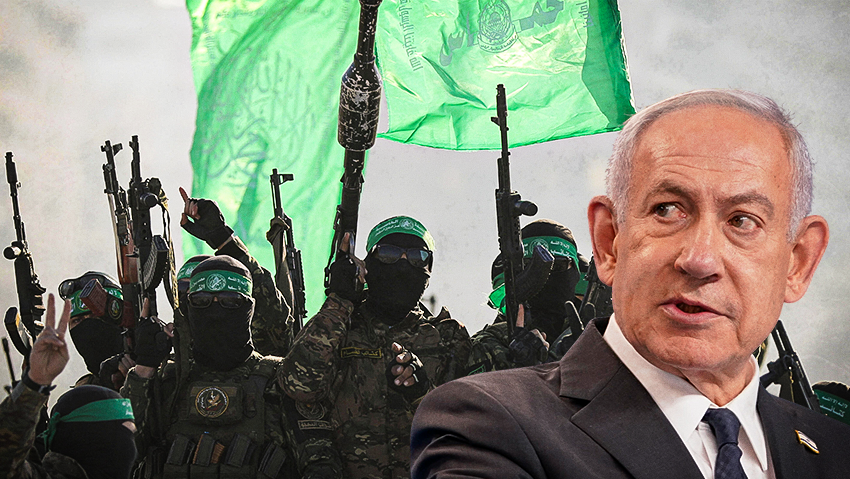
According to the report, the IDF assessment warned that Hamas is working “from the bottom up” to maintain influence by embedding loyalists in government ministries, security bodies and local authorities. Fourteen of 17 Hamas-run ministries are currently operating, compared with five at the height of the war, and at least 13 of 25 local municipalities have resumed activity.
Reuters also reported that Hamas has appointed officials linked to its military wing to senior posts, replaced top figures in the interior and economy ministries, and continued collecting taxes, including on smuggled goods such as cigarettes, batteries, solar panels and mobile phones.
The IDF assessment cautioned that even if a U.S.-backed technocratic Palestinian committee formally assumes governance, Hamas could continue to wield real power absent disarmament.
IDF officials told Reuters that Hamas has used the ceasefire to rebuild its strength and consolidate control in areas under its authority. One Israeli source was quoted as saying that within territory not under IDF control, there is currently no effective opposition to Hamas.
A senior Israeli government source dismissed the possibility that Hamas would retain a governing role in Gaza, calling it a “distorted fantasy” and saying the terrorist organization is “finished as the governing authority in the Gaza Strip.”
Prime Minister Benjamin Netanyahu reinforced that message in remarks delivered in Israel shortly before the Washington conference.
“We agreed with the United States — there will be no reconstruction of the Strip before the Strip is demilitarized,” Netanyahu said at a military officers’ graduation ceremony. “Very soon, Hamas will face a dilemma — to disarm peacefully or be disarmed forcefully.”
He added that Hamas would be disarmed “one way or the other” and that Gaza would no longer pose a threat to Israel.
Board of Peace launches amid uncertainty
The IDF warning came as Trump convened the first meeting of the U.S.-led Board of Peace for Gaza, unveiling financial pledges and security plans aimed at rebuilding the enclave once Hamas disarms.
At the meeting, Trump announced that contributing nations had raised $7 billion as an initial payment toward Gaza reconstruction and pledged an additional $10 billion from the United States. He did not specify the source of the U.S. funds or whether congressional approval would be required.
Contributing countries include Kazakhstan, Azerbaijan, the United Arab Emirates, Morocco, Bahrain, Qatar, Saudi Arabia, Uzbekistan and Kuwait. The Board of Peace includes Israel but does not include Palestinian representatives.
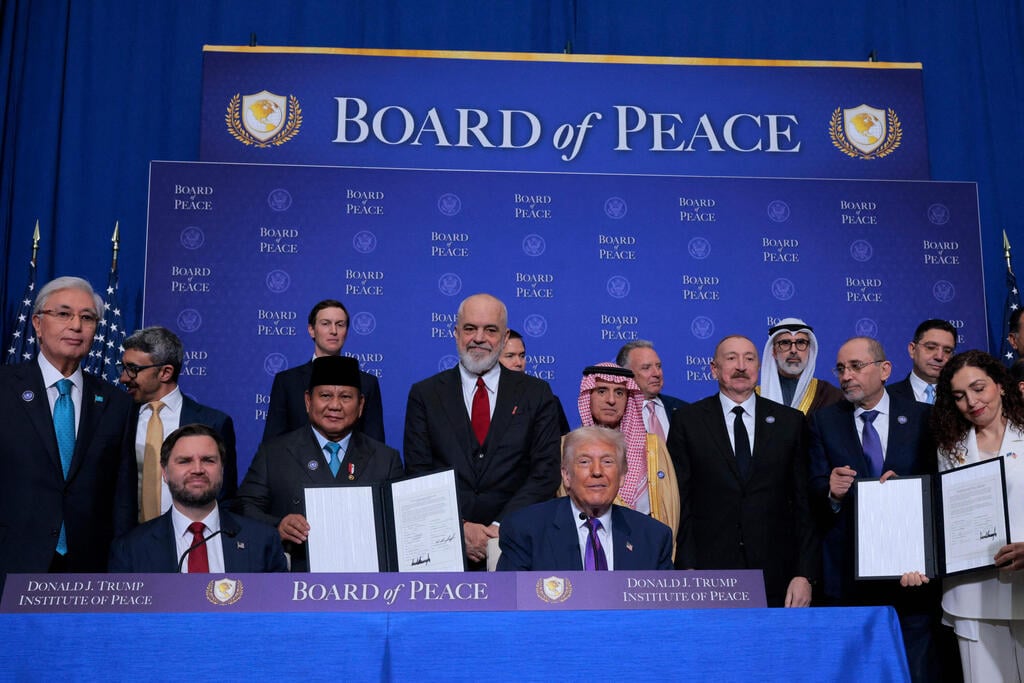
(Photo: CHIP SOMODEVILLA / GETTY IMAGES NORTH AMERICA / AFP)
Estimates for rebuilding Gaza — much of which has been reduced to rubble — range as high as $70 billion.
Trump acknowledged that Hamas’ disarmament remains uncertain.
“I think Hamas will give up their weapons — that’s what they promised. If not, the response they get will be very tough. Very tough,” he said.
He also said he expects to know within 10 days whether a deal can be reached with Iran over its nuclear program, warning that without a “meaningful deal,” “bad things will happen.”
Trump said the United Nations would provide $2 billion in humanitarian assistance and that FIFA would raise $75 million for soccer-related projects in Gaza. He added that Norway would host a future Board of Peace event, though Norway later clarified it was not joining the board.
International force and new police plan
A central component of the plan is the creation of an International Stabilization Force, or ISF, intended to help maintain security once deployed.
According to details presented at the meeting, the ISF would be led by U.S. Gen. Jasper Jeffers with an Indonesian deputy. It would initially deploy in Rafah, in southern Gaza, an area under full Israeli control after Israeli forces depopulated and demolished large sections during the war.
The force would include up to 20,000 troops and expand gradually across Gaza, which would be divided into five sectors, each assigned a battalion.
Indonesia, Morocco, Kazakhstan, Kosovo and Albania have agreed to contribute troops. Jordan and Egypt will not send forces but have pledged to assist in training. Turkish Foreign Minister Hakan Fidan expressed readiness to send Turkish troops, though Israel is expected to oppose such a move.
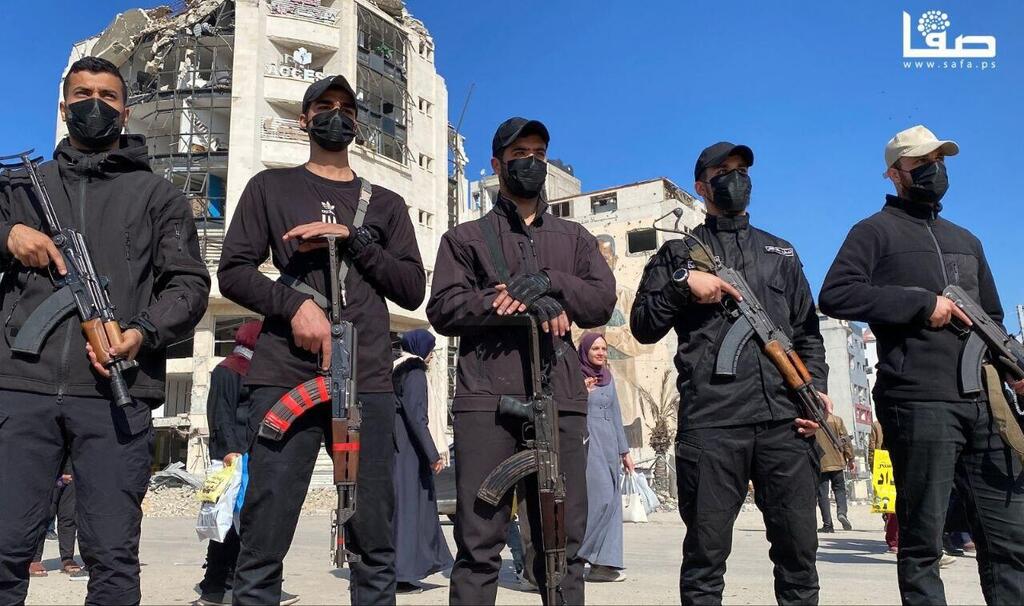
Alongside the ISF, the Board of Peace envisions establishing a new Palestinian police force to operate under a U.S.-backed technocratic committee led by Ali Shaath, intended to replace Hamas in governing Gaza.
Shaath said restoring security through the new police force is his top priority and announced a goal of recruiting and deploying 5,000 officers within 60 days, with the force eventually reaching 12,000. Training would involve Egypt and the ISF.
Nickolay Mladenov, a senior official involved in the Board of Peace, said recruitment began Thursday morning and that 2,000 Palestinians had applied within hours.
According to Reuters, eligibility criteria do not explicitly bar members of Hamas, raising concerns in Israel that the terrorist organization could attempt to infiltrate the new force. Hamas is believed to have around 10,000 personnel in its existing police apparatus.
Hamas has said it is prepared to hand over administration to the U.S.-backed technocratic committee but has not declared a willingness to disarm.
Hamas spokesperson Hazem Qassem said in a statement that the real test of the Board of Peace “lies in their ability to compel the occupation to halt its violations of the ceasefire” and begin a genuine reconstruction process.
U.S. Secretary of State Marco Rubio underscored the stakes.
“We have to get this right. There is no plan B for Gaza. Plan B is going back to war. No one here wants that,” Rubio said.