


Against the backdrop of the recent massacre by the Syrian regime targeting the Druze in the southern province of Sweida, President Isaac Herzog met with leaders of the Syrian-Jewish community in Israel and abroad. In the meeting, Herzog called for efforts “to build regional reconciliation—we must not miss the opportunity that has arisen.”
During the gathering at the President’s Residence in Jerusalem, Herzog also met with Rabbi Binyamin Hamra, the chief rabbi of Syrian Jews in Israel. He echoed the call of the Syrian-Jewish leadership to “renew dialogue between peoples and religions as a bold step toward regional reconciliation.”
Gallery
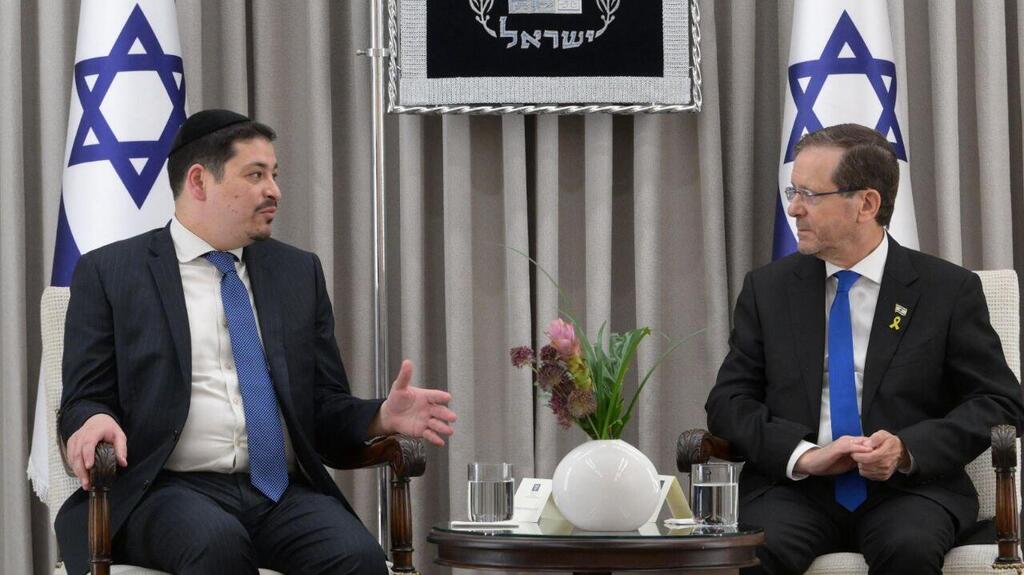
Rabbi Binyamin Hamra, the chief rabbi of Syrian and Isaac Herzog
(Photo: GPO/ Amos Ben Gershom)
The community representatives also shared plans to establish a dedicated center for Syria–Israel relations, aimed at preserving Syrian Jewish heritage, honoring prominent figures in the community, and promoting reconciliation initiatives that connect religious leaders across the region.
Hamra spoke of the atrocities in Syria, stating that “the massacre of the Druze breaks the heart.” Nevertheless, he urged an “optimistic approach” toward the regime of Syrian President Ahmad al-Sharaa, asserting, “We believe he seeks peace.” Herzog opened his remarks by saying, “The story of Syrian Jewry is a remarkable one, still untold in full. We’re witnessing how Assad’s grip is weakening and how Iranian influence in the region is diminishing. This opens a rare window for regional reconciliation and new agreements.”
Hamra, whose late father Avraham was the last chief rabbi of Syria, spoke of his family's deep historical ties to Syria and the enduring dream of peace. “There are ongoing contacts with the Syrian regime, through intermediaries in Washington and London who are familiar with the path my father paved. This past January, I sent a letter to Syria’s leadership and received a surprisingly positive reply—even from al-Sharaa himself, who said he appreciated the outreach.”

resident Isaac Herzog met with leaders of the Syrian-Jewish community in Israel and abroad
(Photo: GPO/ Amos Ben Gershom)
“We will continue to advance peace between Israel and Syria through all available means,” he added, “and work toward mediation between the countries. We long for full peace.” According to Hamra, “There are many people in Israel with Syrian roots, and now there’s a younger generation born here—we must preserve our story and pass it on.” Herzog concluded: “This isn’t just about memory and heritage—it’s a complete vision for the future.”
The last Jews in Syria
In a conversation with Ynet, Hamra revealed that only seven Jews currently live in Syria—three men and four women—all residing in Damascus. The synagogues and cemeteries are closed. The Jobar Synagogue, one of the oldest in the world, was destroyed during the civil war. According to tradition, the site includes the Cave of Elijah the Prophet. There is also a stone inscription said to mark the spot where Elijah anointed Elisha.
“At the beginning of the war, the site was hit in the bombings,” said Hamra. “I don’t believe it was intentionally targeted, but the result is deeply painful. Today the synagogue is closed, and all that’s left is a pile of rubble. Some published photos of walls from the site, but they were from an adjacent structure, not the synagogue itself. The true remains are just a collapsed ruin. It breaks the heart.”
Get the Ynetnews app on your smartphone: Google Play: https://bit.ly/4eJ37pE | Apple App Store: https://bit.ly/3ZL7iNv
Hamra said that under al-Sharaa’s regime, “They are signaling peace. From their perspective, Syrian Jews can return and live there.” He shared: “The Jews still there are isolated. They are not being harassed, and at the same time, the authorities show signs of goodwill. The government’s message to Jews abroad is: ‘Come back, return, and reclaim your property.’ They want peace—this shows a spirit of reconciliation, and that’s what we hope for.”
When you see the massacre of the Druze, aren’t you concerned that Jews might also be targeted?
“What’s happening in Syria these past days is heartbreaking, even if it’s unrelated to the Jews. We stand in solidarity with peace and reconciliation among religions—whether it’s Christians, Muslims, Druze, Bedouins, or any part of humanity. We must respect one another. The images from Sweida are heartbreaking, regardless of who I identify with. We want all communities to live in peace and coexistence.”
Are you optimistic about the prospect of peace between Israel and Syria?
“We hope and pray for peace between Israel and Syria—that was the vision of Chief Rabbi Avraham Hamra, who believed in peace. We are passing indirect messages to the al-Sharaa government. The moment Israel is in a position to reach Syria, I believe we will be welcomed with open arms. We can’t predict the future, but we hope and pray that peace will come.”