

Maj. Gen. (res.) Tamir Hayman, who served in a senior military intelligence role during Operation Roaring Lion, confirmed reports that the United States and Israel had planned for former Iranian president Mahmoud Ahmadinejad to replace Iran’s regime. In an interview with U.S. network PBS, Hayman said Turkish President Recep Tayyip Erdogan was the one who thwarted the plan.
Last month, The New York Times reported that Israel and the United States had devised a plan to replace Iran’s current regime with the Islamic Republic’s former president, but that it quickly unraveled and was never implemented. The American and Israeli choice of Ahmadinejad to replace Iran’s leadership was, however, unusual. During his presidency from 2005 to 2013, he repeatedly threatened to “wipe out Israel and Zionism,” and became known as a Holocaust denier who did not hesitate to use blatantly antisemitic language.
Maj. Gen. (res.) Tamir Hayman, who served in a senior military intelligence role during Operation Roaring Lion, on PBS's 'Firing Line'
(Video: PBS)


Hayman, a former head of Military Intelligence, has now confirmed the New York Times report, saying: “Regarding Ahmadinejad, there was a sequence of special operations, very, very unique that was supposed to happen. And Ahmadinejad was a part of that sequence. The rest of the operations are not fully disclosed with the public, except for the Kurdish invasion.”
Asked why the plan failed, Hayman replied: “Because the centerpiece of all the sequence should have been started with the Kurdish invasion. According to what was published is that Erdogan, who really considered the Kurdish as a strategic threat to the stability of Turkey, convinced Trump that it's a bad idea to give the Kurds a state. And backing the Kurds goes against the interest of Turkey. and I think that had something to do with the decision of Trump to cancel this operation.”
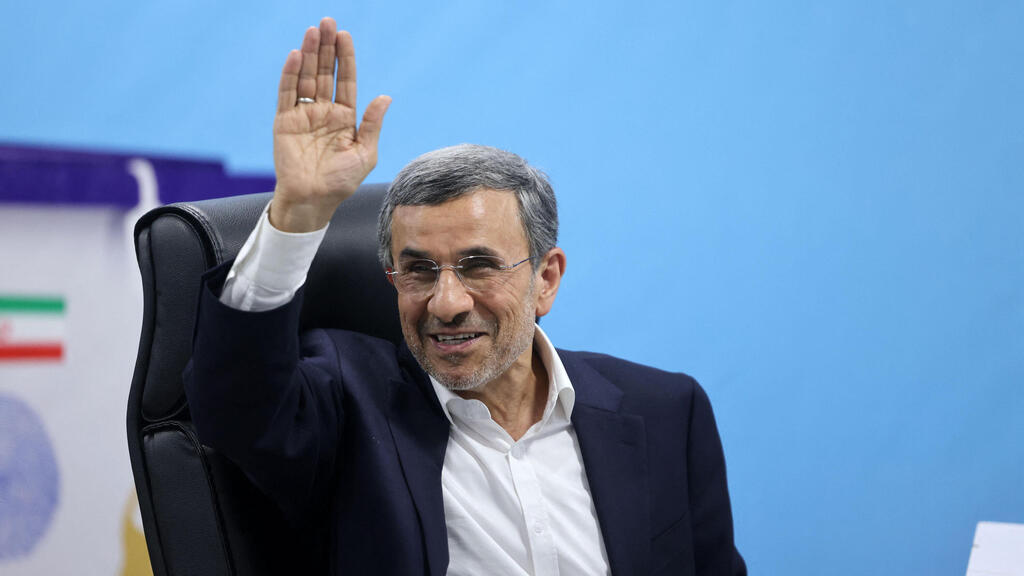
Former Iranian President Mahmoud Ahmadinejad
(Photo: Atta Kenare/AFP)
Hayman also addressed the circumstances that led to the outbreak of the war, pointing to the U.S. actions in Venezuela and the operation to capture Nicolas Maduro.
"Let's start with Venezuela, because that is really what's behind the sense of confidence and maybe arrogance. And that the sense of success probably led Trump to tweet that help is on the way, which was a huge surprise to Israelis," he said. "We know that there is a kind of concept that Israeli drove, kind of convinced Trump to strike. That's not accurate. When Trump said 'help is on the way' and decided to strike, Iran surprised Israel in early January. So why did Trump say 'help is on the way'? Why he pushed himself into the Iranian arena? Probably because of the success in Venzuela."
Hayman said that Israel "was not planning anything" in early January. "Trump surprised the Israelis out of nowhere and said he would strike Iran. Trump sort of shuffled the deck when he surprised Israel with his willingness to attack Iran. That led to Israeli planning, American motivation and February 28,” the day the current war began.