

Mojtaba Khamenei’s failure to appear at his father’s funeral has deepened uncertainty inside Iran over who is actually running the country, The New York Times reported, as a power struggle intensifies between rival conservative camps.
Khamenei, who succeeded his father, Ayatollah Ali Khamenei, as supreme leader, has not appeared in public since taking power. His absence from the funeral ceremonies, which were meant to project unity after months of war with Israel and the United States, has instead underscored the political vacuum at the top of the Islamic Republic.
Iran’s leaders weep over Khamenei’s coffin in mass funeral show of defiance


According to the Times, Iran’s internal divide is no longer the familiar split between reformists and conservatives. The main battle now is inside the conservative camp itself: on one side are pragmatic conservatives who argue that Iran must reach an understanding with Washington to ease the country’s crisis; on the other are hard-liners who reject concessions to the United States and say the country should continue confrontation.
The pragmatic camp, the report said, includes senior generals in Iran’s Revolutionary Guard Corps whose names were not disclosed, parliament speaker Mohammad Bagher Ghalibaf, President Masoud Pezeshkian and Gen. Mohammad Bagher Zolghadr, head of the Supreme National Security Council. That camp has so far gained the upper hand, pushing ahead with a ceasefire agreement, direct talks with the United States and an effort to shape a broader deal.
The hard-liners have responded with public attacks on the negotiating team and its allies. In one striking episode, Ghalibaf was abruptly cut off during a live television interview while discussing details of the ceasefire agreement with the United States. The incident sparked calls in Iran to dismiss the head of state broadcasting, an appointee of the elder Khamenei who belongs to the ultra-hard-line camp, according to the Times.
Ali Khamenei’s funeral: Chants of ‘Death to America’ and ‘Death to Israel’
(Video: Reuters)
State television has also intensified its criticism of the talks, including attacks on Foreign Minister Abbas Araghchi, who has taken part in the negotiations. In rallies and public appearances, hard-line voices have accused negotiators of appeasement and betrayal, turning what was once largely an internal policy fight into a visible battle over the direction of the regime.
But the public clashes are only part of the story. Four senior Iranian officials and two members of the Revolutionary Guard told the Times that each side is trying to pull the new supreme leader into its camp, knowing that his backing could determine Iran’s next political course. In the meantime, IRGC generals have consolidated influence during the war and are effectively running much of the country, the report said.
The shift has also changed how power is discussed in public. Mohammad-Jafar Ghaempanah, Iran’s vice president for executive affairs, recently suggested that the supreme leader’s view should be debated by state institutions rather than treated as a final command.
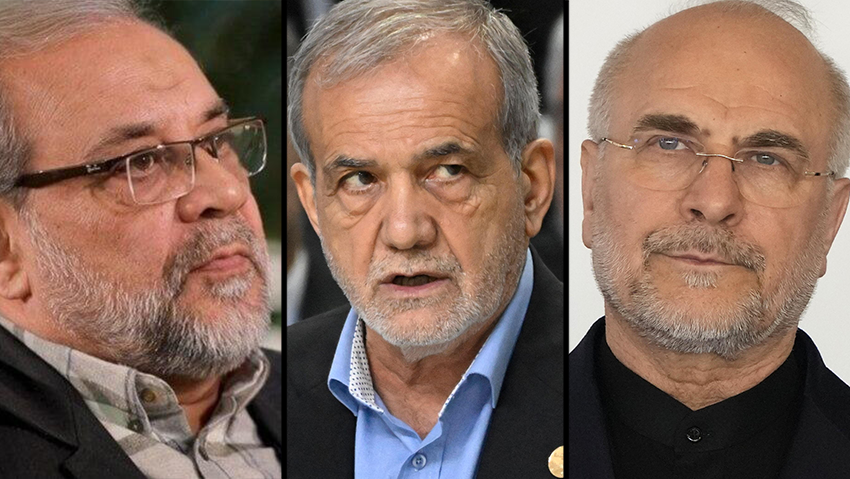
(Photo: AP Photo / Eraldo Peres, Alexander NEMENOV / POOL / AFP)
“If we are supposed to only implement the supreme leader’s opinions, then why do we have a Parliament and a national security council?” he said, according to the Times.
Such a statement would have been almost unimaginable under Ali Khamenei, who exercised decisive authority over Iran’s major policies.
The question now being raised in Iranian political circles, the Times reported, is whether Mojtaba Khamenei can continue to rule while remaining unseen. His absence has become especially sensitive because he has also struggled to quiet the fight over negotiations with Washington.
During the final stages of talks, when Khamenei was hesitating over the preliminary ceasefire agreement, Pezeshkian went to see him and warned that Iran’s economy was in severe distress, according to four Iranian officials familiar with the meeting. The president said the U.S. naval blockade was crippling the country and threatened to resign if the deal was rejected.
Abdolnaser Hemati, the head of Iran’s Central Bank, also warned Khamenei in a letter that Iran faced an acute budget crisis and that critical food and medical supplies could run out by the end of August if the blockade continued, the officials told the Times.
Those warnings helped push Khamenei toward backing the agreement. In a written statement, he said he opposed the deal “on principle,” but instructed the president to proceed if he had the support of the Supreme National Security Council. Pezeshkian has said the council voted 12 to 1 in favor.
Khamenei’s next major test will come after the funeral period, when he must make key appointments to lead the judiciary, state broadcasting and the Basij militia, as well as choose his own chief of staff. Iranian officials told the Times that those decisions will show which faction he intends to favor, and whether the hard-liners or the pragmatists will shape the future of the Islamic Republic.