


Despite repeated requests from the Israel Tax Authority over the past three years, the Transport Ministry's security division sought access to information on airline crews only after a closed-door Knesset hearing into the attempted flydubai cockpit attack, ynet has learned.
The request came after a confidential meeting of the Knesset's Foreign Affairs and Defense Committee on Tuesday, which examined the attempt by Omani pilot Hamam al-Hammami to crash a flydubai passenger aircraft. Following the hearing, the Transport Ministry's security division requested immediate access to the National Passenger Assessment Center, seeking information about the nationalities of airline crew members.
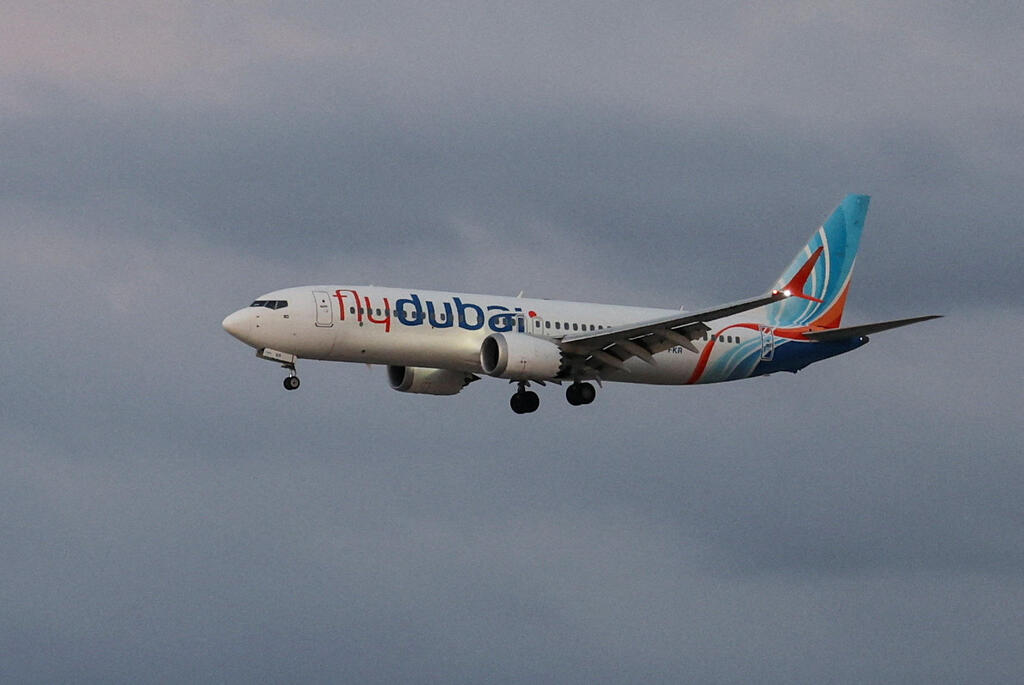
(Photo: REUTERS/Ammar Awad/File Photo)
The Tax Authority confirmed that it had contacted the ministry several times before the attempted attack, explicitly asking it to fulfill its responsibility to appoint an authorized representative who could retrieve information from the center.
Despite those requests, the ministry had not taken the necessary steps to obtain access during the preceding three years.
After finally authorizing a representative, the Transport Ministry was informed that the system was not technically capable of providing airline crew nationality data 48 hours before departure, as required under the legislation governing the center.
Instead, the information becomes available only close to departure, at a stage when it can no longer be effectively used for security screening.
Transport Ministry officials complained about the limitation. However, according to the Tax Authority, the procedure under which crew information is transmitted shortly before flights had already been established with the knowledge and approval of Transport Ministry representatives.
The Transport Ministry disputed the allegation that its security division had failed to appoint a representative despite repeated requests.
"The security division continues to participate in a series of previously scheduled meetings of the National Passenger Assessment Center's steering committee, in order to help define the system and take part in it once it becomes operational," the ministry said.
"Claims that the security division was asked to send a representative and failed to do so are completely detached from reality, since a representative of the division is a member of the center's steering committee."
The ministry added that, regardless of the dispute over representation, the system remained unable to provide information about airline crews sufficiently far in advance.
"In any event, even at this stage, the system is unable to provide the information about airline crews ahead of time, as noted," the ministry said.
The conflicting accounts highlight a dispute over responsibility for obtaining aviation security information, particularly the distinction between participating in the center's steering committee and appointing an authorized official to retrieve operational data.
The revelations come as Lahav 433, the Israel Police's national crime investigation unit, opened a preliminary inquiry Wednesday into suspicions involving senior Transport Ministry officials responsible for aviation security.
The inquiry concerns allegations that officials responsible for security oversight, particularly the screening of pilots arriving in Israel, also worked for foreign airlines, including flydubai, the airline involved in the attempted attack.
Two senior officials are at the center of the inquiry: Avraham "Avri" Cohen, head of the Transport Ministry's security division, and Dvir Rubinstein, director of the ministry's Aviation Security Operations Center. The examination was launched following information provided to police by officials within the Transport Ministry.
The National Fraud Investigations Unit, which operates under Lahav 433, is handling the inquiry, including suspicions of potential conflicts of interest involving ministry employees and the operations of foreign airlines in Israel.
Meanwhile, the investigation into the actions of Omani pilot al-Hammami remains underway. Saudi Arabia is continuing its investigation into the security incident aboard the flight, while the United Arab Emirates is conducting a separate criminal investigation in which Israel's Shin Bet security agency is participating.
Israel has also offered to participate in any aviation safety investigation led by Saudi authorities, but has not yet received an invitation.
Ofer Vaknin, head of the Transport Ministry's aviation safety investigation authority, told Reuters that Israel was prepared to assist with such an investigation. "We are still waiting for an invitation from Saudi Arabia," he said.
Separate investigations are also underway in Australia and New Zealand concerning periods during which the Omani pilot stayed in those countries.
The growing number of inquiries comes as Israeli authorities face questions not only about the attempted attack itself, but also about the aviation security information available before the incident and whether existing procedures were adequately implemented.