

Prime Minister Benjamin Netanyahu presented his version of the first hours of the October 7 massacre, a day after the government advanced its political inquiry commission into the failures surrounding the attack.
Speaking on Ben Ben Baruch’s podcast, Netanyahu said he “immediately” understood Israel was at war and asked for hundreds of thousands of reservists to be called up.
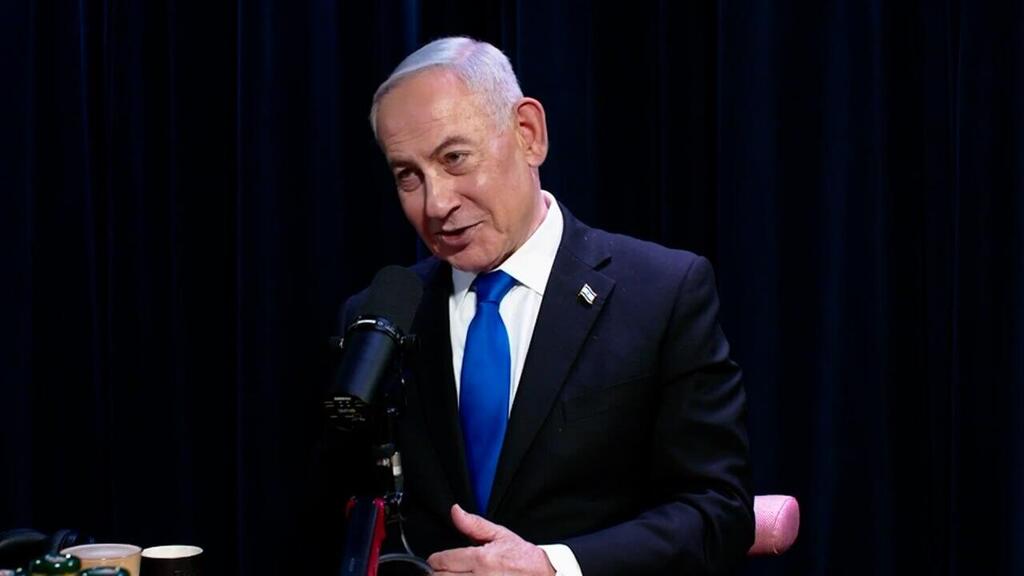
(Photo from 'Ben Ben Baruch’s Mojo')
“It starts with a phone call from the military secretary,” Netanyahu said. “I don’t remember if it was in that call or the one immediately after it, but I had one question: did we seal the border with Gaza? Because I was very concerned that they would take hostages.”
Netanyahu said he then drove to IDF headquarters in Tel Aviv. “At the Kirya, I said: we are at war,” he said. “I understood it immediately. It came from all directions, and then I also asked to call up hundreds of thousands, our entire mobilization system. It was not obvious. They wanted to call up, and it simply amazes me that it was not obvious, but they told me, ‘We’ll call up 80,000, 100,000.’”
But Finance Minister Bezalel Smotrich gave a different account in an interview with ynet last October, saying that during the first hours there was still hesitation and not all forces were immediately sent south out of concern that the Hamas attack might be a deception.
“Between 11 a.m. and noon, I arrived at the Kirya,” Smotrich said at the time. “We are sitting there in the room, the prime minister, Gallant and I, the chief of staff was on the phone, and we are deliberating. We still do not know whether the catastrophe in the south is only a deception exercise that Hamas created so that we would send all forces south, and then Hezbollah would attack us from the north. That is why we also waited for a moment, and only when intelligence arrived and we understood that it was not coordinated, we sent all forces south.”
Netanyahu also said that the next day he told local authority leaders Israel would “change the face of the Middle East.”
“Hezbollah really did join the next day, but it was clear to me that it was not only them,” he said. “It was clear to me that we were fighting Iran’s proxies and Iran, and that eventually it would get there.”
Netanyahu said one of the main lessons he draws from history is to avoid dividing Israel’s military effort across several major fronts at once.
“I read a lot of history books, and one of the main lessons is that if you can, concentrate on one intense arena and do not split yourself into several arenas,” he said. “So regarding Lebanon, I said: active defense, keep pushing all the time, but do not invade. I wanted to move according to the clock, to start with Hamas, then move to Hezbollah.”
In the podcast, “Ben Ben Baruch’s Mojo,” which is set to air Wednesday at 10:30 p.m. on Ben Baruch’s YouTube channel, Netanyahu was also asked what it is like to go two decades without sitting in traffic and whether he still remembers what a traffic jam looks like.
“Yes, I remember them and I also see them, and we are about to open them up,” Netanyahu said. “I’ll tell you the traffic jam I remember. I was in Sayeret Matkal, and some of our activity was in the Suez Canal and some in the Golan Heights. So for a significant part of my service, I would drive on the Beit Lid road, and somehow you would crawl along that road, and then you would reach Wadi Ara to turn right to the Golan, and there you would get stuck behind a thousand trucks. This is a tiny country, and it would take you four or five hours to get to the Golan.”