


U.S. President Donald Trump announced overnight Thursday into Friday that an agreement had been reached to disarm Hamas, a deal that, at least on paper, is meant to ensure the terrorist organization no longer poses a threat to Israel. But the plan is likely to face further ups and downs before it can be implemented. As has often been the case with the current U.S. administration, disagreements were once again pushed aside so a deal could be announced, in the belief that they would be resolved later.
The issue of an Israeli withdrawal from the Gaza Strip, for example, remains disputed. Officials in Jerusalem say there will be no withdrawal without disarmament, while officials in Gaza say there will be no disarmament without a withdrawal.

Another major concern is that the current framework addresses only heavy weapons. Yet the principal threat posed by Hamas today is not necessarily its rocket arsenal, but the tens of thousands of armed operatives it still has in Gaza with small arms. When ordered, they could once again carry out atrocities on the organization’s behalf.
So what does the agreement, whose main provisions were published by several Arab media outlets, actually say, and where are problems likely to arise?
Timetable
- The agreement establishes a 14-day period after its approval or announcement to assess whether the parties are complying with its terms. After that, final timetables would be set for implementation and the transition to operational stages.
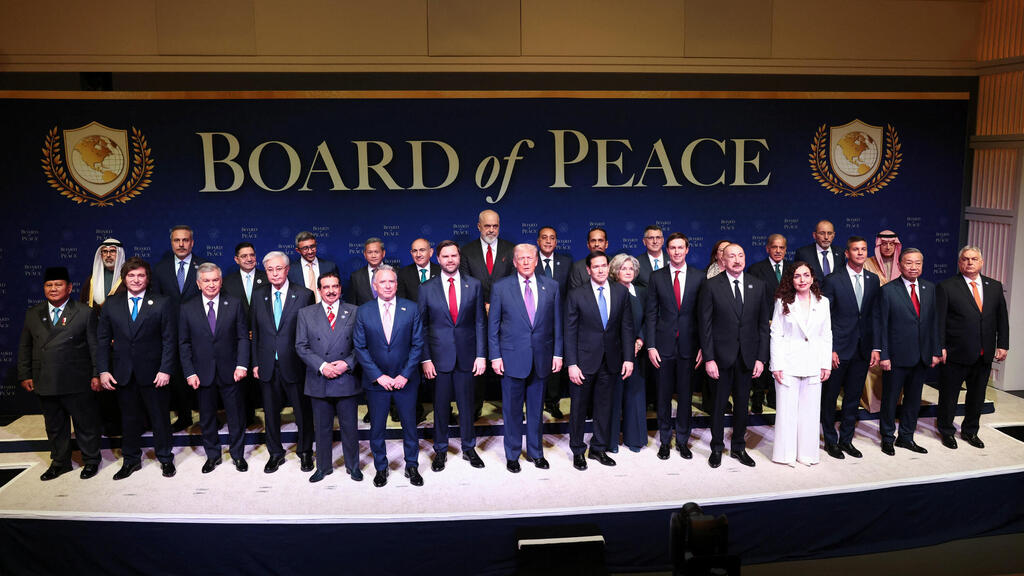
Support and assistance will be provided to Gaza's national committee; Board of Peace meeting
(Photo: Kevin Lamarque/Reuters)
During this period, Israeli strikes would stop and there would be no further military advance along the "Yellow Line." Military operations would be suspended as a condition for moving to the next stage.
- The agreement would also allow 600 aid trucks to enter Gaza each day, including 50 fuel trucks. Support and assistance would be provided to the national committee tasked with administering Gaza.
- The implementation timetable could be extended by a decision of the international verification committee. This is where one of the agreement’s central problems lies: As long as Israel and Hamas do not agree on which comes first, withdrawal or disarmament, implementation will be difficult.
Heavy weapons, military infrastructure and security
- Weapons collection would be limited exclusively to heavy arms and would not include other types of weapons. This is a major weakness in the framework. Hamas is believed to have relatively few rockets left, but its members likely retain large stockpiles of small arms. Those weapons would not be collected and could easily be used to intimidate Gaza’s population and its governing authorities.
- The national committee for the administration of Gaza, effectively a technocratic government, would be the only body authorized to organize the collection of weapons under international supervision. It alone would be responsible for maintaining, storing and controlling them.
Some Arab media reports said the national committee would not operate in a vacuum but would collect the weapons "in cooperation with the Palestinian organizations," meaning Hamas, Palestinian Islamic Jihad and other terrorist groups. In practice, although the heavy weapons would be taken from the terrorist organizations, they would remain in Gaza under Palestinian control, whether in the hands of the technocratic government or another body. Those organizations would also retain considerable influence over the process.
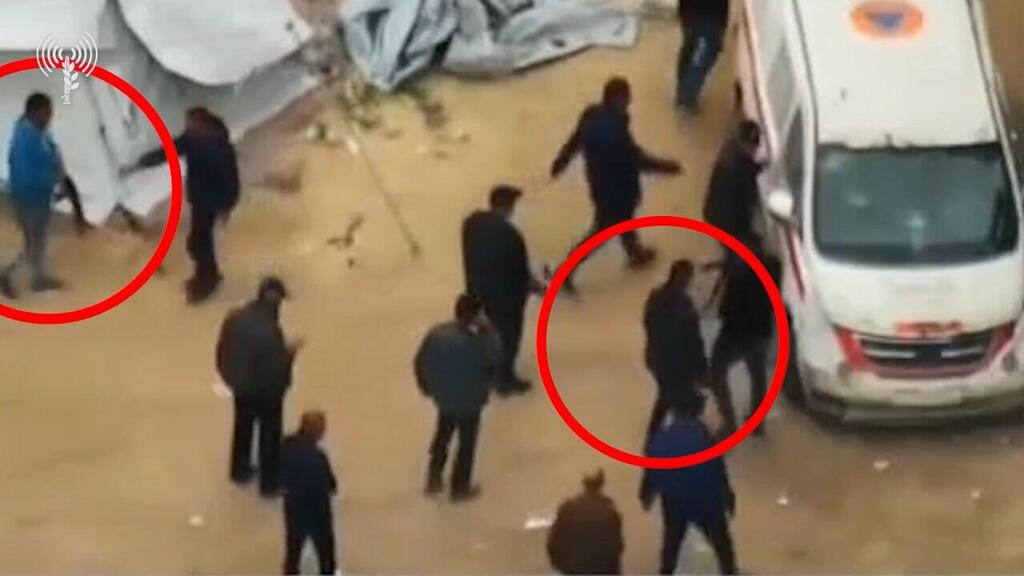
The weapons are to be collected; footage shows Hamas terrorists using ambulances to transport weapons
(Photo: IDF Spokesperson's Unit)
The process of dismantling, consolidating and storing heavy weapons, as well as tunnels, weapons depots and production sites, would be carried out gradually and in stages. It would begin only after the first stage is completed in full, all other commitments under the Sharm el-Sheikh protocol are met, the national committee enters Gaza and the international stabilization force is deployed. In other words, it would take considerable time before the weapons are actually collected.
- The process and the dismantling of military infrastructure would be supervised and verified by a special international verification committee and a monitoring mechanism, in the form of an international stabilization force.
- The agreement states explicitly that at no stage would weapons be transferred or handed over to Israel or to any non-Palestinian body.
- Regarding other security forces and militias in Gaza, the agreement calls for an accord banning military displays and retaliatory actions by those groups. Armed groups and militias would be dismantled simultaneously under an agreed timetable.
According to some Arab media reports, qualified security personnel would be integrated into official institutions, but militia members would not be incorporated into Gaza’s security services. This could create another gap capable of derailing the framework during implementation. Hamas, for example, is expected to insist that its members be absorbed into the new security bodies under a "civilian" designation.
Israeli withdrawal
- The framework states that the arrangements would be implemented alongside a gradual Israeli withdrawal from areas under its control in Gaza. The question of which step comes first remains unresolved.
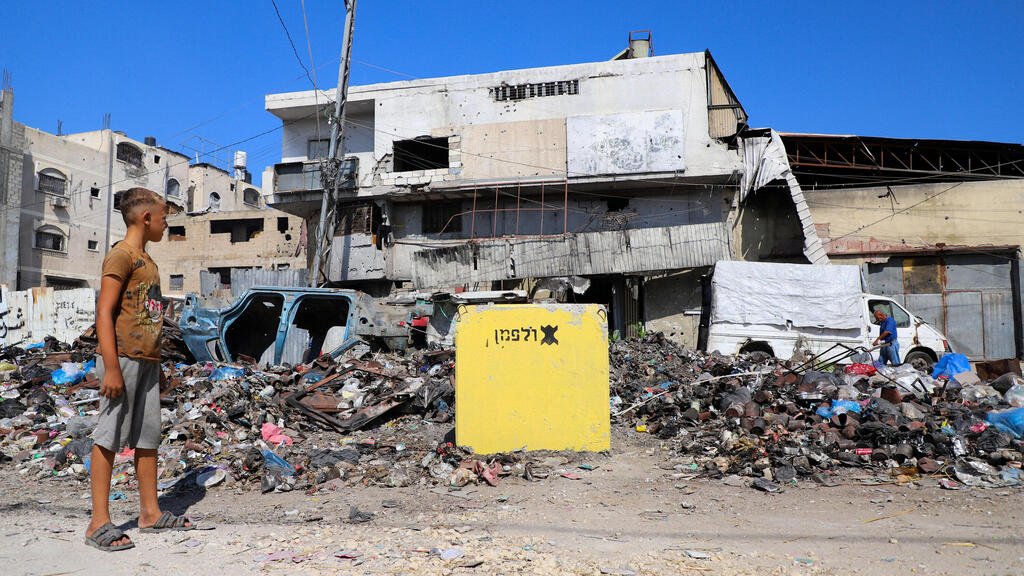
The IDF is expected to withdraw at a later stage; concrete barriers along Gaza's Yellow Line
(Photo: Ebrahim Hajjaj/Reuters)
The weapons issue and implementation of the agreement are not treated as a separate process. Instead, they are linked to and conditional on a political process guaranteeing Palestinian self-determination and the establishment of a Palestinian state.
This is another major obstacle. The Israeli government is unlikely to approve a clause linking Gaza’s disarmament to the establishment of a Palestinian state, creating another dispute the U.S. administration appears to have pushed aside.
Technocratic government
- Civilian and security responsibility for the Gaza Strip would be transferred to the national committee for the administration of Gaza, which includes figures identified with the Palestinian Authority.
- The committee would operate Gaza’s institutions and public services and conduct a comprehensive review of their financial and administrative affairs.
- The agreement also stipulates that the committee’s work must remain free from outside interference during the transitional period.
First published: 08:06, 07.31.26