


Operation Mid-Summer is the name Southern Command has given to the current mission by the regular 7th Armored Brigade, which has been underway for the past three weeks in Zeitoun, one of the southern neighborhoods of Gaza City.
It is the seventh time Israeli forces have swept through the area between Shijaiyah, along the border and the Beit Hanoun–Netzarim axis since the ground offensive began in late October 2023. The southern sections of Zeitoun were already flattened last year as part of establishing the Netzarim Corridor. “This time we will destroy all of its infrastructure, including underground, and then Hamas will struggle — if not be unable — to reestablish its local battalion here,” commanders in the field vowed Thursday.

Most of the officers now leading brigades, battalions and companies were not in those roles during the original ground maneuver early in the war, a reflection of the high turnover in nearly two years of fighting. “There’s fresh blood — fighters and squad leaders entering Gaza for the first time just this past month. It brings original ideas and renewed motivation, but we’re also here to calibrate them and reset what they don’t yet know,” said Capt. L., commander of the spearhead company in Givati’s Tzabar Battalion.
The small press convoy visiting the soldiers includes dusty Namer armored carriers, some with worn protective plates lying on the ground beside them. Inside Namer No. 3, three young soldiers sit waiting for their turn to head out for a brief respite outside Gaza. “Some of these guys came here straight from advanced training,” said their squad commander, a sergeant who proudly notes his accumulated “Gaza mileage.”
On the stairs leading to the brigade commander’s quarters — a four-story, shell-pocked building — graffiti is scrawled across the walls. Early in the war, such slogans were quickly scrubbed away under orders from above. One still reads: “No ceasefire.” Another, painted in large letters on the wall between the border fence and the nearby kibbutz and Nahal Oz outpost, declares: “Until total victory and the expulsion of the Gazans.” This is the backdrop the soldiers encounter both inside Gaza and upon exiting it, in contrast to the graffiti at the war’s start that focused mainly on hostages’ names and in-jokes among units.
“Izz al-Din al-Haddad, commander of Hamas’s Gaza Brigade and now effectively its leader, once said that if this corridor falls, the whole city will fall,” a senior officer here recalled. “The commander of the 77th Battalion is close to locating and destroying a large tunnel we found on the other side of the axis, and by doing so we’ll eliminate it both above and below ground.” The corridor in question is the east–west road connecting Shijaiyah to central Gaza City.
Earlier this week, a small Hamas cell emerged from beneath the brigade’s fortified position we visited and attempted to attack the compound. Two reservists serving with the regular brigade spotted the move with unusual alertness, opened fire and foiled the surprise assault.

'No ceasefire' scrawled on a wall inside a home in Gaza City's Zeitoun neighborhood
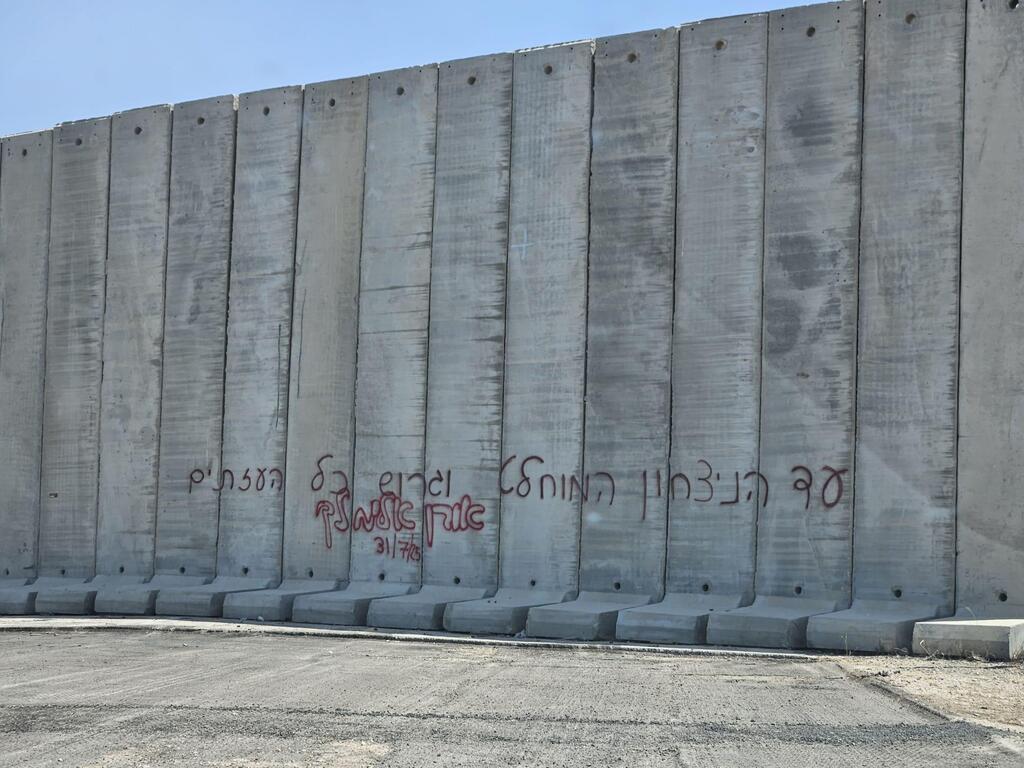
'Until total victory and the expulsion of the Gazans' painted in large letters on the wall between the border fence and the nearby kibbutz and Nahal Oz outpost
“This is without doubt an imitation of the Khan Younis incident with the Kfir Brigade. Hamas' current goal is to attack our fortified positions, our operational rear inside Gaza, with guerrilla squads,” military officials assessed, referring to an incident where a cell of at least 15 terrorists stormed an IDF outpost in southern Gaza.
Commanders from the 7th Brigade, together with Yahalom combat engineers, began examining the tunnel beneath the fortification and discovered a well-preserved underground terror base: a kitchenette, a bunker stocked with weapons and relatively comfortable living quarters.
Last month, Hamas withdrew most of its armed fighters from Zeitoun — between 400 and 500 men — hiding them among the roughly one million civilians concentrated in central and western Gaza City. Only a few dozen fighters were left behind to stage ambushes from concealed shafts, damaged buildings and piles of rubble. The tunnel has since been bombed in recent days, with other sections to be dealt with later.
“Yes, forces have maneuvered here seven times, but sometimes had to stop mid-operation because of ceasefires or because raids were brief,” commanders explained, adding that this round is intended to clear the way for the major assault planned inside Gaza City. “In the past ten months, the IDF had not operated in Zeitoun, so now we are acting differently — systematically, like in Khan Younis — also destroying buildings without which the tunnels cannot be restored or used.”
The 7th Brigade is one of the few formations currently conducting assaults in Gaza during these twilight days of fighting, and for now it enjoys a luxury it will not have in the larger offensive. For the past several weeks, the army has provided the brigade with generous resources: reconnaissance assets, aerial surveillance, more drones and a steady supply of shells. That will change once an additional 12 to 14 brigades join the campaign in the coming months and into next year, under the broader Operation Gideon's Chariots II.

In the outskirts of Gaza City's Zeitoun neighborhood
Some of the vehicles are worn but still running. The bigger problem lies in the heavy armored platforms, which require thorough maintenance that forces them out of combat for two to three days at a time. Even so, in the Zeitoun operation so far, troops have held the upper hand in most encounters.
“The local Hamas battalion excels at booby-traps and has packed the routes with roadside bombs ahead of us. In one place, we found seven large explosive charges that could have lifted our tanks. But we operate smartly, with a lot of experience, and don’t rush into harm's way. Wherever there are signs of explosives, we pull back and deal with the scene thoroughly,” officers explained.
They said Hamas’ Zeitoun Battalion is “very arrogant, and its commanders think they managed to drive out seven IDF brigades since the start of the war.” Still, they added, “we don’t underestimate them. One of their squads wounded our deputy battalion commander in the hand last week. We only wish we encountered them more often.” The army believes many of the routes toward Hamas strongholds inside Gaza have already been rigged with dozens of explosives.
Despite the heat, the officers giving interviews keep black hoods over their faces, fearing arrest if they travel abroad, and their identities remain concealed. Alongside them in the command posts sits a “matchmaker,” an intelligence officer who directs strikes toward possible hostage locations, dead or alive, inside Gaza City. This requires adjusting lines of fire and redirecting tank barrels.
Questions about why the army keeps returning to the same areas of Gaza after nearly two years are raised not only outside Israel but also by soldiers themselves. Members of the 82nd Battalion, just before heading out for a break, asked their commanders the same.
“So we made them a short 90-second clip showing the achievements and destruction of enemy infrastructure they carried out here in the past month,” officers recounted. “They also ask what the purpose is, and we share with them that Hamas in Gaza is very worried about our approach to their strongholds in the city, about our activity already on the outskirts of the next neighborhood, Sabra. Hamas rebuilding its tunnels worries us, and that’s why we are acting differently now.”
Suddenly, bursts of nearby gunfire cut through the midday heat. We step outside and are told this is how troops inside the fortified compound prepare for surprise Hamas attacks: firing short, disruptive bursts in different directions, deliberately and without warning, so that if a terrorist is about to raise his head from an undiscovered shaft, he will think twice and move to another hideout.
The gap between politicians’ promises of “total victory” and grandiose comparisons of Gaza to Berlin or Rafah to Stalingrad does little good for the seasoned officers here. They refrain from openly criticizing, but they stress again and again to the public that this kind of war is drawn-out, Sisyphean and grinding — especially when expectations are for the lowest possible casualties among Israeli troops.