

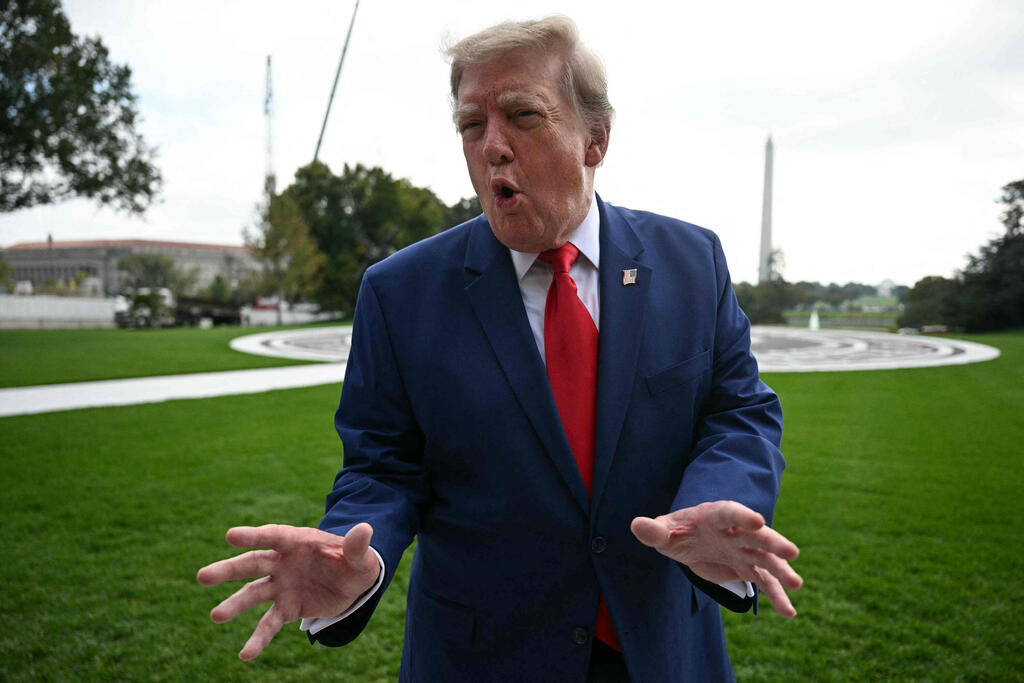
U.S. President Donald Trump intervened again Sunday in the violent unrest sweeping France, blaming immigration for the destruction and looting that have devastated parts of Paris and other major cities. "France is burning!" Trump wrote on Truth Social. "The immigration of people from an entirely different world, people with hatred in their hearts, has shattered that once great country. Close your Borders and take control, before it is too late!"
His remarks followed a day of widespread violence Saturday in which masked rioters attacked police officers and bystanders, set government buildings ablaze and looted hundreds of stores. The violence erupted following nationwide demonstrations against the rising cost of living and deteriorating public services, drawing hundreds of thousands of participants. French authorities reported at least 2,000 arrests and approximately 600 injured police and security personnel, according to the latest figures released Sunday.
Limoges city hall engulfed in flames before its tower collapses during the riots
(Video: X)


The full extent of the destruction remains unclear, but French business representatives estimated that at least 1,500 businesses had been damaged, with losses running into hundreds of millions of euros. In Paris alone, hundreds of stores were looted. Mayor Emmanuel Grégoire said "entire streets were systematically destroyed," while Le Parisien described extensive damage in neighborhoods across the capital.
In the central Les Halles district, rioters targeted virtually every type of business, including pharmacies, clothing stores, beauty salons, tobacco shops and opticians. Similar scenes unfolded near Porte Saint-Denis, where dozens of businesses were vandalized. Burned bicycles, broken glass and piles of debris littered the streets. Sanitation workers told Le Parisien that clearing the wreckage would take days.
According to AFP, some looting appeared organized and coordinated. Small groups of masked young people wearing gloves reportedly disabled security cameras before smashing storefront windows and stealing merchandise. In one widely circulated video said to have been filmed in Paris, a woman desperately tried to stop masked looters from entering a supermarket. "Why are you doing this?" she shouted before being pushed aside. "Stop! That's not the point!"
Another video from Nice showed a video game store employee trying to protect a Micromania branch from looters before being kicked in the back and knocked to the ground. In Paris, groups were filmed emptying cellphone stores and passing stolen merchandise to accomplices outside. AFP described scenes resembling an uprising, with protesters shouting "Revolution!" The agency said the scale and intensity of the violence appeared to exceed previous waves of unrest in France, including the 2023 riots following the police killing of teenager Nahel Merzouk and the Yellow Vest protests of 2018 and 2019.
Historic city hall goes up in flames
Some of the most dramatic scenes came from Limoges in central France, where masked rioters set fire to the historic city hall, a building inaugurated in 1883 that had survived both world wars. Flames engulfed the structure, and its bell tower collapsed in footage circulated widely online. Authorities said much of the building had been destroyed.
Government buildings were also attacked in Marseille, Lille, Angers and Bordeaux, where protesters broke into municipal offices and regional administrative buildings. In Lyon, the local tourist office was set ablaze, and police reported that hostile crowds interfered with firefighters attempting to extinguish the flames. Footage from the city showed one rioter waving a Palestinian flag.
Police disperse demonstrators with tear gas in Lille
(Video: Reuters)
The weekend's violence followed weeks of growing frustration over inflation, fuel prices, declining public services and deteriorating conditions in French schools. Students, labor unions and members of the Yellow Vest movement, which emerged in 2018 in opposition to President Emmanuel Macron's economic policies, joined Saturday's demonstrations.
The unrest also follows student protests that began last month in poorer suburbs north of Paris over teacher shortages and inadequate school conditions. Those demonstrations were accompanied by violence that subsequently spread to other European countries, including Belgium.
Macron's government and figures on the French right have accused far-left groups of hijacking legitimate social grievances and turning the demonstrations into violent confrontations ahead of next year's presidential election. The political tensions come as France prepares to choose a successor to Macron, who is barred from seeking a third consecutive term. Polls cited in French political coverage have pointed to a possible contest between far-right leader Marine Le Pen and Jean-Luc Mélenchon, leader of the far-left France Unbowed party.
Trump and Vance blame immigration
The unrest has also reignited fierce arguments over immigration and integration, with French right-wing politicians and prominent conservative figures abroad blaming immigrants and their descendants for a significant share of the violence. These accusations have become central to the political debate, although the broader demonstrations have involved people from different backgrounds and political movements.
Marion Maréchal, the niece of far-right leader Marine Le Pen, accused supporters of left-wing politician Jean-Luc Mélenchon's vision of a "new France" of destroying the country. "The whole world is watching in astonishment and disbelief as the children of Mélenchon's 'new France' destroy their country," she wrote.
The phrase refers to Mélenchon's vision of a French society in which immigrant communities are an integral part of national identity, but Maréchal and other right-wing figures have adopted it as a warning about demographic change.
Nice Mayor Éric Ciotti expressed outrage over the destruction in Limoges, calling the burning city hall a symbol of a republic in decline. "This is an allegory of our republic going up in flames and dying," he wrote. "We will not allow our country to die without a response. Millions will reject chaos. We will win!"
Trump had already linked the unrest to immigration earlier this month, arguing that student demonstrations were a cover for broader political and cultural aims. In a Truth Social post about two weeks ago, he claimed that the protests had nothing to do with schools and instead reflected mass immigration that had spiraled out of control. He also accused Islam of seeking to take over France.
Vice President JD Vance echoed those accusations Sunday, sharing footage of the destruction in Limoges. "Liberals in the West imported the Third World into France and other countries in the name of diversity and compassion," he wrote, accusing political leaders of ignoring questions about integration and cultural compatibility. He said Western governments had been warned about the consequences but had refused to listen.
Vance also connected the violence to the upcoming U.S. midterm elections, as Trump and Republicans seek to maintain control of Congress. "I hope Americans are paying attention," he wrote. "This is the future congressional Democrats want for your country."
Palestinian flags displayed during some of the demonstrations have drawn particular attention from conservative commentators, who linked them to the broader pro-Palestinian protest movement. American commentator Meghan McCain, daughter of the late Republican senator John McCain, shared footage of the burning Limoges city hall and wrote: "This is what 'globalize the intifada' means."
The slogan, heard frequently at anti-Israel demonstrations in Europe and the United States in recent years, is defended by supporters as a call for Palestinian liberation but criticized by opponents as an endorsement of violence against Jews and Israelis.
Macron faces criticism over response
Macron, meanwhile, was preparing to address the nation at 9 p.m. Israel time Sunday following mounting criticism of his response to the unrest. Opponents of the violence accuse him of failing to take sufficiently decisive action, while supporters of the protests argue that his government has failed to address their demands and restrain police tactics.
In recent weeks, Macron has largely responded with statements acknowledging public anger while condemning violence. Critics have called for stronger measures, including emergency powers that could allow authorities to deploy additional security forces and impose tighter restrictions on rioters. The government has so far avoided declaring a state of emergency.
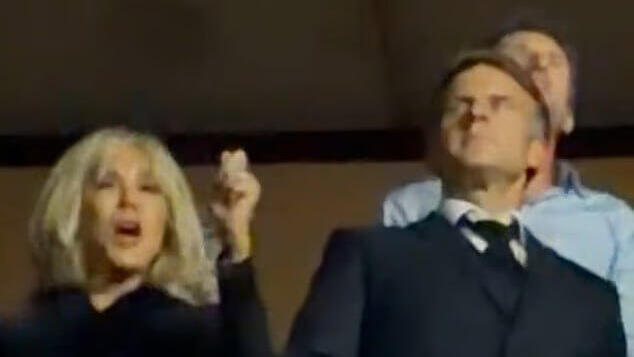
French President Emmanuel Macron and his wife, Brigitte, attend a Céline Dion concert on the eve of the riots
The president also faced criticism over footage showing him and his wife, Brigitte, dancing and enjoying a Céline Dion concert Friday night, just hours before the unrest erupted. The video circulated widely over the weekend, with critics accusing the couple of appearing detached from growing public frustration over rising living costs, pressure on public finances, political paralysis and violence in the streets.
Some compared the images to Marie Antoinette, the French queen who became a symbol of royal excess during the economic crisis preceding the French Revolution. Critics argued that Macron's appearance at the concert reflected a disconnect between the presidency and the mood of a country facing deepening social and economic tensions.
Macron, whose second term ends next May, cannot run for another consecutive term. The unrest has added to the political pressure on his administration at a time when France is already grappling with economic uncertainty and divisions over immigration, public services and national identity.
With damaged businesses counting their losses, historic buildings in ruins and security forces facing questions about their preparedness, Macron must now contend with both the immediate consequences of the violence and the wider political crisis ahead of France's presidential election.