


Two days after Israel's final election results were released, both political blocs are struggling to find a way out of the deadlock. Calls for a national unity government are growing, but forming one would require more than overcoming the deep distrust between party leaders. Both sides would have to make major political concessions, including abandoning some of their central election promises.
In Prime Minister Benjamin Netanyahu's right-wing bloc, senior ministers say the chances of a unity government are slim. "The political concessions required of each side are so substantial that they make the prospects of such a government extremely unlikely," a senior Likud official said.
Gallery
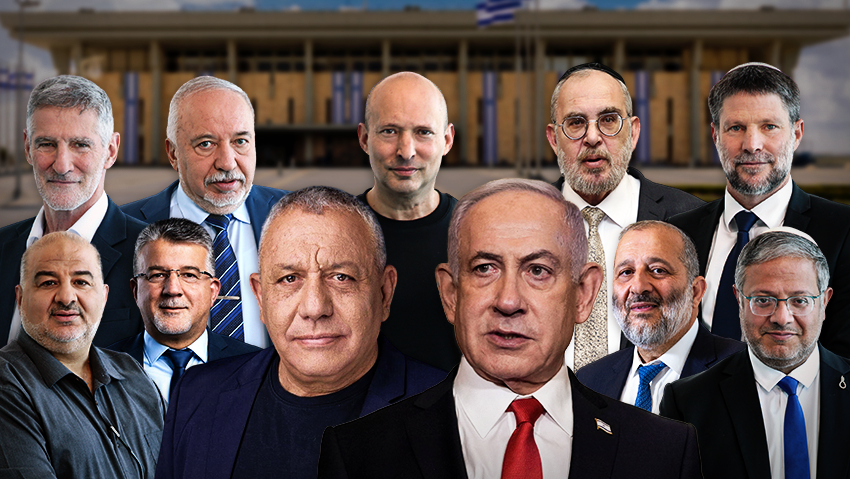
Party leaders following Israel's 2026 election
(Photo: Shutterstock, Shalev Shalom, Elad Malka, Joint List spokesperson, Ryan Frois, Alex Kolomoisky, Oliver Contreras/AFP)
For Netanyahu, unity would mean reversing a campaign promise, breaking up his alliance with his traditional political partners and excluding at least Otzma Yehudit leader Itamar Ben-Gvir, potentially along with some of the ultra-Orthodox parties.
The opposing bloc would face an equally difficult decision. Its parties campaigned on promises not to govern with Netanyahu or the ultra-Orthodox parties, a position tied in part to their commitment to passing legislation requiring broader military conscription. Entering a unity government would force them to reconsider those commitments.
Golan, Liberman and Eisenkot caught in the middle
There is no consensus within the anti-Netanyahu bloc about what should happen next. Each of its leaders has a different idea of how to form a government.
Democrats leader Yair Golan is pushing strongly for a government that would rely on the support or abstention of the Joint List, or one that would include Mansour Abbas' Ra'am party as a coalition partner.
Yisrael Beiteinu chairman Avigdor Liberman, however, has repeatedly ruled out supporting such an arrangement. He also sought to dismiss speculation about his own political ambitions, writing in response to claims that he would demand the position of Knesset speaker: "I have absolutely no desire or intention to serve in that position."
Some figures in the anti-Netanyahu bloc believe that forming a government capable of surviving two or three years might justify the political cost of breaking an election promise. But they see little point in establishing a fragile coalition that could collapse within months and send Israel back to the polls.
While Golan and Liberman have taken firm positions on opposite sides of the debate, the other party leaders have left themselves more room to maneuver.

Yair Golan meeting with Mansour Abbas
Gadi Eisenkot, chairman of Yashar! and leader of the largest party in the anti-Netanyahu bloc, is expected to receive the mandate to form a government following consultations with President Isaac Herzog.
On Thursday, Eisenkot told his supporters that he intended to establish a good government and deliver on the choice voters had made. He did not, however, explain how he planned to do so.
Throughout the campaign, Eisenkot said he would be willing to form a minority government if necessary. But not all his potential coalition partners are now prepared to support that approach.
His options are further complicated by United Torah Judaism, which is seeking military conscription legislation favorable to the ultra-Orthodox community. Eisenkot has repeatedly declared that if he cannot pass a fair and equitable military draft law, he would prefer another election.
Naftali Bennett, leader of the Beyachad party, is another major question mark. Bennett has not supported forming a government dependent on the backing or abstention of Arab parties, and it remains unclear how much flexibility he is prepared to give Eisenkot.
Bennett's position is closer to Liberman's. He believes a government dependent on Arab party support would be unlikely to survive and could collapse quickly, allowing Netanyahu to return to power with a substantial majority and govern for a long, stable term. As a result, Bennett is also reluctant to support this approach.
Yair Lapid, by contrast, is more open to alternatives, according to political sources. He believes that if a workable arrangement can produce a stable government capable of serving for a substantial period, it deserves consideration.
Eisenkot and Lapid met in the evening, and a statement issued on their behalf said they had "discussed the election results and coordinated their next steps, reflecting their shared commitment to carrying out the will of the voters."
A government backed by ultra-Orthodox parties carries its own risks
Another possibility Eisenkot is exploring is a minority government that would take office with the support or abstention of ultra-Orthodox parties, particularly United Torah Judaism.
If United Torah Judaism allows Eisenkot to form a government, his side would have 55 Knesset seats compared with 53 for Netanyahu's bloc.
But this possibility has also raised considerable suspicion among the parties seeking to replace Netanyahu.
Some fear the ultra-Orthodox parties could be playing both sides, using negotiations with Eisenkot to increase their bargaining power with Netanyahu while attempting to repair their political standing after a difficult parliamentary term.
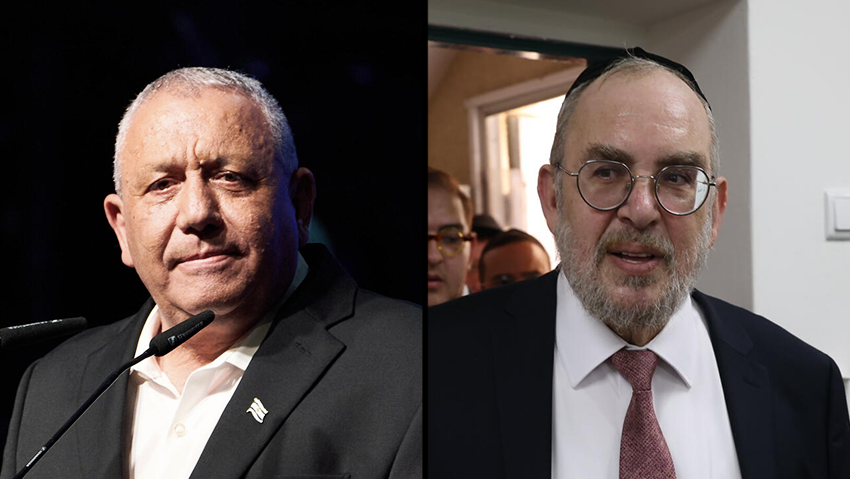
Yaakov Asher and Gadi Eisenkot
(Photo: AP Photo/David Goldman, טל שחר)
"The ultra-Orthodox option is risky because it is unclear whether we could maintain a long-term partnership with them," a source in the anti-Netanyahu bloc said. "It would also force Liberman and Bennett to break a fundamental election promise. The political cost would therefore be high."
The source added: "Eisenkot is working toward that possibility, but it is far from certain that the ultra-Orthodox parties can be trusted to genuinely commit to a government not led by Netanyahu."
On Friday, Lapid published a Facebook post urging supporters to remain patient despite the uncertainty surrounding coalition negotiations.
"It wasn't a knockout victory. It was a win on points, and that counts too. A win is a win," Lapid wrote.
"Now comes the really hard part: trying to form a government. We owe it to everyone who stood in line on Tuesday, everyone who flew in especially to vote, and everyone who spent eight hours outside a polling station trying to persuade people to vote."
Lapid acknowledged that the negotiations would be difficult and that he could offer no guarantees.
"This will be hard. I can't promise anything. There is no simple formula for this. Forming a government is a complicated political process," he wrote.
"But we have something we didn't have on Monday morning: an overwhelming majority of Israelis who made clear that this is what they want."
He concluded with an appeal to his supporters: "So I need to ask you for something that is particularly difficult to ask of Israelis: patience."