



For nearly three years, Israelis living along the Gaza border and Israel's northern frontier with Lebanon have experienced the war more directly than most. What began on the morning of October 7, 2023, transformed their communities into front lines, bringing fighting, prolonged evacuations and an often difficult return to homes and neighborhoods.
Now, as Israel approaches its October 27 election, a new survey reveals how the war has shaped the political priorities of residents in these areas, their assessment of the government's performance and the issues likely to influence their votes.
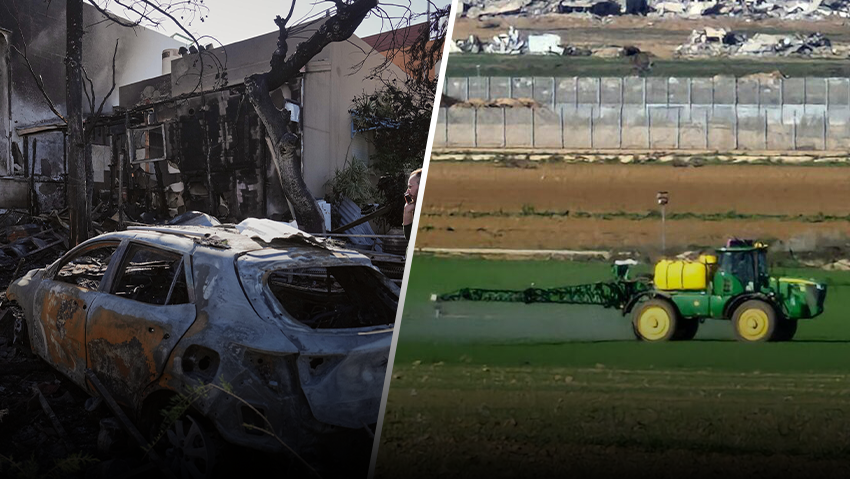
Israel's border communities fault October 7 response but rate later war management higher
(Photo: Reuven Nir, ShKM, AP Photo/Ariel Schalit)
A survey conducted for ynet and Yedioth Ahronoth by the Dialog polling institute, part of the Amanat Pro Group, questioned 498 Jewish residents of communities affected by the war. Respondents came primarily from kibbutzim, agricultural villages and small communities, alongside several towns and cities in the north and south.
The results show that approximately 75% believe the war that began on October 7 will influence their vote to a great or very great extent. Nearly half, 48%, say it will have a very significant impact on their decision.
But the findings also reveal a distinction between how these residents judge the government's initial response to the Hamas-led October 7 massacre and how they assess its subsequent management of the war.
Only 31% satisfied with government's response to October 7
Asked about the government's response to the October 7 attack, 48% of respondents expressed low satisfaction, compared with 31% who reported high satisfaction.
The divide is particularly pronounced along party lines. Among voters supporting Prime Minister Benjamin Netanyahu's Likud party, 30% said they were very satisfied with the government's response. Among supporters of National Security Minister Itamar Ben Gvir's far-right Otzma Yehudit party, however, only 9% expressed the same level of satisfaction.
The criticism extends to voters backing parties within Netanyahu's governing coalition. Among Otzma Yehudit supporters, 23% said they were not at all satisfied with the government's response, compared with just 7% of Likud supporters.
Among voters supporting former military chief Gadi Eisenkot's Yashar party and former prime minister Naftali Bennett's B'Yachad party, 47% and 48%, respectively, said they were not at all satisfied with the response to the attack.
The government's handling of international public opinion received even lower marks. A majority of respondents, 54%, expressed low satisfaction with Israel's wartime public diplomacy and international messaging, while only 23% reported high satisfaction.
Among Likud voters, 45% said they were satisfied or very satisfied with the government's performance in this area. By contrast, 85% of Yashar supporters said they were either not at all satisfied or only slightly satisfied.
Otzma Yehudit voters were also critical. Some 42% expressed dissatisfaction with the government's international messaging, compared with 22% of Likud supporters.
Age also played a significant role. Respondents aged 65 and older were the most critical, with 52% saying they were not at all satisfied and only 11% expressing satisfaction. Among respondents aged 18 to 24, just 16% said they were not at all satisfied.
War management receives better marks than initial response
Although many respondents expressed dissatisfaction with the government's immediate reaction to the October 7 massacre, their assessment of its subsequent wartime management was somewhat more favorable.
Overall, 43% expressed high satisfaction with the government's conduct of the war after the attack, compared with 36% who reported low satisfaction.
Likud supporters were the most positive, with 78% saying they were satisfied or very satisfied with the government's management of the fighting.
Otzma Yehudit voters, despite their criticism of the government's initial response, also gave its later wartime performance relatively high marks, with 61% expressing high satisfaction.
The picture was markedly different among supporters of Ofer Winter's People of Israel party. Only 4% reported being very satisfied with the government's conduct of the war, while another 60% expressed little or no satisfaction.
Among supporters of Yair Golan's Democrats party, 87% said they were not at all satisfied with the government's handling of the war. Half of Bennett's B'Yachad supporters gave the same response.
Northern residents less satisfied with reconstruction efforts
The survey also examined how residents assessed government assistance during the fighting and efforts to rehabilitate communities damaged or disrupted by the war.
Only 34% expressed high satisfaction with the assistance provided to residents during the fighting, while 32% gave similarly positive assessments of the reconstruction and recovery of affected communities.
Once again, supporters of coalition parties generally expressed greater satisfaction than opposition voters. Among Likud supporters, 58% said they were satisfied or very satisfied with reconstruction efforts.
Among Eisenkot's Yashar supporters, none reported being very satisfied, and only 7% said they were satisfied to a great extent.
Among supporters of the Democrats, 90% said they were not at all satisfied with reconstruction efforts, while 7% expressed moderate satisfaction. The remaining respondents said they did not know.
A geographic divide also emerged. Only 27% of respondents living in northern communities expressed high satisfaction with the government's reconstruction efforts, compared with 38% of respondents in the south.
The findings suggest that perceptions of postwar recovery differ not only according to political affiliation but also between communities near the Lebanese border and those surrounding Gaza.
Cost of living and security top election priorities
Despite the war's profound impact, the survey found that economic concerns remain central to voters' decisions.
Asked to identify the single most important issue from a list of options, 32% of respondents selected the cost of living, narrowly ahead of the security situation at 31%.
Another 17% identified establishing a commission of inquiry into the failures surrounding October 7 as their top priority, while 13% selected equality in military service obligations and the conscription of ultra-Orthodox Jewish men, many of whom currently receive exemptions from mandatory military service.
The differences between political parties were substantial.
Among Likud supporters, 50% identified national security as their most important election issue. The corresponding figure among Otzma Yehudit supporters was 49%.
Among Shas voters, 34% prioritized the cost of living, while 66% said none of the issues presented in the survey was their most significant concern.
Supporters of Winter's People of Israel party, whose leader has pledged to join only a Netanyahu-led government, also emphasized security, with 40% identifying it as their leading concern. Another 35% prioritized equality in military service and ultra-Orthodox conscription.
Among Eisenkot's Yashar supporters, the leading issue was establishing a commission of inquiry into October 7, selected by 39%. Military service equality and ultra-Orthodox conscription followed at 21%, while only 20% identified the security situation as their top priority.
For Bennett's B'Yachad supporters, the cost of living was the dominant concern, cited by 41%, followed by an October 7 inquiry at 25%.
Among supporters of Avigdor Liberman's Yisrael Beytenu, 42% prioritized the cost of living, while 28% chose equality in military service and ultra-Orthodox conscription.
Undecided voters focus on their wallets
Respondents who had not yet decided which party to support were particularly critical of the government's performance.
Among these undecided voters, 74% expressed dissatisfaction with the government's response to the October 7 massacre, while 57% were dissatisfied with its international messaging.
Nevertheless, their most pressing concern was economic rather than security-related. Half of undecided respondents, 50%, identified the cost of living as the most important issue influencing their vote.
Regional differences reinforced the importance of economic pressures. In southern communities, 37% of respondents chose the cost of living as their leading election concern, compared with 27% in the north.
The issue of equality in military service and ultra-Orthodox conscription was more prominent in the north, where 17% selected it as their top priority, compared with 9% in the south.
National security received nearly identical levels of support in both regions, with approximately 31% identifying it as the most important issue.
Younger voters focus on prices, older residents on security and accountability
Age emerged as another important factor shaping election priorities.
Among respondents aged 18 to 44, 40% identified the cost of living as their primary concern. That figure fell to just 17% among those aged 55 to 64, a group in which national security was the leading priority at 39%.
Respondents aged 65 and older stood out for their emphasis on accountability and military service obligations. In this age group, 23% prioritized a commission of inquiry into October 7, while 22% selected ultra-Orthodox conscription and equality in military service.
This was the only age group in which both issues approached a quarter of respondents, highlighting differences in how generations view the questions facing Israel after three years of war.
Women more critical of government's performance than men
The survey results were weighted by gender to give men and women equal representation in the findings. The responses revealed a consistent gender gap in assessments of the government's wartime performance.
Among women, 57% expressed low satisfaction with the government's response to the October 7 attack, compared with 39% of men.
The divide was also evident in evaluations of the government's subsequent management of the war. Only 33% of women reported high satisfaction, compared with 52% of men.
On the reconstruction of communities affected by the fighting, 23% of women expressed high satisfaction, compared with 42% of men.
Taken together, the findings paint a complex picture of attitudes in communities that have borne some of the heaviest consequences of the war. While three in four Jewish respondents say October 7 and the ensuing conflict will influence their vote, their assessments of the government's performance differ sharply depending on political affiliation, age, gender and location.
For some, the overriding concern is national security. For others, it is the rising cost of living, the reconstruction of their communities, the demand for accountability over October 7 or the unequal burden of military service.
Three years after the massacre, the war remains central to the political considerations of these residents, but the survey shows that their experiences have produced sharply different judgments about what the next government should address first.