

If Bar Zonshine had been asked on Oct. 6, 2023, what his life would look like, his answer would have been very different from the one he gives today. He wanted to become a mechanical engineer, travel through Alaska and eventually leave the IDF.
Three years later, at 26, when asked where he sees himself in another three years, his answer is simple: “Probably in some trench beyond enemy lines.”

Between those two answers lies Oct. 7.
The interview is part of Ynet and Yedioth Ahronoth’s “Where Are They Now?” project, revisiting several people whose actions during the Oct. 7 massacre became symbols of courage and survival.
‘In the end, I did not accomplish my mission’
Zonshine was 23 on Oct. 7 and commanded a tank company in the 77th Battalion of the IDF’s 7th Armored Brigade in the Kissufim sector near the Gaza border.
For two and a half days, he and his men fought continuously. At one point, his tank was the only one operating along a 19-kilometer stretch of the sector.
Four soldiers from Tank 3 under his command were abducted: Omer Neutra, Oz Daniel, Shaked Dahan and Nimrod Cohen.
His actions became one of the best-known battlefield stories of that day, and some compared him with Avigdor Kahalani, the celebrated Israeli tank commander whose forces held off Syrian armor during the 1973 Yom Kippur War.
But “hero” is almost the last word Zonshine would use to describe himself.
“In my story I’m the hero, but I’m the failure,” he said. “However you turn it around, that’s what it is. Today I can give exact numbers, how many I killed, how many encounters there were, how much fighting there was. But when you’re a commander in the IDF and you have responsibility, there’s an unwritten contract between you and the people and the kibbutzim.”
“I look at the four-year-old riding his bicycle and I commit to protecting him. He looks at me and knows I’ll do everything I can to protect him.”
Asked whether there is room for self-compassion, given that he was a young officer suddenly thrown into an event of almost unimaginable scale, he refuses to give himself that concession.
“In the end, I did not accomplish my mission. They penetrated our defenses. People were abducted in our sector. Residents were murdered. We failed, even with all the actions and all the heroism.”
“The entire Israel Defense Forces failed that day in protecting the residents of the Gaza border communities. That stays with us.”
Nir Oz and the tank that never leave him
There are two images from Oct. 7 that Zonshine knows will remain with him forever.
The first is the tank carrying his four soldiers. The second is Kibbutz Nir Oz.
“Those are two moments that will stay with me forever and accompany me every day,” he said. “One is reaching the crew’s tank. The second is Nir Oz, which we did not enter and whose residents we did not reach in time.”
The question “what if?” still surfaces every day.
Looking back, Zonshine says he can explain to himself why it took hours of fighting before he reached his soldiers’ tank.
Nir Oz is harder.
While fighting in the area that morning, he saw terrorists arriving from the direction of the kibbutz. Amid the chaos, he could not understand what that meant in real time. Only later, when he learned what had happened there, did the picture become clear.
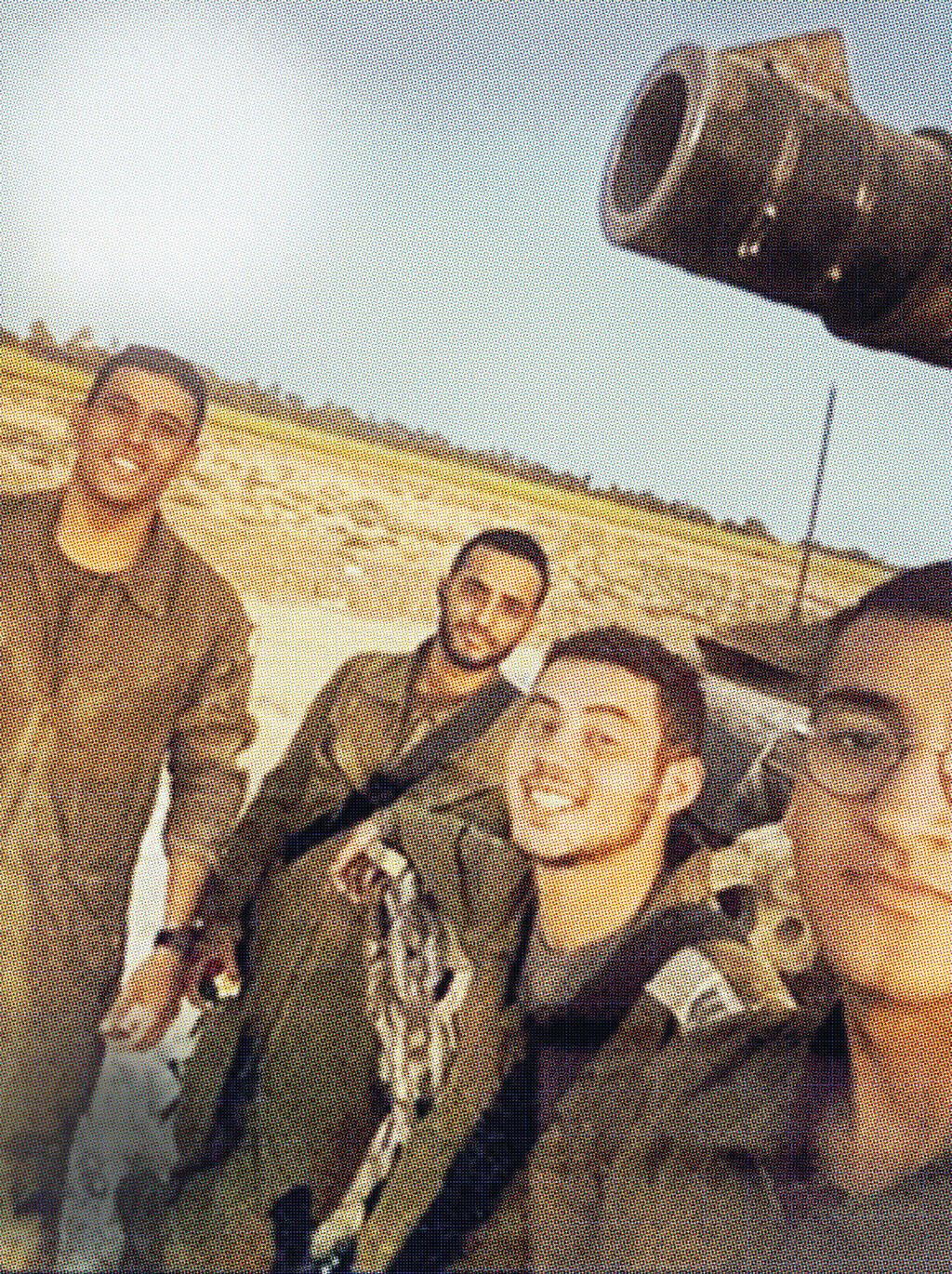
‘When a soldier is killed under my command, I failed.’ Tank 3 crew on the Gaza border. From right: the late Shaked Dahan, the late Omer Neutra, Nimrod Cohen and the late Oz Daniel
Asked whether, in hindsight, he would have changed his priorities and gone first to his soldiers rather than the communities, his answer is unequivocal.
“My first duty was to go to the kibbutzim. Even looking back, I would do the same thing. I would do everything to save the residents before myself.”
The four abducted soldiers remained with him when his company later entered Gaza.
“Every day, every hour, every mission,” he said. “No matter the level of risk, whenever there was even the slightest indication involving captives or missing people, we did everything, absolutely everything, to try to bring them back.”
Just over two weeks after Oct. 7, his company was back in combat.
“Those soldiers are the real heroes of Israel,” he said. “This was a company that had an entire platoon wiped out and half the company had gone through an enormous event, and yet they entered Gaza and fought there for more than a year.”
‘Oct. 7 is not my calling card’
For Zonshine, the war did not end on Oct. 7.
He continued fighting in Gaza for the following year. He later moved on to command the training of armored corps officers, fought alongside his cadets and in November 2025 began studying law.
Even then, the army called him back to combat. Along the way, he lost more soldiers.
Meetings with bereaved families were among the hardest moments.
“You arrive and lower your eyes because you come with this feeling of colossal failure,” he said. “My job as a company commander is to win the battles my commanders give me and bring my people home.”
“When a soldier is killed under my command, I failed. Going to a mother who raised her son for 21 years and telling her that he didn’t come home is very difficult.”
Counterintuitively, those meetings strengthened his decision to remain in the military.
“The message from the families, both of the hostages and of the fallen, was to keep moving forward and make sure their sons did not die for nothing,” he said. “Something in that continuing last will and testament directed me toward serving the State of Israel through the IDF.”
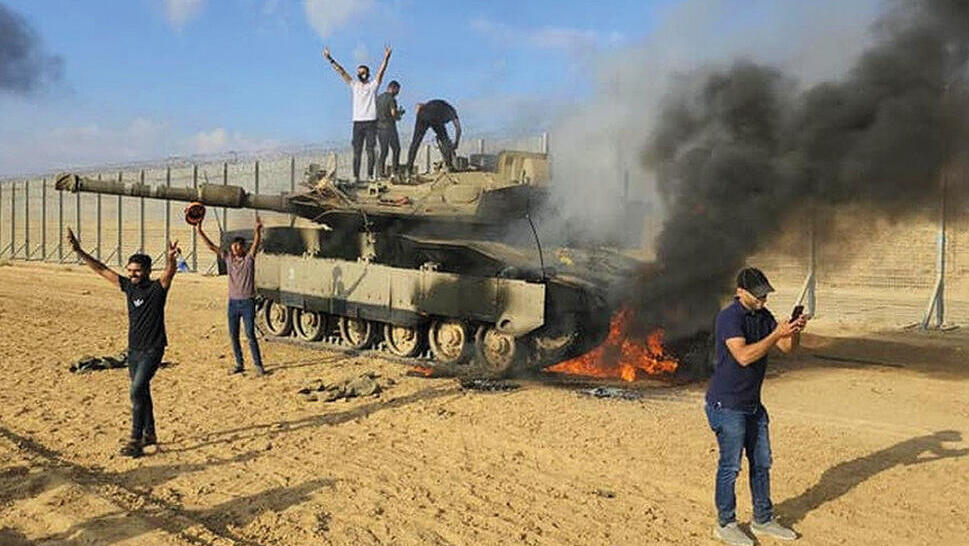
Tank 3 on the morning of Oct. 7
Zonshine was wounded twice during the war. On one occasion, he said, he woke up in intensive care.
Even then, the company was what occupied his thoughts.
“When you command people, you walk around with a nine-ton weight on your back, always,” he said. “All I could think about was getting back to the company. That was the only thing that mattered.”
“If there is a situation on the battlefield where I have to risk my life to save my soldiers, I will do it without thinking twice.”
Between rounds of fighting, Zonshine suddenly found himself somewhere that felt almost foreign: university.
“I was in shock,” he recalled. “I said, how does the average person wake up in the morning without being responsible for about 100 people running around them? At first it drove me crazy. Being responsible only for myself was almost too much for me.”
The ordinary problems of people his age look different now as well.
“It aged me an entire lifetime,” he said. “Sometimes I look at the problems people have, at the things that keep them awake, and I think it’s worlds apart. The car breaks down, things like that. For me, everything else has become smaller.”
But the change goes beyond perspective.
Over the past year, Zonshine has been in a relationship with Neta, who also serves in the military. They met at an army conference where he had been invited to speak about Oct. 7.
He saw her and approached her the old-fashioned way, face to face.
But he told her the full story of that day only months later.
“Oct. 7 is not my calling card,” he said.
“One of the things that changed is that you become a little more numb, and that shows in your emotions too. To go out and fight for such a long time, you put layer after layer of body armor over yourself, over your feelings and over your soul.”
“Only when I let that vest open did I feel it was right to speak to her openly.”
They are already talking about having a family.
Zonshine knows that if he remains on the path he has chosen, there will be a price: months away from home, field assignments and wars that cannot be planned.
When he describes the periods in which he is studying and seemingly living as a civilian, he uses an unexpected phrase.
“I feel like I’m dressing up as a civilian in my everyday life, because it isn’t real,” he said.
“Neta jokes that she wishes I would smile at her the way I smile when I put on a uniform and get the call to come back to the army. That’s my inner fire.”
Before Oct. 7, he wanted to become a mechanical engineer and travel through Alaska.
Today, the dreams have changed.
“Having a family has become one of the dreams of my life,” he said. “Another dream is that things will be better for us in this country.”
‘We must carry it like a warning sign’
Unlike others whose lives were overtaken by Oct. 7 and who have tried to find their way back to the people they were before it, Zonshine has little desire to return.
The three years since the massacre have bound him more closely to the army, to responsibility and to the day on which everything changed.
“God help us if I disconnect from that day,” he said. “We need to walk around with it like a warning sign above our heads.”
“This wasn’t some battle that went badly and you say, OK, we’ll investigate it, learn the lessons and move on. It has to be a milestone for us. That day cannot become something that belongs to the past.”
“We owe it to those people who were abducted and murdered that this day remains with us and serves as a compass, so we make sure something like this never happens again in the State of Israel.”
Perhaps that is why, when asked to picture himself three years from now, Zonshine does not talk about a degree, a civilian career or the trip he still has not taken.
“Probably in some trench beyond enemy lines,” he said, “making sure things are better here.”
And when the question turns from the officer to the 26-year-old underneath the uniform, another version of his future briefly appears.
“A family man who is probably more afraid of changing a diaper than confronting a terrorist.”