


The official letter sent by U.S. President Donald Trump to President Isaac Herzog, requesting a pardon for Prime Minister Benjamin Netanyahu, is not a game changer, even though it comes from the head of the world’s most powerful nation. Still, there is no doubt that Trump is increasing the pressure on Herzog.
This follows earlier moves, including social media posts, a public appeal during his speech to the Knesset and various media interviews. Still, that alone is unlikely to move the needle.
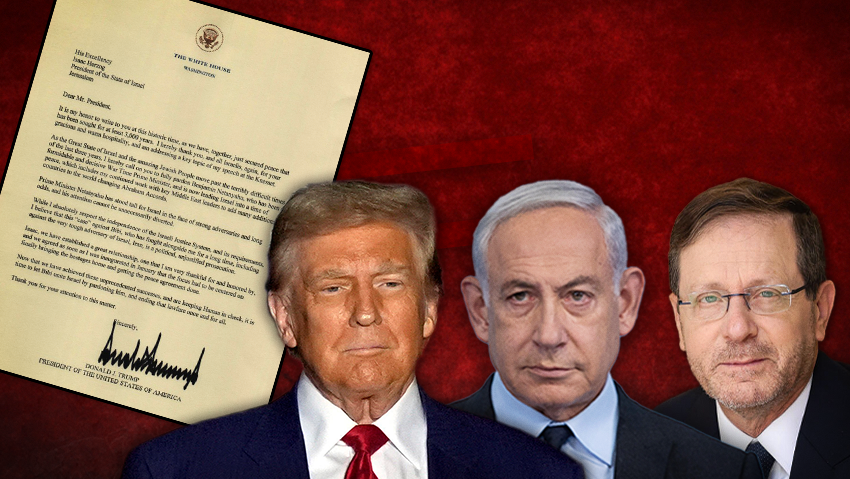
To formally initiate the pardon process, Netanyahu—through his attorney or a first-degree relative—must submit a personal letter to the president requesting clemency. Netanyahu himself has refrained from doing so, apparently out of concern that any admission of guilt or expression of remorse could harm his legal standing in court. The prime minister would prefer Herzog to grant the pardon “here and now,” even before a court decision is reached. Yet there is no apparent legal obstacle preventing, for instance, his wife Sara Netanyahu from submitting such a request on his behalf.
The president is required to base any decision on recommendations from the Justice Ministry and its Pardons Department. Since no plea deal has yet been reached in Netanyahu’s trial, it is likely that officials on Salah al-Din Street—where the ministry is headquartered—will oppose granting a pardon at such an early stage.
Some argue, however, that the precedent set in the Bus 300 affair works in Netanyahu’s favor.
In 1984, after two Palestinian terrorists who hijacked a bus were captured alive and later killed by Shin Bet agents, then-President Chaim Herzog (the current president’s father) granted a preemptive pardon to the intelligence agency’s top officials—before any investigation, and certainly before any indictments.
This is not a direct parallel, as Netanyahu has already been indicted and is currently on trial. Still, a precedent from over four decades ago may offer Netanyahu some legal maneuvering room: The Shin Bet officials at the time never admitted to the allegations against them. In their pardon request to President Herzog, they simply wrote that it had been “alleged” they had done certain things.
Likewise, Netanyahu could, in theory, avoid admitting guilt, stating instead that certain actions have been alleged against him—without expressing remorse or taking responsibility. Whether that would be enough remains uncertain.
Trump requests Herzog pardon Netanyahu during Knesset address, last month
(Video: Knesset Channel)


Unlike in the Bus 300 affair, Netanyahu has yet to make any request of the president. Legally, a defendant is not required to accept responsibility for the charges or express remorse in order to receive a pardon. But he must at least request one.
If Netanyahu or a first-degree relative submits a clemency request to Herzog, the president would be required to pass it to the Justice Ministry’s Pardons Department, which would weigh the state’s position—namely, that of Attorney General Gali Baharav-Miara.
Approval would then require the signature of the justice minister. In this case, Justice Minister Yariv Levin would need to recuse himself, since he is a prosecution witness in Netanyahu’s trial. Still, even if the Pardons Department were to oppose granting clemency—given the lack of a plea deal and Netanyahu’s refusal to show remorse—some legal opinions suggest Herzog may have the authority to pardon under exceptional circumstances.
At that point, Herzog would face a major dilemma: whether to extend a pardon without a recommendation from the Justice Ministry. Such a decision would likely bring immense pressure from Trump and Netanyahu’s political base. On the other hand, Herzog could also face strong public backlash, particularly from those opposed to Netanyahu.
Many Israelis are firmly against the idea of a pardon, and Herzog would need to consider how such a decision might shape his legacy.
In general, it is virtually unprecedented for someone to seek a presidential pardon while still on trial. Into that legal vacuum steps Trump’s appeal. While his request carries no legal weight, it is politically significant. The question now: Can the president of Israel afford to ignore such a pointed appeal from a U.S. president?
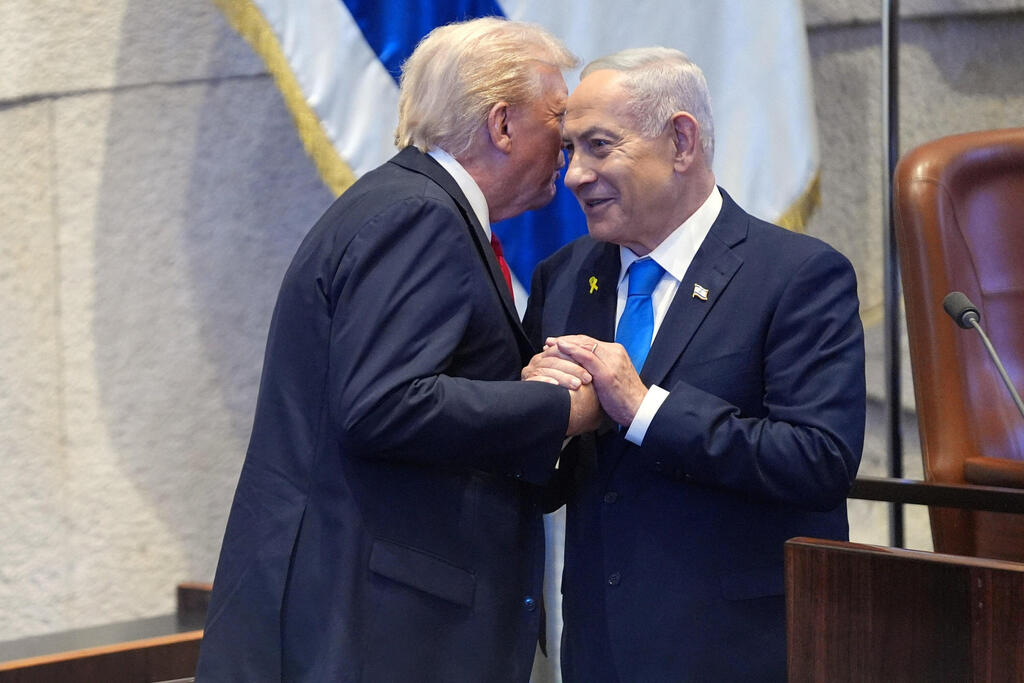
Trump and Netanyahu in the Knesset
(Photo: JALAA MAREY/Pool via REUTERS, Chip Somodevilla / POOL / AFP)
Herzog will also need to consider how he will be remembered if he grants Netanyahu a pardon before any plea deal is reached. He has previously described his current term as the most difficult ever faced by an Israeli president. There is no doubt that this political hot potato now sits squarely on his desk, and any decision he makes will likely be the most consequential of his seven-year tenure.
From Herzog’s perspective, the preferred path would be for Netanyahu to reach a plea deal that includes an admission of guilt. That scenario would make it significantly easier for the president to consider a pardon.
In such a case, other factors could come into play: Netanyahu’s long-standing contributions to Israel’s security, Trump’s request, the potential for future regional peace agreements and more. The key question, however, would be whether Netanyahu agrees to retire from political life. If it becomes clear that he intends to stay in office and is merely seeking a pardon to clear his name, that would undoubtedly complicate matters for Herzog.
Herzog has said in the past he would support a pardon framework that brings national and political reconciliation, but also one that includes agreements on judicial reform. Ultimately, it appears Herzog does have the authority to grant Netanyahu a pardon, but to get there, the prime minister himself—or a first-degree relative—must formally request it.
‘Trump is absolutely right’
In an interview with Australian journalist Erin Molan—a consistent supporter of Israel, particularly during the war in Gaza—Netanyahu addressed the issue of a possible pardon.
“I’ll think about it,” Netanyahu said, “but I’m very grateful to President Trump for being so forthright—he just cuts to the chase. He tells it like it is. This trial is so absurd. I spend three days a week—can you imagine this?—running a war and now seeking to expand the peace.”
He added: “I spend three days a week in a court talking about why my son Yair, when he was five years old, received a Bugs Bunny doll—that's a terrible bribe. Or how I received some cigars from a friend. The whole thing is ridiculous—it's falling apart. The mainstream media stopped covering it because it’s so embarrassing for the prosecution. President Trump basically called it a ‘politicized' and 'unjust witch hunt,’ which it is. The important thing is that I think it hurts both American and Israeli interests, which is also what he said. He said that my time has to be free to pursue the things that will determine Israel’s future and the future of peace in the Middle East. It’s absurd, and these absurdities should end.”
Asked whether accepting a pardon would amount to an admission of guilt, Netanyahu replied: “That’s not going to happen. Nobody suggests that that's what I’ll do, and I certainly won't do that. That's not going to happen.”