

A senior U.S. official told the American news site Axios on Sunday evening that the United States and Iran have agreed to stop attacking each other and to meet Tuesday in Doha, the capital of Qatar, to resolve disputes related to the Strait of Hormuz.
The talks scheduled for Tuesday were originally supposed to take place Sunday and Monday in Switzerland, but according to the report, they were moved to Doha following the escalation and will now focus on the Strait of Hormuz instead of Iran’s nuclear program. Jack Stewart, who heads the U.S. technical team, is expected to take part in the talks.
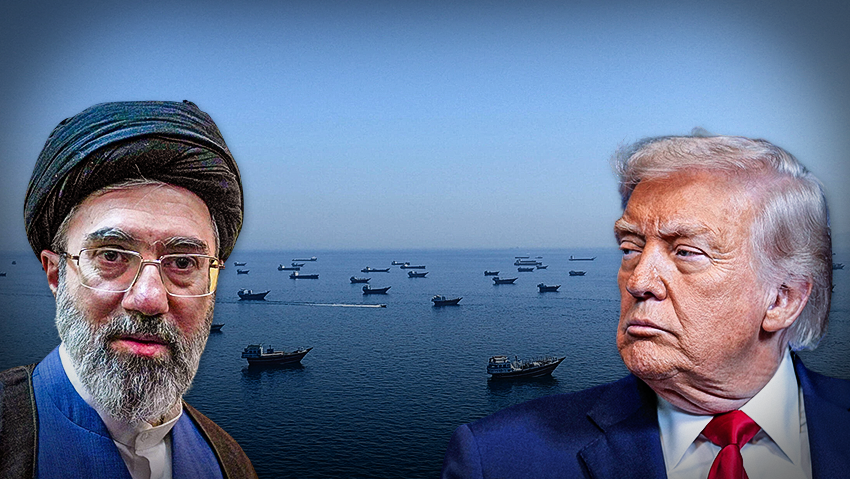
(Photo: Hamed Jafarnejad/ISNA/WANA (West Asia News Agency) via REUTERS, AP/Alex Brandon, REUTERS/Stringer)
Earlier Sunday, Iran announced a “freeze” in talks with the U.S. following the latest escalation, which began after Iran attacked vessels in the Gulf and the U.S. responded with two nights of strikes on targets inside Iran. At the center of the escalation is a dispute over the interpretation of a memorandum of understanding between the U.S. and Iran: According to a Wall Street Journal report, Iranian Foreign Minister Abbas Araghchi said that under the agreement, responsibility for managing traffic in the Strait of Hormuz belongs exclusively to Tehran. “No other country or body has responsibility or authority in this matter,” he said, according to Iranian state media.
The U.S. rejects Iran’s interpretation, arguing that the agreement does not give Tehran control of the strait and that navigation along the international route must continue without disruption. According to the report, the agreement does place responsibility on Iran to work toward safely reopening the strait and allowing commercial ships to pass, but it also states that military obstacles must be removed and that maritime traffic is supposed to resume immediately.
In practice, the dispute over those clauses has become the focus of confrontation in recent days: Iran attacked a ship that tried to pass near the coast of Oman in an attempt to bypass the route Tehran is seeking to impose near its shores, while the U.S. responded with strikes against Iranian communications sites, drones and missiles along the shores of the strait.
The U.S. military struck 10 military targets in Iran overnight, the second night in a row, following what it described as “continued Iranian aggression against commercial vessels” in the Strait of Hormuz area. U.S. Central Command said Iranian forces launched a drone that hit a tanker carrying more than 2 million barrels of crude oil, and that the U.S. strikes targeted, among other things, surveillance infrastructure, communications systems, air defense sites, drone facilities and mine-laying capabilities.
Iran rejected the U.S. claims, accused Washington of violating understandings between the sides and responded with strikes on U.S. bases in Bahrain and Kuwait. The Revolutionary Guards threatened that U.S. bases in the region would “experience hell,” and warned that vessels violating the instructions in the Strait of Hormuz would “from now on be dealt with with greater force.”
Now, it appears the sides have ended another round of escalation by agreeing to return to discussions on the Strait of Hormuz — a problem that has yet to be resolved. Iran insists that as part of any final agreement, it will collect transit fees in the strait area, a demand the U.S. firmly opposes.