

The collapse of the Gaza ceasefire, three months after the end of the war, has in recent weeks become a realistic scenario being considered by the Israel Defense Forces. This follows repeated Hamas violations, growing confrontations with Israeli troops, renewed military buildup and the terror group’s refusal to return the body of hostage Ran Gvili.
Above all, however, senior IDF officials are voicing firm opposition to any renewed involvement by Qatar, Hamas’ primary financial backer and a patron of the Muslim Brotherhood-linked terrorist organization, in Gaza’s reconstruction.
Gallery
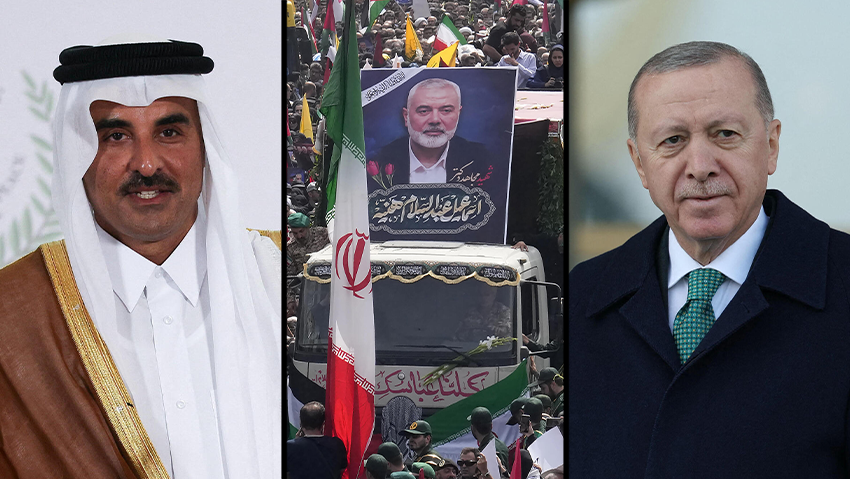
Qatar’s emir Tamim bin Hamad Al Thani, Ismail Haniyeh’s funeral , Erdogan
(Photo: AFP/ TURKISH PRESIDENTIAL PRESS SERVICE / AP /Vahid Salemi, Suzanne Plunkett/ Reuters)
The expanding footprint in Gaza of two powerful states tied to the Muslim Brotherhood, Turkey and Qatar, did not surprise senior security officials who were closely involved in recent months in negotiations over ending the war. Political leaders in Israel were aware that Qatar’s entry into a long-term reconstruction process was accepted by the United States as a condition for ending the war and securing the return of hostages.
This reality is compounded by the makeup of the new Palestinian governing body for Gaza. Of its 15 members, the vast majority are affiliated with the PLO, with a small number identified as having ties to Hamas itself.
“These developments were known to everyone in Israel. There is no surprise in the U.S. announcements of recent days. Israel agreed to this, at least implicitly,” security officials said.
While a Palestinian Authority-led administration in Gaza is viewed by senior IDF officials as an acceptable option in the absence of any alternative, provided Hamas is not formally in control, there is no compromise when it comes to Qatar, according to recommendations from the defense establishment.
The people set to run Gaza
In closed-door discussions over recent months, IDF officials have repeatedly stressed that Hamas became a terrorist monster by October 7 largely due to hundreds of millions of dollars in Qatari cash that Israel allowed into Gaza in the years preceding the attack.
From this perspective, Gaza became an attractive investment for the Muslim Brotherhood movement as early as the reconstruction years following Operation Protective Edge in 2014.
“For every kilogram of cement that built the Qatari neighborhood in Khan Younis about a decade ago, three kilograms of concrete went into Hamas’ terror tunnels,” IDF officials recalled, describing the issue as a red line.
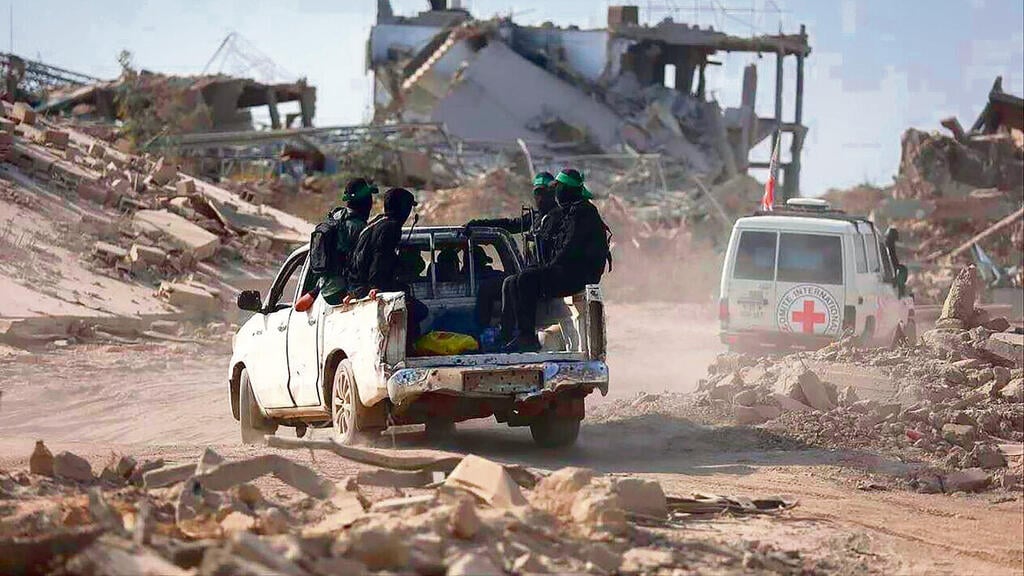
Hamas terrorists in Gaza
“This simply must not happen again,” they said. “In the end, the money will be diverted to strengthening Hamas, even if it initially serves civilian purposes. That will help preserve Hamas’ de facto rule in Gaza.”
Security officials pointed to alternative options, including fundraising from donor states, establishing aid funds, using World Bank mechanisms or enlisting the United Arab Emirates to contribute similar sums.
At the U.S. coordination headquarters in Kiryat Gat, which oversees implementation of the Hamas agreement and Gaza reconstruction, officials are not slowing down. Concrete plans are already being advanced to build housing for Gazans, initially on the Israeli side of the so-called Yellow Line, and to increase oversight and control over the roughly 800 aid trucks entering Gaza daily.
According to Israeli estimates, those shipments generate tens of millions of shekels for Hamas due to the double taxation imposed by the terrorist organization.
Hamas regroups on the ground
The IDF has emphasized that plans for Operation Gideon’s Chariots II remain on the table, despite political leaders approving a relatively calm stabilization year, without initiating renewed ground fighting that would require the unplanned mobilization of hundreds of thousands of reservists beyond their scheduled annual deployment.
Some in the IDF describe the current situation as a political trap that erodes, week by week, the gains achieved by Israeli forces after nearly two years of sustained ground maneuvering that significantly degraded Hamas.
That trap is also evident on the ground. Hamas has grown increasingly bold, not only by violating its commitment to return all hostages under the first phase of the ceasefire agreement, but also by firing at Israeli troops in Gaza with increasing frequency.
Although the IDF has not yet withdrawn from the Yellow Line and Israel has not opened the Rafah crossing in both directions, the current stalemate serves Hamas alone.
As revealed by ynet in recent weeks, this includes economic enrichment, salary increases for tens of thousands of Hamas operatives and officials across Gaza, a return to rocket production and even planning for a future October 7-style attack, albeit in a different form.
The IDF said late Wednesday that intelligence authorization had been granted for airstrikes carried out last Thursday against senior operatives from Hamas and Palestinian Islamic Jihad units that were largely intact after the war.
Among those killed was Muhammad Khuli, head of operations in Hamas’ Central Camps Brigade. Also killed were Ashraf al-Khatib, commander of Palestinian Islamic Jihad’s rocket and missile array in the Central Camps Brigade, and Saeed al-Rahman, identified by the IDF and Shin Bet as a Hamas sniper commander in the Deir al-Balah area.
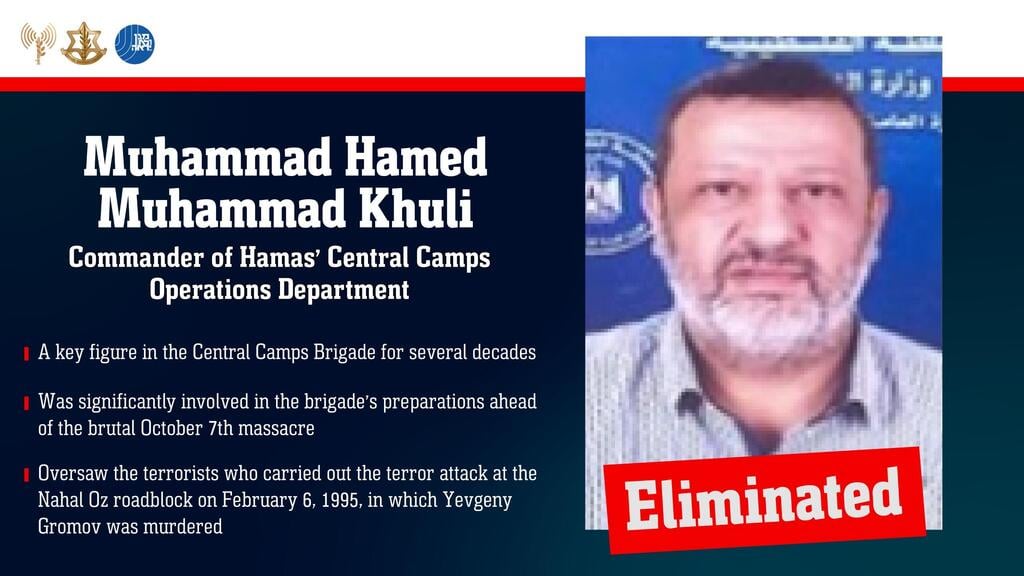
Muhammed Khuli
(Illustration: IDF)
The strikes followed an attempted attack earlier in the week, when six Hamas terrorists were sent toward IDF defensive positions along the Yellow Line inside Gaza. Israeli forces responded with tank fire and airstrikes, killing all six terrorists. Two Israeli soldiers were lightly wounded by shrapnel during the incident, according to the military.
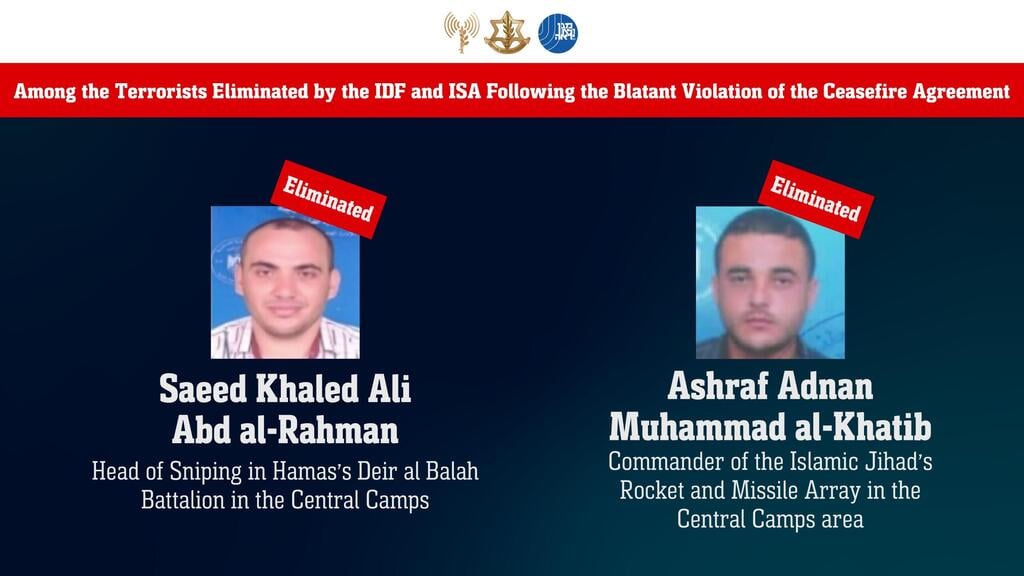
Two terrorists eliminated alongside Khuli
(Illustration: IDF)
At the same time, officials noted that the IDF statement should also be read in reverse: how these senior operatives, like many others in Hamas and Islamic Jihad, survived the war and in recent months, took part in rebuilding the group’s military capabilities and advancing new attack frameworks against Israeli forces.
On the ground, the defense of the Gaza sector continues to fall primarily on reservists. In recent days, the Alexandroni Brigade has replaced the Jerusalem Brigade, whose fighters had guarded the Yellow Line in central and northern Gaza in recent months.
The Jerusalem Brigade played a central role in the race against time ahead of a potential IDF withdrawal from the Yellow Line if a long-term second phase of the agreement with Hamas is implemented. Together with Yahalom engineering unit forces, the brigade uncovered hundreds of terrorist infrastructures, both above and below ground, including shafts, tunnels and large quantities of weapons that remain hidden on the Israeli side of the Yellow Line, according to the IDF.