

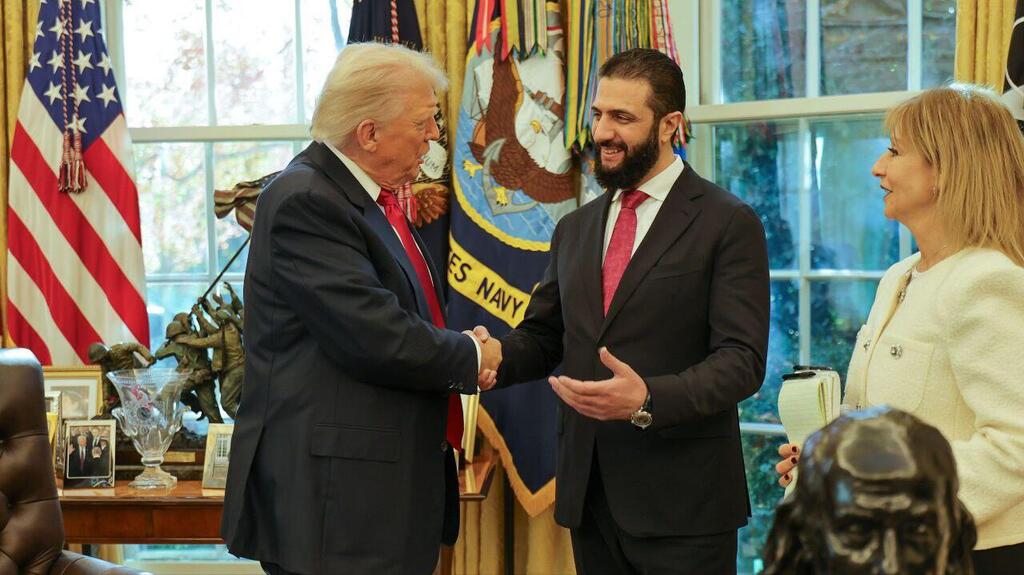
After meeting Monday at the White House with U.S. President Donald Trump, Syrian President Ahmad al‑Sharaa said overnight that his country will not enter direct negotiations with Israel at this time over joining the Abraham Accords. However, he did not rule out the possibility of such talks later, perhaps with U.S. assistance.
Al‑Sharaa told U.S. media that “the situation in Syria is different from the situation of the countries who signed on to the Abraham Accords. Syria has borders with Israel, and Israel occupies the Golan Heights since 1967,” he said. He added: “We are not going to enter into negotiation directly right now. Maybe the United States administration with President Trump will help us reach this kind of negotiation.”
Trump meets Syria's al-Sharaa in the Oval Office
(Video: Fox News)


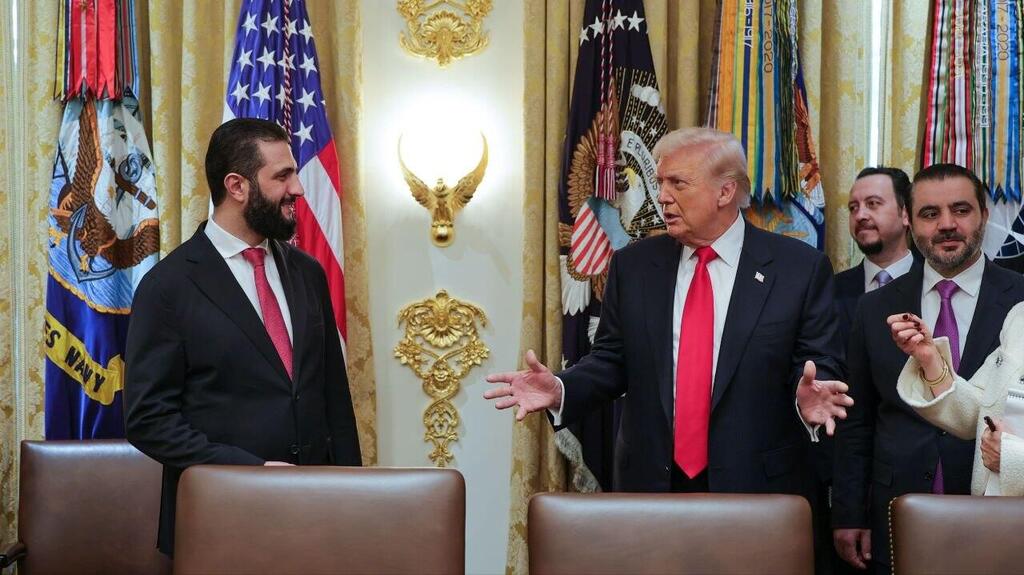
At the summit at the White House, the two leaders discussed several key issues now on the agenda — primarily U.S.‑mediated security arrangements between Israel and Syria that are aimed at regulating the border situation after Israeli forces took control of areas of the Syrian Golan following the overthrow of the regime of Bashar Assad. A recent Reuters report said Washington is preparing to establish a military base in the Damascus region to oversee implementation of the deal, and is pushing for approval by year’s end.
The meeting marked an unusual milestone: it was the first time a Syrian leader has visited the White House since Syria’s independence in 1946, and al‑Sharaa’s past as a jihadist — once affiliated with Al Qaeda — stood in sharp contrast to his new posture toward the West.
In the Fox News interview, al‑Sharaa was asked whether Trump raised his extremist background; he said he was not asked. “I think that’s a matter of the past. We didn’t in fact talk about it. We spoke about the present and the future,” he said. When asked whether he regretted the fact that Al Qaeda carried out attacks that killed 3,000 Americans, al‑Sharaa replied: “I was only 19 years old. I was very young, and I had no authority to make decisions at that time, and I had no connection to it. We mourn every civilian killed. We know people suffer from war, especially civilians who pay the price again and again.”
Al‑Sharaa said his talks at the White House lasted nearly two hours and described them as “amazing.” He reported that President Trump gave him a “MAGA” (Make America Great Again) cap, and said he intends to take it back to Syria.
In advance of the meeting, the United States led a U.N. Security Council resolution to lift international sanctions on al‑Sharaa, and also removed him from its global terrorist list, after it had already removed a $10 million reward on his head last year. “We talked about removing sanctions — there was a decision in the U.N. Security Council to remove sanctions from me and others,” he said. “We also discussed future investment possibilities in Syria so that it will no longer look like a security threat. Today Syria is seen as a geopolitical ally, a place where the U.S. can make substantial investments, especially in gas production.”
He said: “For the past sixty years, Syria has been isolated from the rest of the world, with relations severed between Damascus and Washington. This is the first time a Syrian president has visited the White House since Syria’s founding in the 1940s. After the fall of the former regime, Syria entered a new era, particularly in its relationship with the U.S. During my meeting with Trump, we discussed both the present and the future, including investment opportunities in Syria. The goal is for Syria to no longer be seen as a security threat but as a geopolitical ally and a country where the U.S. can invest significantly, especially in gas extraction.”
He also said he will do everything he can to help in the search for missing U.S. journalist Austin Tice, who disappeared in Damascus in 2012, and that he has been in contact with his mother.
Al‑Sharaa also discussed Assad, whose regime was toppled last year by jihad‑led rebels. “Russia took part, one way or another, in the war against the Syrian people,” he said. “Part of the agreements made with Syria is that those wanted will be extradited, including Bashar Assad. The Russians have a different view. Even so, justice must be done. We established a traditional justice commission so that all will bear responsibility for their acts, including Bashar Assad.”
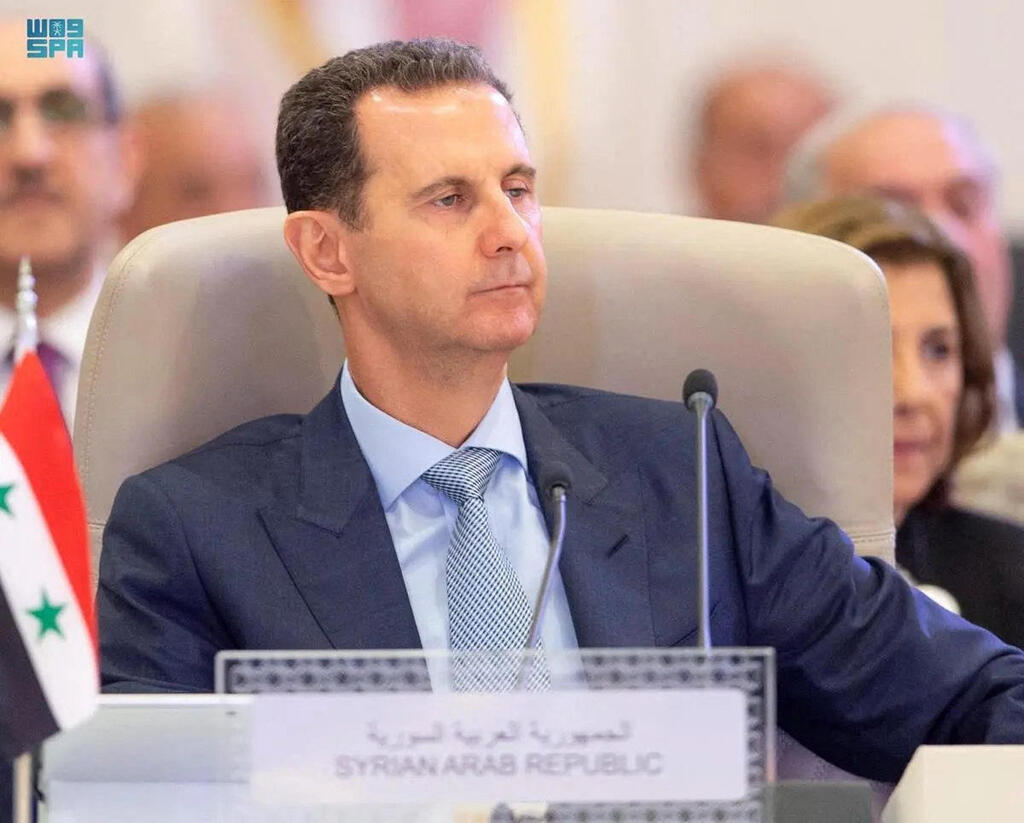
Bashar Assad
(Photo: Reuters)
President Trump commented on the meeting on his social network Truth Social: “It was an Honor to spend time with Ahmed Hussein al-Sharaa, the new President of Syria, where we discussed all the intricacies of PEACE in the Middle East, of which he is a major advocate. I look forward to meeting and speaking again. Everyone is talking about the Great Miracle that is taking place in the Middle East. Having a stable and successful Syria is very important to all countries in the Region.”
Syrian Information Minister Hamza al‑Mustafa announced after the meeting that Syria recently signed a political cooperation statement with the international coalition to defeat Islamic State of Iraq and the Levant (ISIL). “The agreement with the coalition does not include military clauses at this stage, Syria is participating in the fight against terrorism and in support of regional stability,” he said. A U.S. official confirmed to the French news agency AFP that “Syria will thus become the 90th member of the coalition against ISIL, and will join forces with the United States to eradicate its last strongholds and end the ‘flow’ of foreign fighters.”
In the interview, al‑Sharaa said: “We have taken part in many, many battles against ISIL over a period of 10 years. We suffered greatly in those battles, and I lost a large part of my forces. There are reasons for the U.S. military presence in Syria, and that presence now needs to be coordinated with the Syrian government.”
The information minister also announced that Washington has officially declared the reopening of the Syrian embassy after more than a decade, and a U.S. official confirmed: “The United States will approve Syria renewing its embassy activity in Washington in order to strengthen coordination on terrorism, security and economy.” He added that President Trump supports a possible security agreement with Israel “to strengthen national and regional stability.”
Al‑Shraa – aged 43 – is a former member of Al Qaeda who was born in Saudi Arabia to a father from the Golan Heights, which earned him the nickname “Abu Mohammed al‐Golani.” Although world leaders have appeared willing to engage, and embassies have reopened in Damascus and sanctions on him and Syria have been lifted, many remain skeptical of his credibility.
Concerns about the fate of minorities in Syria have risen after the March massacre of the Alawite minority — from which the Assad family originates — where more than 1,000 people were reportedly killed. In July, clashes broke out in the Druze‑majority Suwayda province, where hundreds of Druze were reportedly massacred. Al‑Sharaa condemned those massacres and ordered investigations to hold perpetrators accountable.