

U.S. President Donald Trump said a deal to reopen the Strait of Hormuz could be announced as early as Wednesday or Thursday, as Iran and Oman moved closer to an agreement over the critical waterway.
Asked Tuesday evening in California about reports that an announcement could come Wednesday, Trump said: “It could happen. Tomorrow or the next day. A lot of progress has been made.”
Trump sets deadline for deal with Iran


Oil prices eased on hopes that an agreement would allow tankers to leave the Persian Gulf freely and resume delivering crude around the world. Brent crude, the international benchmark, fell 1.2% to $78.43 a barrel early Wednesday.
Two regional officials told The Associated Press that the emerging proposal would establish separate shipping routes controlled by Iran and Oman. Ships would enter the Persian Gulf through an Iranian-controlled route and leave through one controlled by Oman.
Service fees would be charged for providing security and protecting the maritime environment, the officials said. They spoke on condition of anonymity because negotiations remain sensitive.
The Trump administration has rejected any arrangement granting Iran control over the strait, which operated as an open international waterway before the United States and Israel attacked Iran on Feb. 28.
Before the war, about one-fifth of the world’s oil and natural gas passed through Hormuz. Shipping has since been reduced to a trickle amid repeated Iranian attacks.
Trump reiterated Monday that he opposed allowing Iran to charge vessels using the waterway.
“I’m not going to let them charge,” he said. “Anybody’s going to charge, we’ll charge.”
The regional officials cautioned that negotiations were continuing and that the final agreement could take a different form. Any deal could also be linked to lifting the U.S. blockade on Iranian ports.
Iranian Foreign Ministry spokesman Esmail Baghaei said Tehran’s talks with Oman focused on “establishing safe inbound and outbound shipping lanes.”
The routes would “uphold sovereign rights while also addressing the national security considerations of both Iran and Oman,” he said.
“The final results of these negotiations will be announced once concluded,” Baghaei added, according to Iran’s state-run IRNA news agency.
U.S. Secretary of State Marco Rubio confirmed that progress had been made, “but not finality yet.”
Rubio has previously opposed any deal giving Iran control over Hormuz, warning that it would create a “very dangerous precedent” for other strategic waterways.
U.S. Treasury Secretary Scott Bessent also expressed optimism.
“There is a chance we may have a deal today or tomorrow to open the strait and move towards a more normalized position in this conflict,” he told CNBC.
Qatar has joined regional efforts to broker an end to the war. Emir Sheikh Tamim bin Hamad Al Thani spoke to Trump by phone Tuesday about efforts to bridge the remaining gaps.
The two discussed ways to narrow the divide “in a way that enhances the prospects of reaching a sustainable diplomatic settlement to the crisis,” the emir’s office said.
Trump is facing growing pressure to end a war that has driven up fuel prices ahead of the U.S. midterm elections and depleted American stocks of some munitions.
In recent days, he has alternated between threatening major new strikes and supporting diplomatic efforts.
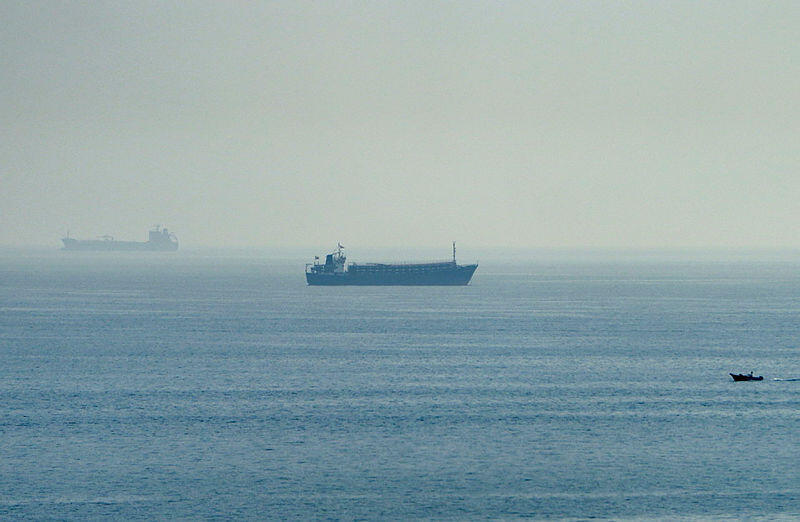
Strait of Hormuz
(Photo: REUTERS/Stringer)
Trump said Monday that Washington was negotiating with Tehran and described the talks as Iran’s “last chance” to avoid another U.S. military escalation.
“The first phase is the opening of the straits. The second phase will be the denuclearization,” he said. “And that will take a little while.”
Iran denies that it is negotiating with Washington and insists its talks are solely with Oman.
The diplomatic push continued as commercial vessels faced renewed attacks in regional waterways.
An Indian-flagged ship sank Tuesday in the Red Sea off Yemen after being struck by an explosive-laden boat, Yemeni and Indian authorities said. Yemen’s coast guard rescued the crew, including 13 Indians and one Yemeni.
There was no immediate claim of responsibility, though Yemen’s Iran-backed Houthi terrorists have repeatedly attacked ships traveling through the Red Sea.
Earlier Tuesday, a cargo ship reported being struck by an “unknown projectile” while passing through the Strait of Hormuz, according to the United Kingdom Maritime Trade Operations center.
The vessel was damaged at about 2 a.m. local time, around 37 kilometers northeast of the Omani port city of Khasab. British maritime security firm Ambrey also confirmed that it sustained damage.
First published: 07:14, 08.05.26