

Early on the morning of Oct. 4, 1950, before 6:45 a.m., Reuven Dafni and his wife left their room at San Francisco’s Fairmont Hotel. The room number, 753, was recorded in an FBI report. So were details of the couple’s flight to Los Angeles: Western Airlines Flight 301, scheduled to depart at 8:30 a.m. The airline would later become part of Delta Air Lines.
FBI agents wanted to know who had booked the room, where the bill was sent and whether any outgoing telephone calls had been made from it. The hotel manager was asked to check the records and reported that no outgoing calls had been placed on the dates in question.
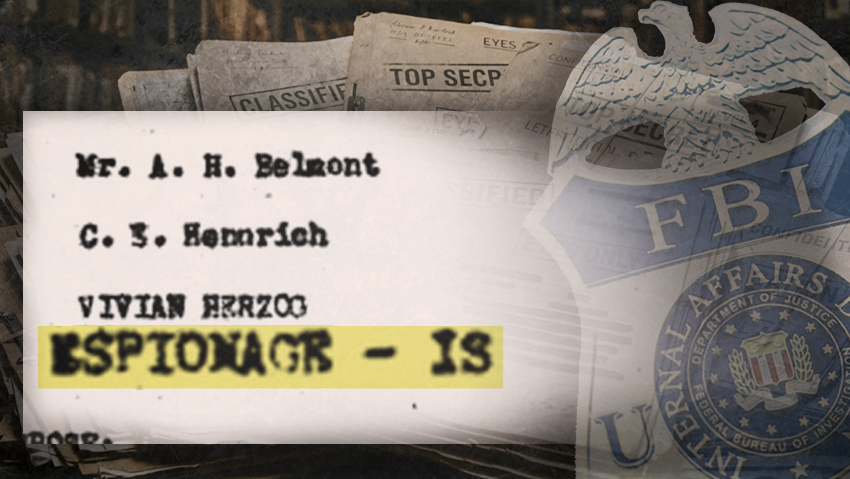
Dafni, Israel’s consul in Los Angeles, was a familiar figure in the U.S. Jewish community. During World War II, he served in the British Army, parachuted into occupied Yugoslavia and operated alongside partisan forces. He later became a representative of the young State of Israel in the United States. His visit to San Francisco was hardly secret: The Jewish public had been invited to hear him lecture on Israel’s place in the world. The hotel bill was to be sent to the Jewish organization hosting him. Nevertheless, details of the visit, the flight reservation and the inquiry into his telephone calls all entered a report classified “Espionage, Israel.”
Dafni was only one of dozens of Israelis and American Jews whose names appeared in FBI investigative file 65-58700, maintained under the designation ISINT, short for Israeli Intelligence Service. The documents mention Chaim Herzog and Teddy Kollek, diplomats and procurement officials, Zionist activists, businesspeople, journalists and office secretaries. They contain surveillance instructions, checks of money transfers, suspicions of leaked government information and numerous inquiries that ultimately turned up nothing.
The documents obtained by ynet are part of a collection recently released under the U.S. Freedom of Information Act. The request for the investigative file was submitted in March 2014 by the U.S.-based Institute for Research Middle Eastern Policy, or IRmep, which examines, among other issues, the activities of the pro-Israel lobby in the United States. The FBI initially demanded hundreds of dollars in fees, warned that processing could take years and, in 2018, tried to reach an agreement to narrow the scope of the material. The applicants insisted on receiving the entire file.
Only in June 2026, more than 12 years after the request was filed, did the FBI begin releasing documents. Additional batches arrived in July and August, and the complete collection was delivered at the end of October. Many names and entire passages remain redacted, but even the material that has been made public offers an extraordinary picture of how the U.S. government viewed Israel during the young state’s early years.
Who leaked to the Zionists?
The suspicions in the file went well beyond hotel expenses or diplomats’ travel arrangements. By July 1949, when Israel was barely a year old, senior FBI officials were already corresponding about suspected transfers of U.S. documents to “Zionist” figures who were not supposed to possess them. A memorandum sent to FBI Director J. Edgar Hoover said that, if the suspicions proved true, the acts could constitute violations of U.S. espionage law. Hoover, who dominated the FBI for nearly half a century, was one of the most powerful and feared figures in Washington. Even U.S. presidents were wary of crossing him.
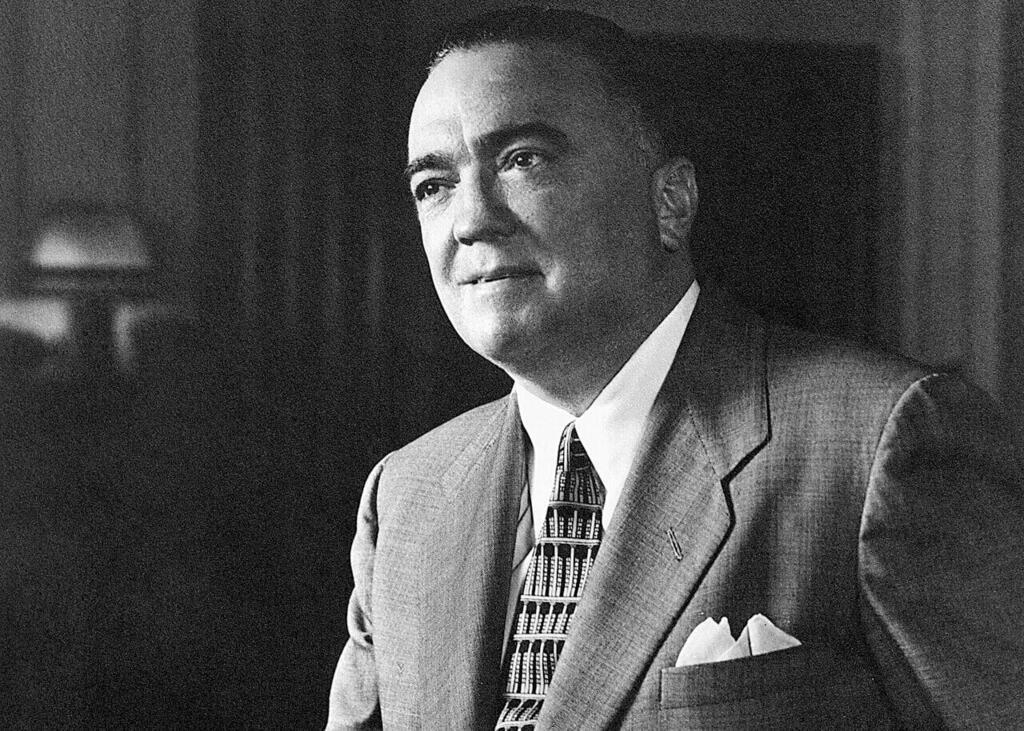
Former FBI Director J. Edgar Hoover in 1959
(Photo: FBI)
The suspicion was part of an investigation the FBI sought to keep under its own control. A July 20, 1949, memorandum said a State Department representative had been told explicitly that “the entire case will be handled by the Bureau, and no interference by other investigative agencies will be tolerated.” The representative assured the FBI that the message had been understood.
The precise purpose of some inquiries remains redacted, but by November 1950 a more concrete line of investigation had emerged. In an internal memorandum, investigators reported that a person in Washington, whose name is blacked out, had quoted precisely from five reports prepared by U.S. air attachés. Because he repeated their contents word for word, FBI officials concluded that he probably possessed copies. They now wanted to determine how he had obtained them.
To find out, the FBI began checking which U.S. government bodies had received copies of the reports. Investigators found that they had been distributed to the State Department, Army and Navy, as well as six Air Force bodies, including Strategic Air Command. Each was asked to determine whether all copies it had received were still accounted for, in an effort to identify the possible source of the leak.
Special approval to investigate a future president
On May 8, 1950, a week before Chaim Herzog arrived in the United States, the FBI had already prepared a memorandum on him. At the top of the page appeared his English name, “VIVIAN HERZOG,” followed by the classification “Espionage, Israel.”
The purpose of the memorandum was to obtain State Department approval for a “discreet investigation” of the Israeli officer as soon as he arrived. Herzog, then 31, had been sent to Washington as Israel’s new military attaché. In the preceding years, he had been among the key figures involved in establishing Israeli military intelligence and had also headed it.
On May 15, the Queen Elizabeth arrived in New York with Herzog among its passengers. FBI agents were waiting. They recorded his arrival time, details of his diplomatic passport and his destination: the Israeli Embassy in Washington.
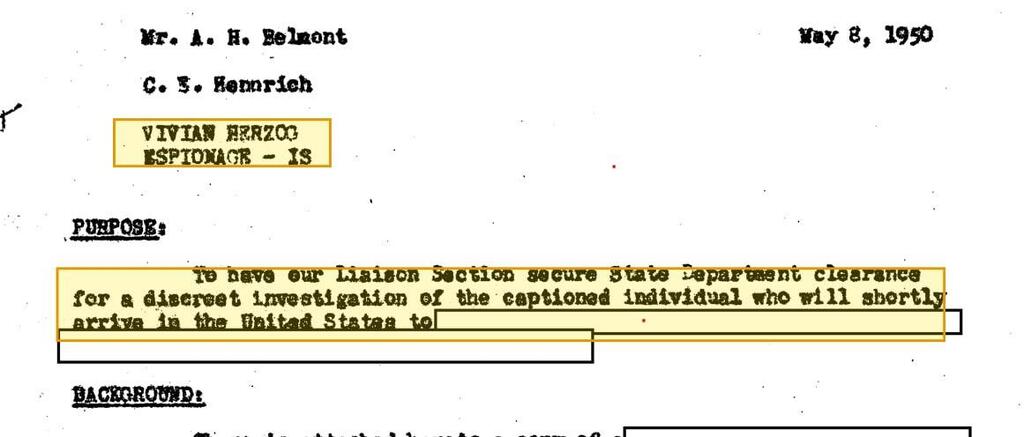
'Vivian Herzog. Espionage - Israel'; from the documents
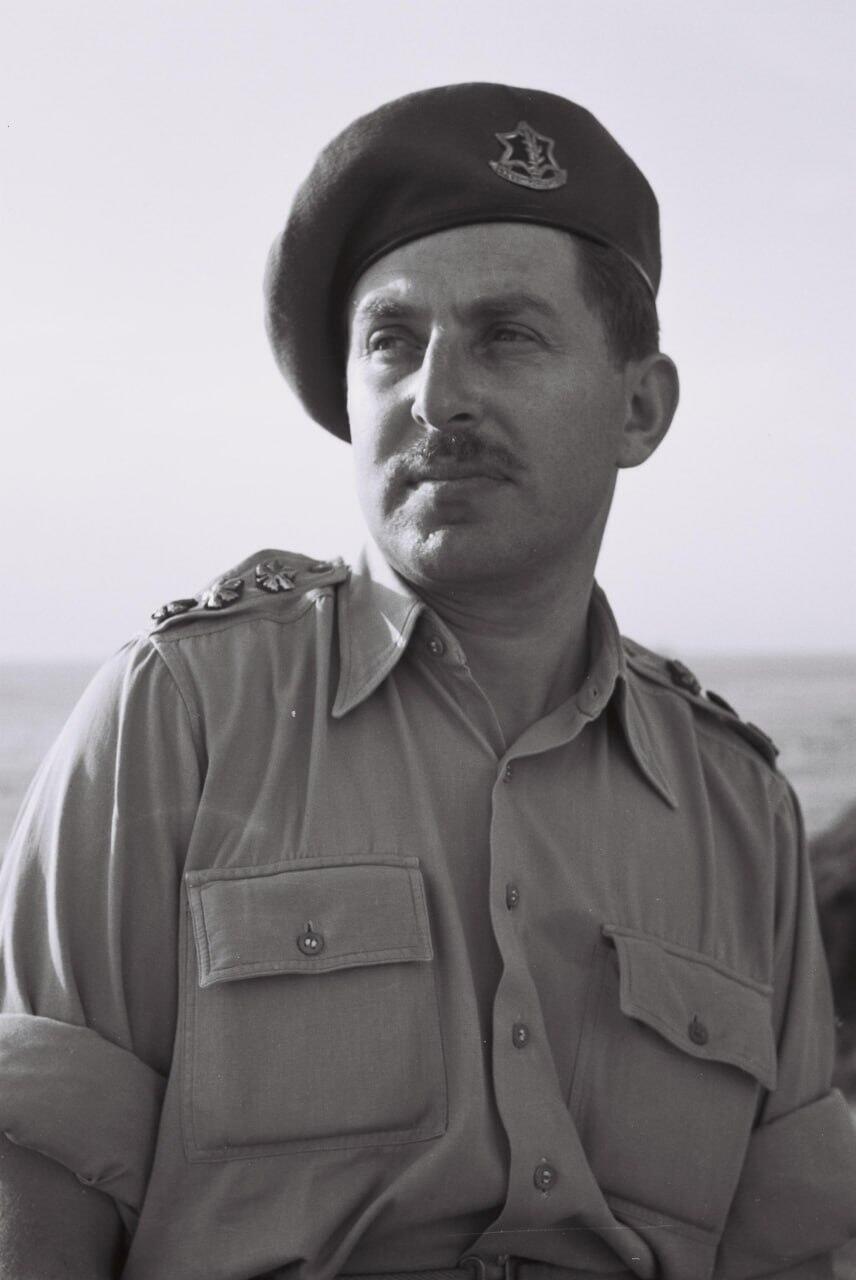
Chaim Herzog during his tenure as military attaché; agents were waiting for him
(Photo: Fritz Cohen, GPO, National Photo Collection)
It was not the only time U.S. authorities would become suspicious of Herzog. In 1986, at the height of the Jonathan Pollard affair, The Washington Post quoted a U.S. intelligence officer as saying Herzog had tried to recruit a Jordanian military officer stationed in Washington and had left the United States after learning that the FBI had uncovered his activities. Herzog strongly denied the allegations and stressed that he had completed his assignment normally and honorably.
The 1950 memorandum documents the FBI’s interest in Herzog even before he arrived in the United States to begin his posting. The reason for requesting the investigation is not stated in the unredacted sections.
Herzog was not alone. On March 23, 1950, about two months before Herzog’s arrival, Hoover reported that the State Department had already approved a discreet investigation of Gideon Rafael, who would later become director-general of Israel’s Foreign Ministry and Israel’s ambassador to the United Nations. Hoover demanded that the investigation be thorough, assigned to an experienced agent and “conducted with the utmost caution.” Investigators even recorded details about Rafael’s car and his travels.
Another figure to attract the FBI’s attention was Eliezer Livneh, a Knesset member from the ruling Mapai party. In September 1950, the FBI noted that Livneh had left the United States several months earlier and ordered agents to be prepared to investigate him if he returned.
Investigators also tried to determine whether he was related to Jay Lovestone, the former head of the Communist Party USA who, after falling out with Stalin, became one of America’s most prominent anti-communists and later cooperated with the CIA. Livneh had been born with the surname Liebenstein, while Lovestone’s original surname was Liebstein. Investigators noticed the difference in spelling but continued looking into the possibility.
Moshe Rosetti, the Knesset’s first secretary, also found his way into the file. In 1950, he visited the United States as a guest of the U.S. government to study the work of Congress and state legislatures. The FBI noted that a photograph of him was available at its Los Angeles office.
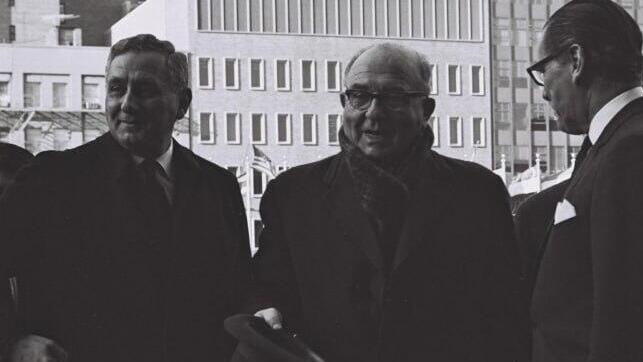
Gideon Rafael with Prime Minister Levi Eshkol at the UN in 1968; even details about his car were recorded
(Photo: David Eldan, GPO, National Photo Collection)

Teddy Kollek; no surveillance was deemed necessary
(Photo: Yaakov Saar, GPO)
Teddy Kollek, however, received different treatment. In May 1951, Kollek, then a close aide to David Ben-Gurion and later Jerusalem’s longtime mayor, was preparing to visit Los Angeles. His name was already familiar to U.S. security officials. During World War II, he had served as a liaison between the Haganah and Allied intelligence services, and in the years before Israeli independence he had also been involved in the Haganah’s clandestine arms procurement operations in the United States.
This time, however, FBI headquarters in Washington determined that the visit did not appear to be connected to intelligence activity and that physical surveillance of Kollek was unnecessary. Local agents were instructed to pass along relevant information only if it came from sources already available to them.
The money moved through Chase, the planes were meant for Israel
In the case of Nahum Bernstein, a Jewish Agency attorney involved in purchasing aircraft for Israel, the FBI had a more specific reason to investigate.
In January 1948, according to an FBI agent’s account, Bernstein told investigators he had never met Al Schwimmer, the Jewish American aviation figure involved in purchasing aircraft and transferring them to Israel. Two years later, however, during Schwimmer’s trial in the United States, Bernstein gave a different account: He said he had met Schwimmer as early as 1947 and had recruited him for the procurement mission.
The trial concerned violations of U.S. neutrality and export laws that restricted the transfer of weapons and military equipment to the Middle East. The aircraft involved included Constellations and C-46 transport planes.
Bernstein also testified about how the operation was financed. According to his account, the Jewish Agency provided him with funds in the form of checks deposited into a special account belonging to his law firm at Chase Bank in New York. Schwimmer opened an account at Bank of America in Hollywood, where the money was transferred.
Bernstein denied in court that he had ever told FBI agents he had not previously met Schwimmer. To the bureau, the discrepancy between the accounts was suspicious. In July 1950, Hoover ordered a separate report prepared containing the allegedly incriminating details that had emerged from Bernstein’s testimony and sent it to the Justice Department for an opinion.
Ultimately, the federal prosecutor in Los Angeles said he would take no action against Bernstein in his district because no offense had been found to have occurred within his jurisdiction. Hoover persisted and asked the Justice Department in Washington for its assessment.
From Levi’s to Harvard
Not everyone who came under scrutiny was a diplomat, procurement official or security figure. The same report that examined Reuven Dafni’s visit to San Francisco also included the names of two senior figures at one of America’s best-known companies: Walter Haas, president of jeans manufacturer Levi Strauss, and his son, Walter Haas Jr.
Agents checked their addresses, examined their positions at the company and reviewed credit records. The Haas family was among San Francisco’s most prominent Jewish business families, and the family company it headed was on its way to becoming a global fashion empire. The fact that its executives were subjected to background checks as part of a file dealing with Israeli intelligence illustrates just how broad the network of people attracting investigators’ attention had become.
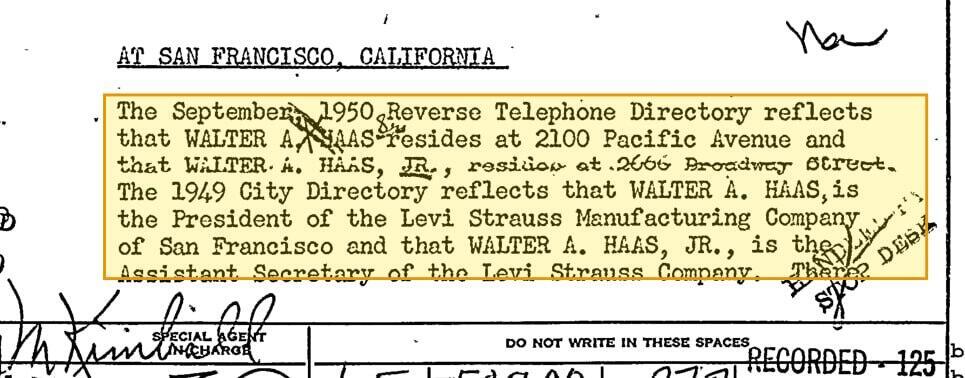
Jewish Levi’s executives were also scrutinized as part of the Israel file
Hollywood was also represented in the file. The FBI checked telephone records and business details concerning Harold Nebenzal, who headed West Coast Productions in Los Angeles, as well as another production company where he held a management position. His father, Seymour Nebenzal, was a prominent German Jewish film producer who, among other films, produced Fritz Lang’s classic 1931 thriller “M,” starring Peter Lorre.
Dafni’s wife, journalist Rinna Grossman, appears in the documents in her own right. The FBI gathered details about her previous work at Time magazine, her immigration documents and her Zionist activities. Grossman was the daughter of Meir Grossman, one of the leaders of the Revisionist movement. Before joining Jewish Agency activities in 1948, she had worked for the U.S. magazine. The FBI wanted to understand why she had left the prestigious job for the new venture.
In another document, the bureau revisited a complaint filed in 1944 against Murray Rosant, a Jewish assistant editor at Time, alleging that he had fraudulently obtained a discharge from the military and had even posed as an intelligence officer. Hoover later ordered investigators to determine whether his wife, Sarah Naima Landman Rosant, had worked for Israeli intelligence or was connected to communist activity.
The FBI suspected Sarah, who came from a prominent Zionist family in Britain, of acting as an intermediary between Alfred Sarant, who was suspected of espionage and was then in Israel, and his wife in the United States.
Another report examined Blanche Shepard, a secretary who worked for Zionist organizations in the New York area. FBI agents collected information about her addresses, contacts and trips to Israel and also investigated her husband, a New Jersey doctor, including his education and professional records. One source suggested Shepard may have played a more significant role than her outward position indicated.
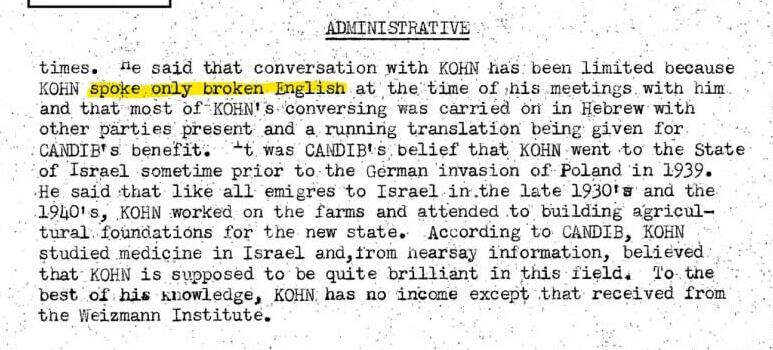
'Spoke only broken English'
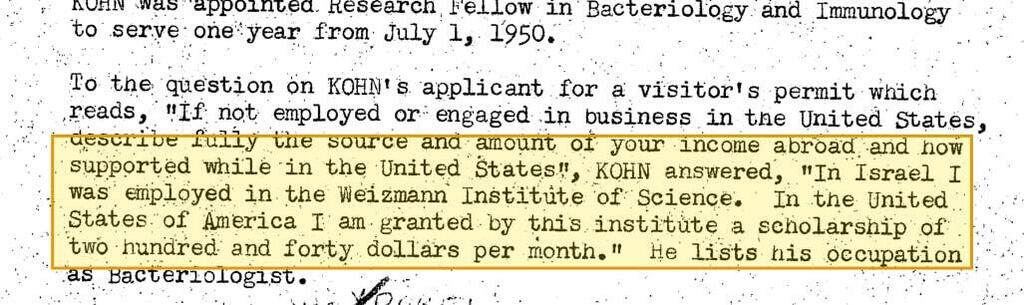
'I was employed in the Weizmann Institute of Science'
One of the most surprising names in the file is Israeli scientist Alexander Cohen, who would later head the Israel Institute for Biological Research in Ness Ziona. In April 1951, the FBI’s Boston office prepared a detailed report on him while he was at Harvard Medical School as a research fellow in bacteriology and immunology.
Agents investigated when he had arrived in the United States with his wife and son, his immigration status and the source of his income. Cohen said the Weizmann Institute had granted him a stipend of $240 a month. One person who knew him told investigators that “his English is limited,” but that he was considered brilliant in his field.
The FBI was also suspicious of another Israeli engineer, Dov Abramiss, whose name is redacted in the documents but was identified by cross-checking biographical details. Abramiss, who was born in Russia and raised in Tel Aviv, studied at the University of California, Berkeley, and had worked since 1943 at U.S. aircraft manufacturer Consolidated Vultee in San Diego. According to company records, he worked on the design of components for guided missiles. He later became one of the founders of a U.S. professional organization in the field of computer simulation.
Investigators painstakingly gathered details about his wife, family, education and connections to Zionist organizations.
The journalist, 76 pages and the source who misled everyone
One of the most intriguing episodes in the collection begins in the offices of the Arab League in New York.
According to an FBI memorandum, Wahid al-Dali, described as a nephew of the head of the Arab League, gave internal organization documents to a Jewish journalist who had managed to win his trust. Al-Dali believed the journalist was sympathetic to the League’s positions. The documents, however, ended up somewhere entirely different.
The journalist passed the material to Sanford Griffith, who was working on behalf of the Anti-Defamation League, or ADL. From there, the documents reached senior ADL official Herman Edelsberg, who passed them to the U.S. State Department. Ultimately, no fewer than 76 pages of material said to have originated in the Arab League’s New York offices were made available to the FBI.
But perhaps the most interesting detail appears later in the memorandum, almost in passing. According to information received by the bureau, the journalist who obtained the documents “may be” a man named Joe Levy.
The name matches Joseph M. Levy, a Jewish American journalist who served for nearly two decades as The New York Times’ senior correspondent in the Middle East. Levy joined the newspaper in 1928, lived in Jerusalem and later Cairo, and covered wars, riots, archaeology and politics across the Arab world.
He spoke Hebrew and Arabic and, as a young man, even lived for seven months with a Bedouin tribe in Transjordan to learn about its way of life. Levy covered the fighting in North Africa during World War II and events in Mandatory Palestine. He left The New York Times in 1947 and later worked as a media adviser at the French Embassy in Washington. An obituary published by the newspaper after his death in 1965 said that, after leaving the paper, he worked privately and through organizations to help Jews in Arab countries.
Levy’s name also appears in another FBI file from April 1951 in which intelligence suspicions about him were investigated through a detailed background check. A source classified as “reliable” provided historical information claiming the British had viewed Levy as a “political intriguer of the first order” and had even suspected him of acting as an agent for Chaim Weizmann, later Israel’s first president, while simultaneously working for Egyptian statesman Ali Maher.
Another source, whose reliability was classified as “unknown,” claimed the Egyptian government had sought to pay a man named Joe Levy $8,000 a year plus $4,000 in expenses in exchange for information about people its representatives had met.
The report also included allegations that Levy hosted Arab figures in his home in an effort to draw information from them. The New York Times, asked by ynet to comment on Levy’s activities, did not respond.
But the journalist’s identity was only part of the problem. In January 1951, a document in the ISINT file made clear that the primary purpose of reviewing the material received from the ADL was to determine whether the information was authentic at all.
In a separate FBI file on the ADL material, Hoover documented an admission by an organization representative in November 1951: ADL officials had concluded that material they had previously provided to the bureau was “completely unreliable.” One of them even said he felt he owed the FBI an apology.
The inconsistencies were fundamental. One source reported statements supposedly made by the head of the Arab League at a meeting, even though the man was hospitalized at the time. In another case, remarks were attributed to a person who had already left the United States aboard the Queen Mary before the meeting was supposed to have taken place. The ADL representative concluded that the source had fraudulently deceived the organization.
Responding to ynet, an Anti-Defamation League spokesperson said that in the 1950s, a person who possessed documents gave them to someone connected to the ADL and that the documents were immediately passed to the FBI and State Department.
“That’s what we know,” the spokesperson said.
The organization rejected any attempt to infer wrongdoing simply from its name appearing in an FBI file: “There is no fire here, and there does not appear to be even any smoke.”
The translator, diplomatic mail and 10 kilograms of gold
The FBI investigation relied on confidential sources, immigration officials, hotel employees and customs officers. The documents also record physical surveillance of people whose names remain redacted, as well as use of a technique known as a “Mail Cover,” the systematic collection of information appearing on the outside of mail, including senders’ and recipients’ names, addresses and mailing dates.
In three cases, the technique was documented as being used on private and business addresses, and the records appear to indicate that agents also opened letters and examined their contents.
At times, however, investigators struggled with far more basic tasks. In June 1950, the bureau discussed finding a translator capable of understanding “modern Palestinian Hebrew,” both spoken and written. Requirements included strong command of the language, unquestioned loyalty to the United States and availability to work in Washington.
A document warned that translation delays could undermine the effectiveness of surveillance. One option under consideration was approaching a professor at an academic institution in Philadelphia.
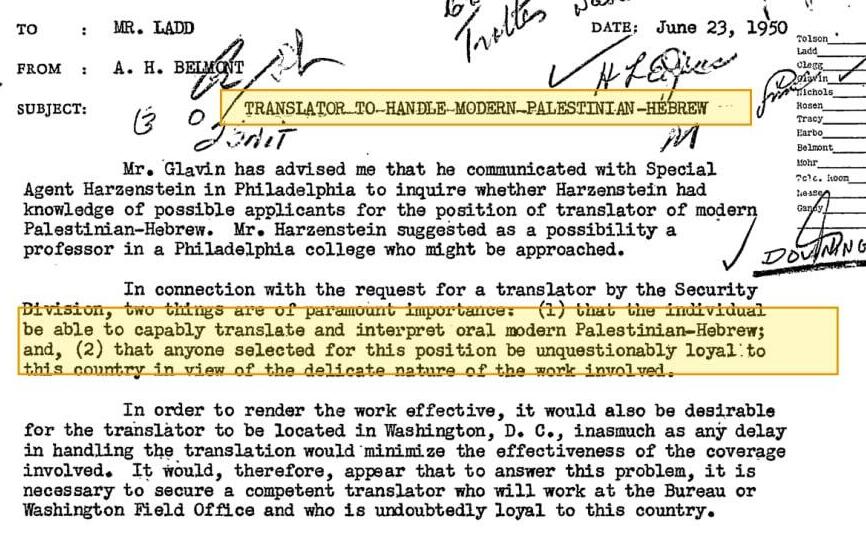
Wanted: A translator of modern Palestinian Hebrew, and one loyal to the United States; from the documents
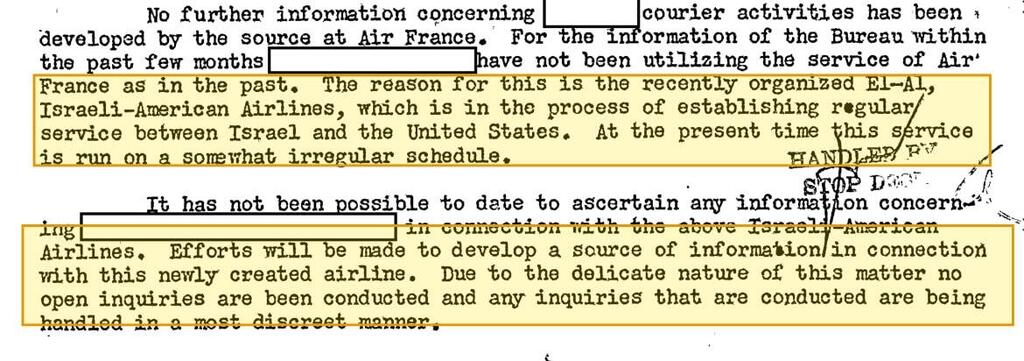
Another communications channel that interested the bureau was Israel’s diplomatic mail. In August 1950, investigators discreetly consulted customs officials at New York’s Idlewild Airport, later renamed John F. Kennedy International Airport, seeking to understand how diplomatic mailbags were transported by airlines and pilots as the young Israeli airline El Al began operating between Israel and the United States.
Investigators learned that Israel generally handed its diplomatic pouch directly to the pilot, who would transfer it to a consular representative after landing. An airport inquiry found nothing suspicious, and investigators struggled to obtain useful information about El Al’s operations. They called for efforts to “develop a source of information” within the airline, in effect seeking to recruit someone on the inside.
Another document, from February 1951, recorded a question the bureau put to the State Department: Were U.S. Foreign Service employees permitted to send personal letters in the diplomatic pouches of foreign governments? The State Department replied that there was no explicit regulation prohibiting it but described the practice as highly unusual. It remains unclear whether U.S. authorities ever penetrated Israel’s diplomatic mail system.
One shipment of gold also found its way into the file. In August 1950, a passenger arriving from the United States aboard a KLM flight was detained in Amsterdam after an inspection uncovered 10 kilograms of undeclared gold in his possession.
Asked where the shipment was headed, he claimed the gold was intended to reach Israel via Paris. The information was passed to the FBI, and Hoover requested an investigation into the man’s identity and whether he had ties to Israeli intelligence.
The documents do not reveal who financed the gold or what was supposed to be done with it in Israel, but in those years the young state faced a severe shortage of foreign currency while trying to finance its military, absorb immigrants and build infrastructure.
U.S. interest also extended to far more routine activities. In June 1950, the file mentioned a delegation of 45 Israeli workers, foremen and mechanics who visited the United States for about 11 weeks, touring some 200 factories to study manufacturing methods and work processes.
The visit was public and was reported in the Jewish press. Nevertheless, the FBI sought details about the travel and stay of Aharon Gilat, who was connected to the delegation’s organization.
A delegation of 34 American Jewish businesspeople and community leaders who traveled to Israel that year at Ben-Gurion’s invitation was also mentioned in FBI surveillance reports.
Several years earlier, even before Israel was established, the FBI had taken an interest in a private home in Brooklyn where, according to reports, “suspicious use” was being made of a shortwave radio receiver. The house was connected to people in Zionist circles, and one person involved was described as an “ardent admirer of Ben-Gurion.”
Investigators gathered information about the relationships between those involved and tried to determine the purpose of the activity. The publicly available documents ultimately describe, at least, a radio receiver used to listen to broadcasts, not a transmitting station sending secret messages.
Even gossip columns provided material for scrutiny. In May 1950, Dorothy Kilgallen, one of America’s most famous journalists, reported that “the second most important man in the Israeli version of the FBI” was traveling around the country under a concealed identity.
Agents tried to determine who she meant. When they failed, they considered approaching Kilgallen herself. But a senior FBI official warned that she was considered “unstable and unreliable” and might publish the fact that the FBI was investigating her sources. The bureau decided not to pursue it.
Jerusalem, long before Trump
The FBI also took an interest in Israel’s diplomatic efforts in Washington.
One 1950 document cited an assessment that President Harry Truman, who had until then been regarded as pro-Israel and had recognized the new state minutes after its declaration of independence, was no longer responding to behind-the-scenes Zionist pressure as he had in the past.
According to U.S. intelligence, whereas Israelis had once been able to obtain “almost anything they wanted” through indirect appeals to the president, Truman had begun showing greater resistance to those pressure tactics.
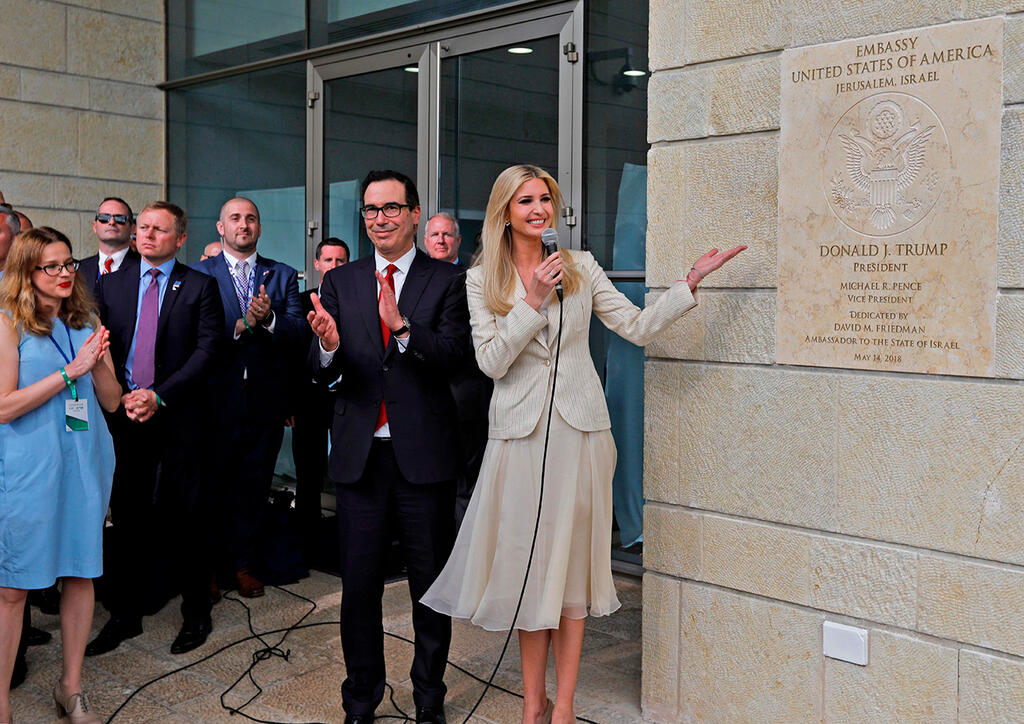
Ivanka Trump inaugurates the U.S. Embassy in Jerusalem in 2018; the issue was already considered crucial in 1951
(Photo: AFP)
Another Hoover memorandum, dated April 17, 1951, reveals U.S. interest in an issue that would remain explosive for decades: moving the U.S. Embassy from Tel Aviv to Jerusalem.
The FBI director wrote that the issue was of “crucial importance” because the United States supported international status for the city. If the Israelis succeeded in bringing about an embassy move through political maneuvering, he warned, they would effectively secure “de facto American recognition of Jerusalem as part of the State of Israel.”
The issue was also being considered by the State Department. A February 1951 policy paper, previously made public in the U.S. diplomatic archives, proposed considering a move of the embassy after consultation with other countries. Large portions of the document remain redacted, making it impossible to determine whether it was connected to any specific covert activity.
The proposal was not implemented, and in 1953 the United States made clear it had no intention of moving the embassy to Jerusalem. The move would ultimately take place only in 2018, during Donald Trump’s first presidency.
Even Hoover eventually had enough
The investigation prompted disputes within the U.S. government over how far the FBI should be permitted to go.
In May 1950, Hoover clashed with the Justice Department after it refused to authorize the use of technical surveillance methods. Another memorandum made clear that a sweeping investigation of American Zionist organizations should not be opened merely because of their ties to Israel, amid concern that the bureau could be accused of persecuting legitimate religious and political organizations.
Investigations of official representatives of foreign governments were also subject to restrictions and required coordination with the State Department.
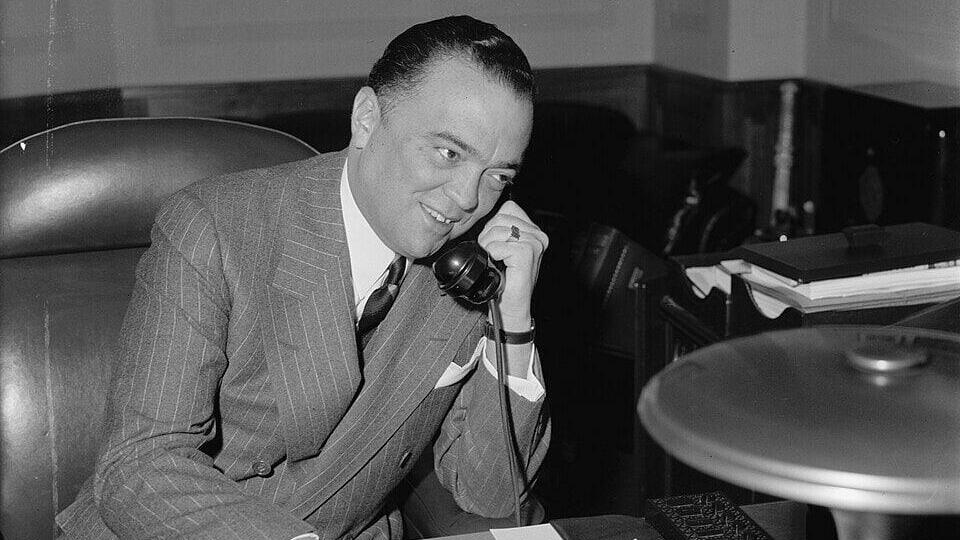
J. Edgar Hoover in 1940; eventually, even he had had enough
(Photo: FBI)
Asked by ynet to comment on the historical investigation and the findings contained in the documents, the FBI said: “No comment.”
In internal correspondence, Hoover was less sparing with words.
On Aug. 20, 1951, he wrote to the New York office about the two latest reports it had submitted in the Israeli case. The FBI director, whose agents had examined passports, hotel bills, addresses and telephone records belonging to dozens of people, ultimately found fault with the material placed before him. The reports, he complained, contained “considerable material which is not pertinent.”