

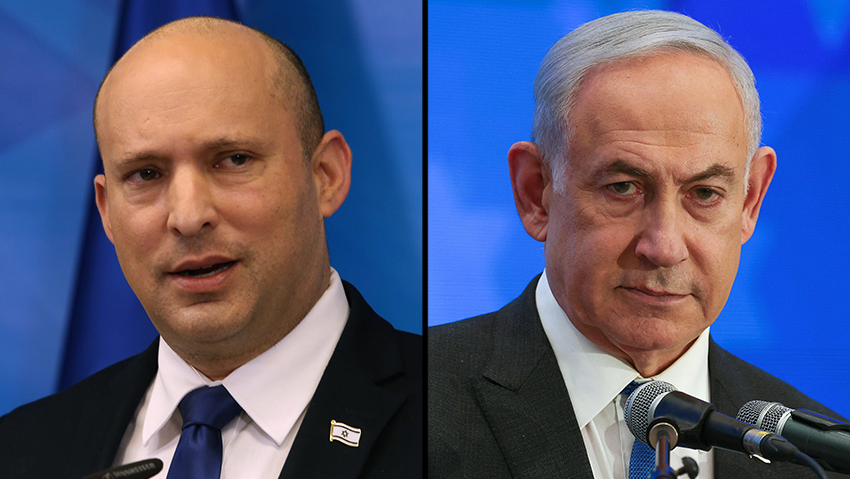
Former prime minister Naftali Bennett on Monday accused Prime Minister Benjamin Netanyahu and his office of betraying Israel and its soldiers during wartime by acting on behalf of Qatar for financial gain, in a blistering statement posted online as part of the growing Qatargate scandal.
Bennett’s remarks follow recent investigative reports by Yedioth Ahronoth and Ynet journalist Ronen Bergman, which revealed how three senior Netanyahu advisers — Eli Feldstein, Jonatan Urich, and Yisrael Einhorn — coordinated wartime media messaging and allegedly promoted Qatar’s interests from inside the prime minister’s office.
According to the report, the advisers were involved in influence operations that included manipulating press coverage of sensitive security matters, including the lead-up to an aborted operation targeting Hezbollah’s former leader Hassan Nasrallah, and pushing a false narrative about an alleged hostage rescue via the Philadelphi Corridor.
“This is the gravest act of betrayal in the country’s history,” Bennett wrote. “Unlike past traitors such as Mordechai Vanunu or Udi Adiv, this happened inside the innermost sanctum of Israeli security — the prime minister’s office.”
Bennett argued that whether Netanyahu was aware of the alleged foreign payments or not, both scenarios demand his immediate resignation. “Three of Netanyahu’s closest advisers received salaries from Qatar during our war with Hamas. That’s no longer in dispute — they’ve admitted it,” he wrote. “They sat in the most classified rooms, entered the Air Force command bunker, and had access to our most sensitive secrets.”

Jonatan Urich
(Photo: Yair Sagi)
He described Qatar as a principal sponsor of Hamas and accused Netanyahu’s advisers of using their positions to advance Qatari interests while Israeli troops were fighting and dying in Gaza. “The declared aim of Qatar is to ensure Hamas’s survival. The declared aim of Israel’s war is to destroy Hamas. They chose sides.”
Among the claims, Bennett pointed to efforts by Netanyahu’s advisers to disparage Egypt — seen as an adversary of Hamas — while defending Qatar, which provides financial and political support to Hamas and hosts its leaders in Doha.
“This is not a legal issue — I’m speaking in security and moral terms,” Bennett said. “Qatar is a bitter enemy of the Jewish state and anyone secretly aiding it during wartime is betraying our soldiers.”
He called for a state commission of inquiry, stating that if he were in office and learned an adviser was being paid by a hostile foreign state, “they would be dismissed on the spot and investigated by the Shin Bet.”
Opposition leaders rally behind Bennett
Opposition head Yair Lapid echoed Bennett’s warning, calling the scandal “the most serious betrayal in the history of the state.” Yair Golan, leader of the Democratic Party, wrote on X: “I agree with Bennett. The Qatar money affair is the gravest security scandal Israel has ever faced. Netanyahu’s office betrayed national security and he must be fully investigated.”

Eli Feldstein
(Photo: Yair Sagi)
The reports, based on internal communications and WhatsApp messages involving Feldstein, show efforts to shape public messaging — including during critical stages of hostage negotiations. One instance cited was a July 2024 moment when Hamas responded positively to a ceasefire framework. Security officials saw it as a major breakthrough, but Netanyahu’s aides circulated contrary talking points suggesting Hamas was stalling.
In another case, Feldstein distributed fabricated quotes attributed to Mossad chief David Barnea, which were later publicly denied by the intelligence agency.
As of Monday, Netanyahu had not issued a formal response. His allies have dismissed the reports as politically driven, but calls for an independent investigation are mounting amid concern about the overlap of national security and political messaging during wartime.