

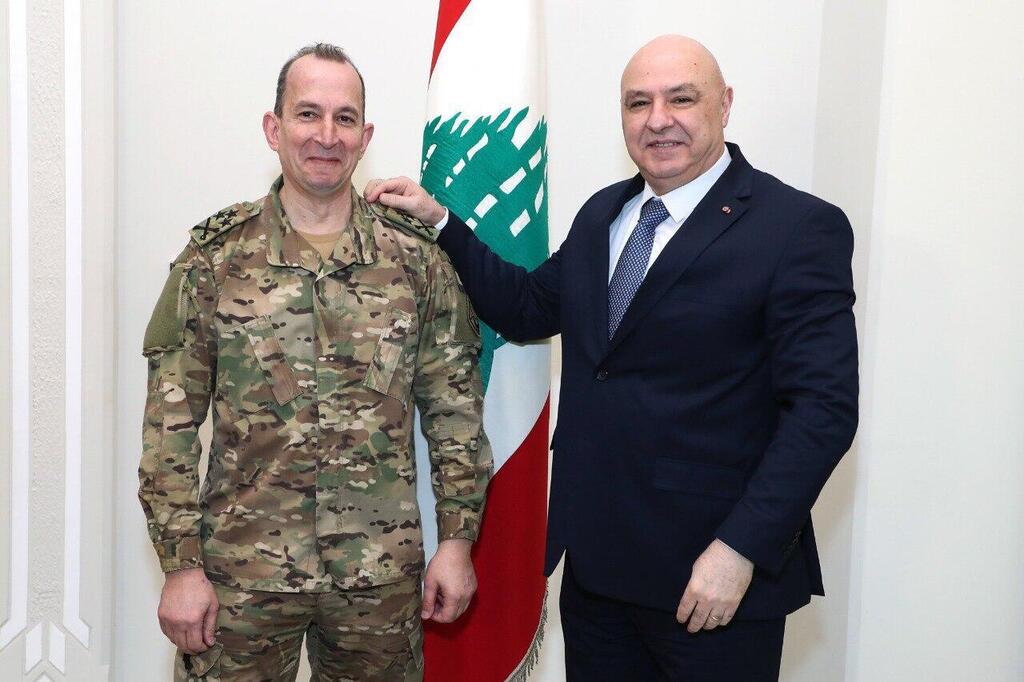
Lebanon’s Al Jadeed television reported Tuesday that the scheduled meetings in Washington for Lebanese Armed Forces commander Gen. Rodolphe Haykal, as well as a reception planned for him at Lebanon’s embassy, were canceled. The move followed what the U.S. administration reportedly described as dissatisfaction with what it sees as the army’s failure to carry out assigned missions and Hezbollah’s disarmament.
Haykal had been expected to meet senior U.S. officials and discuss military issues, including aid programs for the Lebanese Armed Forces. His cancellation comes as the army seeks additional international support to maintain basic operations.
Lebanon’s MTV network also reported that the visit was called off, saying U.S. officials took issue with a recent army statement that blamed Israel, rather than Hezbollah, for rising tensions along the border. According to the report, the matter was elevated to U.S. Secretary of State Marco Rubio, who plays a central role in shaping Washington’s policy toward Lebanon.
Sources told MTV the continuation of U.S. cooperation with the Lebanese army would now depend on the army’s positions in the coming period, particularly regarding border issues and disarmament questions. The reports come as Israel continues preparing for a possible limited military operation targeting Hezbollah’s weapons-production facilities, which Israel says are spread across Lebanon, including in the Bekaa Valley and Beirut.
The Lebanese army’s disputed statement was issued two days ago after Israeli forces carried out warning fire near UNIFIL troops in southern Lebanon, who were mistakenly identified as suspects. The statement accused Israel of ongoing violations of Lebanon’s sovereignty, destabilizing the country and delaying the full deployment of the Lebanese army in the south. It said the army was coordinating with “friendly nations” to halt what it called Israeli escalations.
The Israel Defense Forces said at the time that no deliberate fire was directed at UNIFIL and that warning shots were aimed at two individuals who turned out to be UN peacekeepers patrolling in poor weather conditions.
Separately, the new U.S. ambassador to Lebanon, Michel Issa, held meetings Monday with President Joseph Aoun, Prime Minister Nawaf Salam, Parliament Speaker Nabih Berri and Foreign Minister Youssef Raji as he formally assumed his post.
New US ambassador to Lebanon Michel Issa presenting his credentials


Al Jadeed released a photo of Aoun receiving Issa’s diplomatic credentials, saying their meeting focused on Lebanon’s situation and “the importance of strengthening ties between the two countries.” Issa also conveyed greetings from President Donald Trump, along with what was described as Washington’s intention to strengthen bilateral relations.
After two Hezbollah operatives were killed Monday near Tyre in an Israeli drone strike, Israeli officials say they are weighing a limited offensive aimed at Hezbollah military infrastructure, particularly facilities that convert unguided rockets into precision missiles. According to Israeli assessments, Hezbollah still holds tens of thousands of such rockets, along with thousands of missiles and newly produced drones.
Israeli officials say Hezbollah’s Radwan Forces, an elite unit intended for cross-border raids, have partially reestablished positions in areas between the Litani River and the frontier, including in large towns such as Nabatieh, despite the ceasefire terms. The IDF continue to maintain five positions in southern Lebanon near the line of contact, roughly 500 to 1,000 meters from the border fence.
Israeli officials said Lebanon’s commitment six months ago to begin disarming Hezbollah has made limited progress. “For every Hezbollah rocket launcher the Lebanese army seizes, another launcher is converted into a missile system in the Bekaa,” one official said. “There is considerable looking the other way and instances of cooperation in this long operation the Lebanese call ‘Shield of the South.’ In practice, we have to repeatedly strike weapons-production sites, including the strategic facility in the Bekaa that we hit this week for the ninth time since the ceasefire began.”