

It took nearly a year in Lebanon and just over a month in Gaza—but both of the ceasefire agreements that brought the wars to an end are now, simultaneously, at a critical juncture where they could collapse.
The ceasefire between Israel and Hamas came into effect on October 10, 2025, under a framework that the main issues would be resolved after the return of the living hostages, followed by other explosive questions, such as Hamas’ disarmament.
Gallery
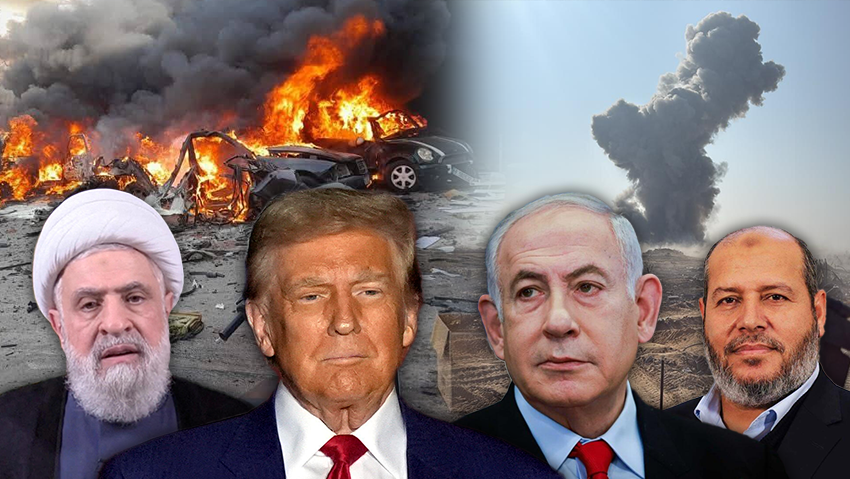
Khalil Al-Hayya, Benjamin Netanyahu, Donald Trump, Naim Qassem
(Photos: Haim Goldberg/Flash 90, Carlos Osorio/AP, Al-Manar/AFP, IDF Spokesperson)
However, due to an inability to resolve the disputes—and amid the failure to return all the deceased hostages—questions are now being raised about Gaza’s future. Several senior officials in the administration of U.S. President Donald Trump fear deeply that his peace plan for Gaza—which was meant to officially end the fighting between Israel and Hamas—could collapse because major parts of the plan are not being implemented.
Under the first phase of the plan—during which all 20 living hostages were returned—Israel took control of roughly 53 % of the enclave's territory, including large agricultural areas, the border city of Rafah in the south and sections of Gaza City and Khan Younis, while nearly two million Palestinians were squeezed into displaced encampments and the ruins left under Hamas control.
The next stage of Trump’s plan—which is supposed to begin only after Hamas hands back all the deceased hostages, reported to be four—includes a further Israeli withdrawal behind the so‑called “yellow line,” the establishment of a temporary transit authority, deployment of a multinational security force and the disarmament of Hamas—but no clear timelines or mechanisms for implementation have been set.
Hamas refuses to disarm, Israel opposes involvement of the Palestinian Authority and there is uncertainty around the multinational stabilization force. In the absence of meaningful U.S. pressure, 18 sources interviewed by Reuters—including six Europeans and a former senior U.S. official—estimate that the yellow line could effectively become the de facto border between two separate Gaza zones.
US concerns about continued implementation of agreement
Politico obtained documents shared with senior figures in Washington, which show that the next stages of the plan are unclear. According to the report, the documents were presented at a briefing last month at the U.S. Civil-Military Coordination Center in Kiryat Gat, which was established to closely monitor the ceasefire led by Trump. At the briefing, concerns were raised about whether the multinational International Stabilization Force for Gaza can in fact be deployed.

Trump's plan contains no clear timelines or mechanisms for implementation
(Photo: Luis M. Alvarez/AP)
In one slide of the presentation, an arrow linking Phase 1 to Phase 2 of Trump’s plan is shown—with a question mark above the arrow—highlighting the uncertainty around the future of the initiative in Gaza. The presentation was divided into six sections, and it revealed that the challenges facing Trump and his U.S. allies in stabilizing Gaza and achieving a sustainable peace between Israel and Hamas are in stark contrast to the public and optimistic rhetoric of the president and his administration.
Nevertheless, the documents show that Washington remains committed to the deal it helped shape, despite the many on‑the‑ground obstacles. One diagram presented at the event outlined U.S. engagement plans for Gaza beyond security matters—including the possibility of overseeing Gaza’s economic reconstruction. Politico described these plans as “significant.”
The report also raises another dimension of U.S. involvement: Trump’s America First policy, which helped propel him to last year’s election victory. According to the report, if the plan for Gaza fails to deliver, Trump “may get mired in the Gaza quagmire”—contrary to his promises and to his stated reluctance to send U.S. troops into distant conflicts.

Secretary of State Rubio with US soldiers at headquarters in Kiryat Gat
(Photo: Fadel Senna)
An additional obstacle for the Americans is Israel’s refusal to withdraw from Gaza as long as Hamas is not disarmed, and Israel’s fear that the terror organization is re‑establishing itself in parts of Gaza. Another significant concern is the composition of the so-called “Board of Peace” that would oversee the multinational stabilization force—Turkey’s name has already been linked to it, drawing Israeli opposition.
A slide in the U.S. presentation stated that one of the force’s legal orders will be that the U.S. supervises it. Further questions raised in the briefing include: What will be the force’s mandate? What are the rules of engagement and fire? How and from whom will it be made up? Where will it be deployed? And who will oversee its supervision?
Will Gaza be divided in two?
Against this backdrop, Western sources warned that Gaza may in practice split into two zones—one under Israeli control, the other under Hamas—in light of the stalemate in implementing Trump’s plan. A Reuters report, citing six European sources involved in the efforts, said the next phase is stalled and reconstruction is focused only on the Israeli‑controlled side of the enclave. “Without progress, years of separation may follow,” the sources warned.
Meanwhile, the Israeli news site Shomrim reported Tuesday that the U.S. plans to establish a large military base in the Gaza border region. Israeli officials familiar with the blueprint say the base is intended for the international forces that will operate in the territory to maintain the ceasefire, and it could host several thousand troops. The estimated budget for its setup is around $500 million. In recent weeks, the Americans have been promoting the initiative with the government and the IDF, and have begun exploring potential locations along Israel’s border region.
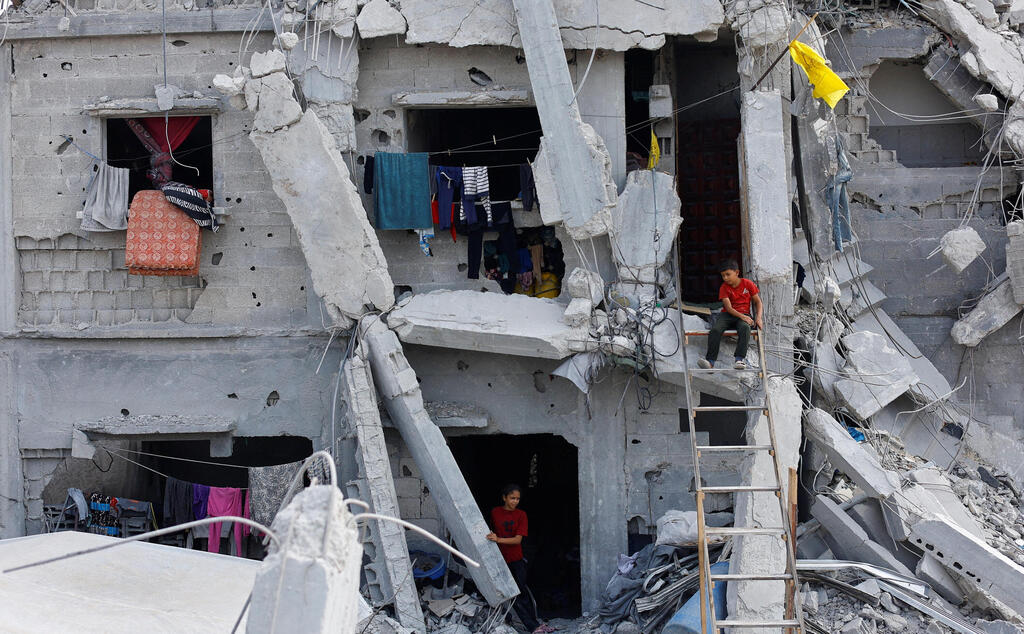
The destruction in Jabaliya: Even after the ceasefire, there is no electricity in Gaza
(Photo: Mahmoud Issa/Reuters)
In the meantime, amid all the unanswered questions, families in Gaza remain without electricity despite the ceasefire, relying on flashlights or solar‑charging stations. According to Reuters, Gaza needed 600 MW of power before the war; it is now without any supply at all.
Before the war, Gaza relied mostly on imported power from Israel, though the supply was already precarious. It received 120 MW from Israel, while its sole power plant delivered another 60 MW. Shortly after October 7, 2023, Israel imposed a “complete siege,” and power in Gaza was cut off when fuel at its power plant ran out within days. Some residents now use solar‑charging stations or private generators.
In March, Energy Minister Eli Cohen ordered the Israel Electric Company not to sell power to Gaza as a punitive measure against Hamas. But even after the ceasefire, returning power to Gaza will require massive infrastructure reconstruction. The war destroyed over 80 % of Gaza’s power distribution networks, with estimated infrastructure and machinery losses of $728 million.
Hezbollah ceasefire under strain
The ceasefire between Israel and Hezbollah in Lebanon took effect on November 27, 2024, with provisions that the terror group would be disarmed and its operatives would not linger near the border with Israel—both provisions that have been violated. Now, almost a year on, the deal is itself in a critical phase.
Hezbollah has been severely weakened by the Israeli invasion and U.S.‑Israeli strikes on its patron Iran—but it still retains considerable power among Lebanon’s Shiite population and within the country’s delicate sectarian power‑sharing system. Since the ceasefire came into effect more than a year ago, Hezbollah has not fired a single shot toward Israel—despite continued Israeli strikes inside Lebanon.
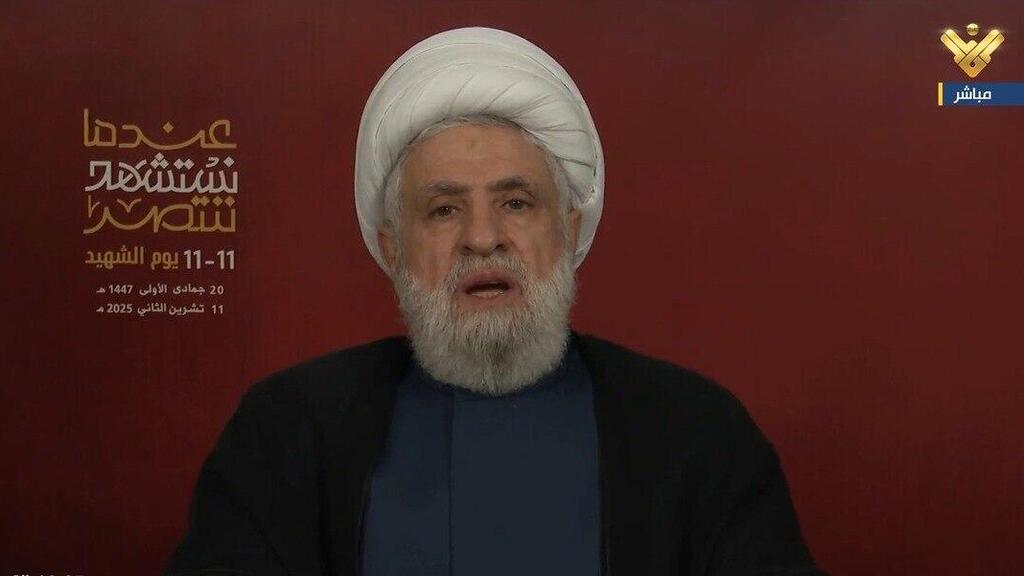
Hezbollah Secretary‑General Naim Qassem
The Israeli Air Force has escalated attacks in southern Lebanon in recent weeks, and IDF spokesman Lt. Col. Nadav Shoshani told international media Tuesday that Hezbollah is trying to rebuild its combat capabilities in southern Lebanon and poses a threat to Israel’s security and to the ceasefire agreement.
According to him, Hezbollah is operating south of the Litani River in violation of the agreement, and therefore the IDF is striking targets of the Shiite terror group in the region. He added that Hezbollah is attempting to smuggle weapons from Syria into Lebanon.
“We are acting to prevent this and to block ground routes from Syria to Lebanon at a high success rate—but they still pose a threat to us,” he said. “We are committed to the agreement, but it must be upheld. We will not return to the reality of October 7—with thousands of terrorists at walking distance from our civilians.”
Hezbollah Secretary‑General Naim Qassem on Tuesday issued a threat from the bunker in which he is believed to be hiding, in response to the wave of strikes.
“The situation cannot continue as it is. Everything has a limit. We cannot replace the ceasefire agreement. It must be implemented," he said. "Our very existence is used as an excuse by the Israelis. They want to destroy us. We face a real existential threat — and we have the right to do whatever we can to confront it. Intimidation and pressure will not change our stance — we will defend our land, our people and our honor. We will not give up the weapons that allow us to defend ourselves.”
He also attacked the U.S. “America and Israel are intervening in Lebanon’s future, including in its army, its economy, its politics and its standing,” he charged. “They want to eliminate Lebanon’s ability to resist and arm the army only to the extent that it can confront the resistance, and not the Israeli enemy. Israel wants Lebanon to be a backyard for expanding settlements within the framework of Greater Israel.”
Push for disarmament in Lebanon
Israeli Air Force strikes in Lebanon have intensified in recent weeks, amid a Reuters report that Israel is pressuring the Lebanese army to take a harder line on disarming Hezbollah—including through house‐to‐house searches for weapons in the south. According to the report, the request was raised in recent weeks and rejected by the Lebanese army’s top command, which fears such action could “spark internal conflict” and sabotage a disarmament strategy it sees as “measured but effective.”
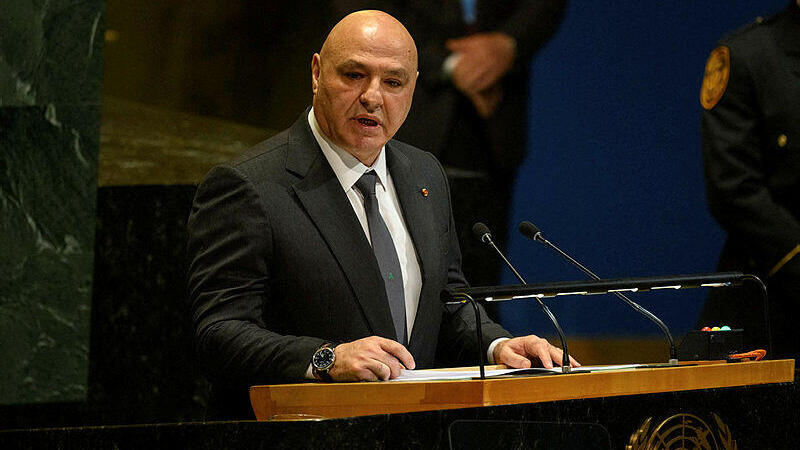
Lebanese President Joseph Aoun
(Photo: AFP)
The Reuters report also states that Lebanese officials believe they will be able to declare southern Lebanon free of Hezbollah weapons by the end of 2025, under the terms of the ceasefire agreement. Two civilian sources involved in army operations said search operations in valleys and forests uncovered more than 50 tunnels and led to the seizure of over 50 guided missiles and hundreds of other weapons. However, Lebanese security sources say that the army’s plan never included searches of private property, a measure Israel views as essential for success.
According to the sources, Israel demanded such raids during meetings held in October as part of the ceasefire enforcement mechanism – a U.S.-led committee including Lebanese and Israeli officers – to monitor the ceasefire’s implementation. Shortly afterward, Israel escalated its ground and air operations in southern Lebanon, claiming to act against Hezbollah’s rearmament efforts. The strikes, the sources added, were seen as a “clear warning” that if more “invasive” searches are not conducted, it could lead to another broad Israeli military operation.
“They demand door‑to‑door searches, and we will not do that. We will not do things their way,” said one source.