

Egyptian intelligence chief Abbas Kamel flew to Israel on Sept. 26, 2023, just 11 days before the Hamas-led Oct. 7 attack, carrying an urgent warning that Gaza was nearing a dangerous escalation and urging economic concessions to avert conflict, The Atlantic reported, citing Israeli, Egyptian, Arab, U.S. and European officials briefed on the visit. The Times of Israel
The visit came on the same day Israel’s leadership gathered in Jerusalem to mark the 50th anniversary of the Yom Kippur War. Prime Minister Benjamin Netanyahu used the ceremony to reflect on the failures that preceded the 1973 surprise attack by Egypt and Syria. “We do not underestimate any threat,” he said.
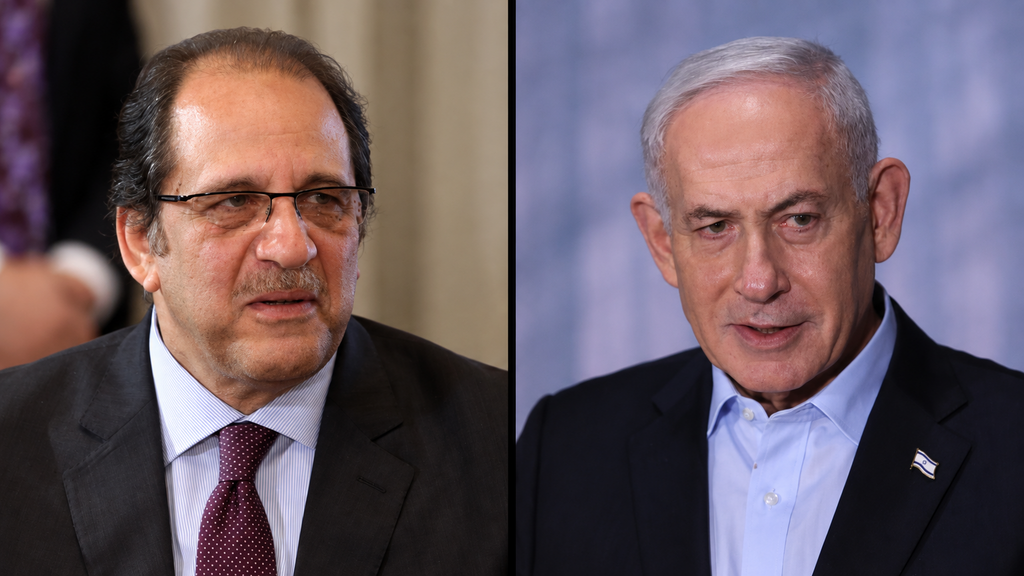
Egyptian intelligence chief Abbas Kamel and Benjamin Netanyahu
(Photo: AP, Alex Kolomoisky)
Roughly two hours before Netanyahu spoke, a chartered Cessna linked to Egypt’s intelligence service landed at Ben Gurion Airport and taxied to an isolated area used for sensitive diplomatic and security missions.
Kamel, then one of the Middle East’s most influential intelligence officials, had come for what officials described as an unusually sensitive mission.
Hamas, the Muslim Brotherhood-aligned terrorist group controlling Gaza at the time, appeared to be mobilizing for a major attack, Kamel warned, according to officials briefed afterward on the visit. He did not provide a date, target or detailed operational intelligence about the assault that would follow.
Instead, he urged Israel to make economic concessions to Hamas in an effort to prevent another round of fighting.
One former Israeli official later briefed on the visit summarized Kamel’s message this way: “If you don’t change course, Gaza is going to blow up in your faces.”
It remains unclear exactly which Israeli officials met with Kamel. Flight records cited in the report show that the Egyptian aircraft remained at Ben Gurion Airport for 67 minutes before returning to Cairo.
What happened to Kamel’s warning inside the Israeli system remains unresolved nearly three years after the attack.
Officials from seven countries said the mere fact that Egypt had dispatched its intelligence chief to Israel should have triggered concern at the highest levels of government.
Netanyahu attended a classified briefing following the Yom Kippur War commemoration, according to his public schedule, and economic concessions to Hamas were approved soon afterward.
“The messenger was the message,” a former Israeli official said. “There is no world,” the official added, in which senior Israeli officials would meet the Egyptian intelligence chief “and Bibi is not aware.”
Netanyahu’s office denied in the days after Oct. 7 that the prime minister had received warnings, either directly or indirectly, from Egypt about the situation in Gaza. Tzachi Hanegbi, who was serving as head of the National Security Council at the time, also denied this week that Kamel had made such a visit or that Egypt had issued any warning. Netanyahu’s office publicly rejected similar reports in October 2023. The Times of Israel
A series of warnings before Oct. 7
Kamel’s visit adds to evidence that Israel received repeated signals from regional and international actors about growing danger in Gaza before the Hamas attack.
A United Nations envoy publicly warned that renewed conflict could bring “grave consequences” while privately trying to calm tensions between Israel and Hamas.
United Arab Emirates President Mohamed bin Zayed also called Netanyahu after receiving intelligence assessments from Egyptian and Palestinian sources, according to U.S. and Arab officials familiar with the conversation.
Earlier this month, Haaretz reported that bin Zayed had warned Netanyahu of the possibility of an imminent Hamas attack. Netanyahu denied the report and threatened legal action against the newspaper. More recent reporting has also described the alleged Emirati warning and Netanyahu’s denial. The Times of Israel
Officials who dealt with the Israeli government in 2023 described a broader belief among Israeli leaders that Hamas had been deterred and that the more urgent Palestinian security challenge was in the West Bank.
“It seemed clear that, for whatever reason, the West Bank was their priority,” a former senior U.S. official involved in talks with Israel said. “They were confident—even cocky—that they had the situation under control.”
Eleven days after Kamel’s visit, Hamas and other terrorists attacked southern Israel, killing about 1,200 people, most of them civilians, and abducting 251 hostages to Gaza in coordinated assaults on communities, military bases and the Nova music festival.
Israel responded with a military campaign in Gaza that has killed more than 73,000 Palestinians, according to Gaza’s Hamas-run Health Ministry. Hamas’s leadership and thousands of its combatants have also been killed.
The failures preceding Oct. 7 have become a central issue in Israel’s political debate ahead of the election.
Former IDF chief of staff Gadi Eisenkot, Netanyahu’s main political rival, is among those demanding an independent state commission of inquiry into the military, intelligence and political failures preceding the attack.
Netanyahu has resisted establishing the type of independent state commission created after previous national security failures, including the Yom Kippur War. His government instead sought to advance a politically appointed inquiry that would include opposition representatives, a proposal opposition leaders rejected over concerns about its independence.
Egypt saw signs of something bigger
Relations between Israel and Egypt have remained a cold peace since the countries signed their peace treaty following the Camp David Accords, but security and intelligence cooperation has been extensive, particularly under Egyptian President Abdel Fattah el-Sisi.
Both countries also shared an interest in containing Hamas and other terrorist groups operating in Gaza, which borders Egypt and Israel.
Much of the intelligence circulating in the weeks before Oct. 7 pointed to the possibility of more conventional escalation, including renewed rocket fire from Gaza and further violence spilling into the West Bank.
But sources inside Gaza gave Egyptian intelligence a more alarming picture, prompting both Egypt and the UAE to raise concerns with Israel that something more significant could be developing.
“For Kamel to go to Israel” for a single hour, an Egyptian official said, “meant that al-Sisi himself felt: You need to go there and tell them yourself.”
At the time, however, Israel was consumed by an intense domestic political crisis over Netanyahu’s judicial overhaul. Hundreds of thousands of Israelis had demonstrated against the plan, and the dispute had opened divisions across Israeli society and within the military.
The West Bank was also experiencing a sharp rise in violence involving Israeli military raids, Palestinian attacks and settler violence. Israel shifted troops and resources into the territory, while the Biden administration focused diplomatic efforts on preventing further deterioration there.
‘Something was cooking’ in Gaza
Israel imposed a land, sea and air blockade on Gaza after Hamas seized control of the territory in 2007. Movement through the Rafah crossing with Egypt was also heavily restricted.
Israel and Hamas had last fought a major war in May 2021. That 11-day conflict ended with a ceasefire mediated in part by Kamel, and Hamas subsequently appeared to Israeli officials and international mediators to have little interest in abandoning the uneasy arrangement.
But contacts in the region had begun detecting signs of change well before the summer of 2023.
One international negotiator said sources were reporting that “something was cooking,” although the intelligence remained vague and sometimes contradictory.
Tensions became more visible by August after Qatar froze deliveries of Egyptian fuel that it had been providing to Gaza since 2021. Hamas resold the fuel and used the proceeds to help pay public-sector salaries, one mechanism through which it maintained control over the territory.
Hamas encouraged demonstrations near the Erez crossing over the delayed Qatari aid and other issues, including the treatment of Palestinian prisoners.
Israel responded to the protests by closing Erez in mid-September, cutting off access for roughly 18,000 Gazans who held permits to work in Israel.
After workers were prevented from crossing, “the escalation started to come much faster,” one negotiator said.
On Sept. 26, the Arabic news outlet Rai al-Youm, citing Palestinian sources, reported that Hamas had told Egyptian officials Gaza would explode if Erez remained closed.
That same day, Kamel flew to Israel.
Egyptian, Qatari and UN negotiators scrambled to prevent further escalation. Hamas presented what one negotiator called a broad “shopping list” of demands, including additional permits for Gazans to work in Israel and restoration of the Qatari fuel arrangement.
By the end of September, Hamas agreed to pull demonstrators away from the border fence and reduce tensions. Israel agreed to reopen Erez and restore a medical-supply route into Gaza, while saying it would consider increasing the number of work permits.
On Sept. 27, UN Middle East envoy Tor Wennesland left Gaza and issued a public warning.
“The situation inside the Strip is dire and we must avoid another conflict that will have grave consequences for all,” Wennesland wrote on X.
A day later, European diplomats visiting Erez saw Palestinian workers once again entering Israel.
Hamas used negotiations to buy time
It later emerged that Hamas had been using the negotiations as cover while finalizing preparations for its attack, according to negotiators and documents recovered by Israel in Gaza.
Documents found during the war indicated that Hamas regarded the 2021 conflict as a success and began preparing afterward for a far larger operation.
A detailed August 2022 memorandum apparently handwritten by Yahya Sinwar, then Hamas’s leader in Gaza, outlined elements of the operational plan that would ultimately be carried out the following year.
While mediators concentrated on work permits, fuel deliveries and economic pressure, Hamas continued preparing for a large-scale assault.
U.S. and Israeli military analysts said Israel misread those signals and concluded that Hamas did not want a military confrontation.
Kamel’s visits to Israel were themselves unusual. His previous publicly known trips had come in May and August 2021, around the previous Gaza war.
After his September 2023 visit, Egyptian officials continued raising concerns until two days before the attack, according to U.S., Egyptian and Israeli officials familiar with the communications.
Those officials stressed, however, that the warnings lacked the type of specific intelligence that might have pointed directly to Oct. 7. They contained no firm date, target or method.
Still, they were persistent.
Around the same period, bin Zayed reportedly called Netanyahu and sought to convey his assessment that Sinwar was planning a major attack. Like Kamel, he urged Netanyahu to ease economic pressure on Gaza.
Two Arab officials familiar with the conversation said Netanyahu appeared unconvinced.
CIA reports pointed to escalation, but not the Oct. 7 assault
UN mediators, U.S. officials and international organizations were also aware that tensions in Gaza were unusually high, but said they did not know that Hamas was preparing a coordinated invasion.
On Sept. 28, the CIA issued an internal report on a possible Hamas escalation in Gaza, based in part on information from foreign intelligence services, according to officials.
U.S. officials said the report discussed the possibility of Hamas firing rockets into Israel over several days.
Another assessment dated Oct. 5 built on the earlier warning but remained analytical rather than revelatory. Neither identified preparations for the kind of multipronged ground assault Hamas launched two days later.
Also on Oct. 5, Egypt sent another message to Israel warning that the situation was unsustainable and conveying urgency about the possibility of an attack, according to U.S., Egyptian and Israeli officials.
Again, the warning included no date or attack method.
Egypt also shared its assessment with other countries in the region, including Saudi Arabia, according to a senior Gulf Arab official.
Jordan’s intelligence chief separately expressed concern to Israeli counterparts that the situation was becoming explosive, particularly in the West Bank, Arab officials said.
Biden administration officials said Egypt and the UAE did not share their warnings directly with Washington before Oct. 7.
Officials offered different explanations. Some said the information was too vague to justify passing it to the United States. Others argued that Israel should have relayed the assessments to Washington.
Several months after the attack, CIA Director William Burns learned about Kamel’s Israel visit and bin Zayed’s call, according to U.S., Israeli and Arab officials, though he was not initially given details about what had been conveyed.
Netanyahu’s office denied receiving an Egyptian warning
Two days after the Hamas attack, Netanyahu’s office publicly rejected reports that he had received a warning from Kamel or Egypt.
“The Prime Minister has neither spoken, nor met, with the head of Egyptian intelligence since the formation of the government, neither directly nor indirectly,” his office said on X.
That denial focused on whether Netanyahu himself had spoken or met with Kamel, leaving unresolved the separate question of whether Egyptian intelligence had reached other Israeli officials and moved up the chain of command.
On Oct. 11, 2023, then-House Foreign Affairs Committee Chairman Michael McCaul told reporters after a classified briefing that Egypt had issued a warning before the attack.
“We know that Egypt had warned the Israelis three days prior that an event like this could happen,” McCaul said. “I don’t want to get too much into classified, but a warning was given. I think the question was at what level.”
An Egyptian official also said at the time that Egyptian intelligence had warned Israeli counterparts that Hamas was preparing “something big,” while saying it was unclear whether that warning had reached Netanyahu. The Times of Israel
Nearly three years later, the central question remains unresolved: how much Israeli leaders knew, who received the warnings and whether a series of vague but increasingly urgent signals should have prompted a fundamentally different assessment before Oct. 7. Pasted text