


No matter what the situation on the ground may look like, nerves remain raw during the holiday season nearly three years after October 7. That feeling is shared by IDF troops operating deep inside the Gaza Strip. The operational reality is vastly different from what it was in the past, with Israel now exercising far broader military control in parts of the enclave, but that control brings its own complex challenges. At the same time, the sense of security among residents of Israeli communities near Gaza remains fragile, despite what the military describes as substantial achievements that are continually being tested.
Nearly three years after October 7, and after 472 IDF soldiers were killed since the start of the Gaza ground operation, Hamas remains armed and retains control over significant parts of the Strip. As long as the terrorist organization does not voluntarily disarm under the U.S.-backed framework, Israeli officials say the IDF may ultimately be ordered to do so by force.
IDF strikes in the Gaza Strip
(Video: IDF)


“Everyone understands that Hamas will not disarm and destroy all the tunnels, and the IDF is prepared, if given the order to eliminate Hamas, to finish the job so that we can also implement the migration plan,” Defense Minister Israel Katz said Wednesday. Katz has previously said plans to facilitate Gazans’ emigration remain under discussion, while acknowledging that other countries have not agreed to receive them.
For now, several kites recently launched toward Israeli communities near Gaza were enough to put the entire sector back on heightened alert. Southern Command has been working to counter the phenomenon, which has since subsided. The situation on the ground is stark: destruction is extensive, while fortified IDF positions known in military terminology as “meteors” are reinforcing Israel’s hold on the terrain and are intended to remain in place.
The IDF is maintaining what officers describe as a high offensive tempo, including targeted strikes and the destruction of weapons depots. Southern Command views those attacks as pressure on Hamas to move toward an agreement that would include disarmament. “If you do not disarm, we will disarm you,” officials in the command say. At the same time, the military’s operational approach inside Gaza is changing.
Reservists from the IDF’s 179th Brigade, who recently completed a deployment in Gaza, operated around Ridge 70 and opposite the south-central part of Gaza City while controlling the northern edge of the central Gaza camps. During the deployment, they dealt with several significant incidents, including the kite launches and an explosive device detonated against a remotely operated “Panda” bulldozer.
The troops are feeling the cumulative strain of repeated deployments. At the same time, there is concern that the transition from the intense maneuver warfare of earlier phases to a forward-defense posture could eventually breed complacency.
Security officials reject the idea that the military is settling into routine. “There is no intention of turning this into routine territorial brigade activity,” they say. “We are constantly initiating attacks and thwarting threats. That creates a tempo and prevents us from being drawn into routine.”
At one IDF position, troops described the complex procedures used when people approach the Yellow Line, the ceasefire boundary behind which Israeli forces are deployed. The IDF began physically marking the line with yellow-painted posts and concrete barriers to provide what it calls “tactical clarity” on the ground.
Contrary to claims sometimes made about Israeli activity near the line, officers say troops do not automatically open fire on every unarmed person who approaches it. According to soldiers and security officials, an unarmed person approaching the boundary is first monitored, warned and tracked. Troops may fire warning shots nearby and, when circumstances allow, attempt an arrest, they say, after assessing the situation.
Officials say the rules are different when troops identify armed people or suspects who pose an immediate threat. The IDF has repeatedly said forces along the Yellow Line will act against threats to soldiers, while Chief of Staff Lt. Gen. Eyal Zamir has said the military must remain prepared to move rapidly from defense to a broader offensive if ordered.
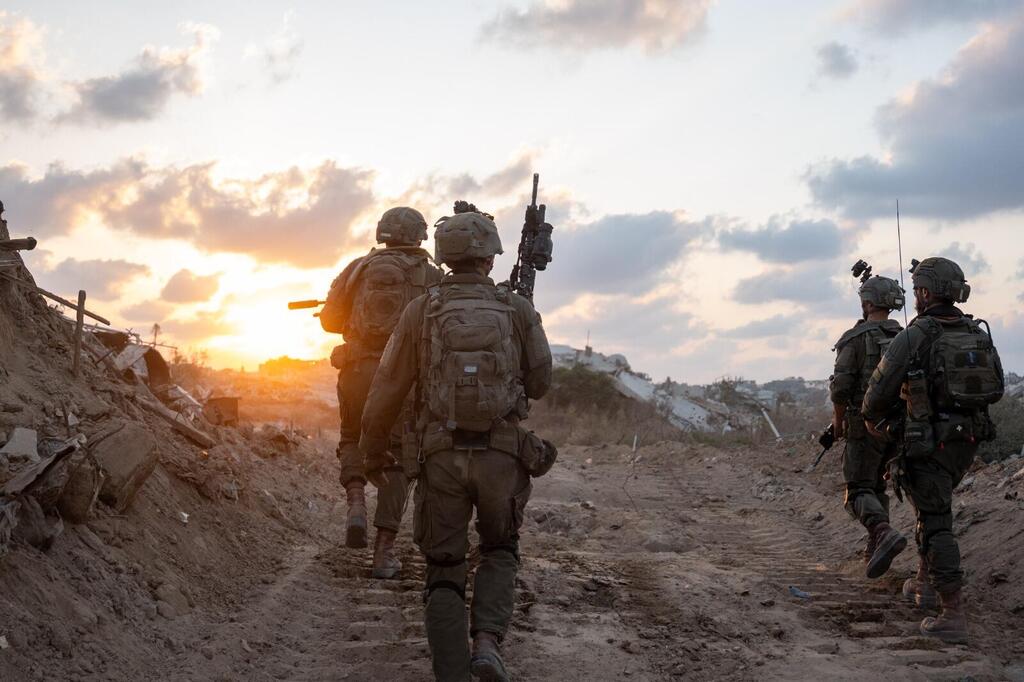
Paratroopers Brigade troops operating in the Gaza Strip
(Photo: IDF)
The issue has taken on additional significance amid international criticism of Israel’s conduct in Gaza and the controversy surrounding NAZA (“collateral damage”), the Israeli documentary that won the Special Jury Prize at the Venice Film Festival and leveled serious allegations against the IDF’s conduct in the enclave.
Only weeks earlier, however, the military faced criticism from the opposite direction, with claims that troops were being forced to stand exposed and take risks because they were supposedly prohibited from opening fire.
“It is neither one nor the other,” security officials on the ground say. “These are measured rules of engagement.”
Zamir, speaking at an event honoring donors to the Association for the Wellbeing of Israel’s Soldiers, said: “The IDF is the most moral army in the world. Faced with deliberate attacks on our civilians, a barbaric raid deliberately targeting a civilian population and missiles fired at city centers, we adhere to the values of the IDF and international law and do everything in our power to avoid harming innocent people.”
In areas of Gaza outside Israeli control, Hamas is trying to recover and reassert governance. Roughly 600 humanitarian aid trucks enter Gaza each day under the current system, broadly consistent with figures published by Israeli authorities since the ceasefire. According to Israeli security assessments cited by Ynet, Hamas is exploiting the flow of goods by establishing checkpoints and collecting levies that can approach 50% in some cases. Independent reporting has also documented Hamas authorities taxing goods and profiting from parts of Gaza’s wartime economy, though the amounts and mechanisms vary.
Israeli officials say that money helps Hamas maintain elements of local governance even as its operatives remain under continuing military pressure. The situation, they argue, is a product of the continuing deadlock in negotiations: Hamas is adapting to the current reality and attempting to consolidate pockets of authority, while the IDF continues carrying out strikes against its operatives and infrastructure.
The political environment is also complicating any step that could be interpreted inside Israel as rebuilding Gaza before Hamas is disarmed, including improvements to civilian infrastructure or the deployment of international forces. Netanyahu and Katz have publicly said there will be no reconstruction before Hamas is disarmed and the Strip is demilitarized.
Against the backdrop of the Jewish holidays, political tensions and uncertainty over the future Palestinian political system, the IDF is entering another sensitive period. Commanders in the field are trying to prevent any decline in vigilance.
Although the Gaza front remains diplomatically frozen, Southern Command is maintaining a high tempo of strikes. Military officials say the aim is to sustain pressure on Hamas, prevent it from rebuilding its capabilities, continue targeting terrorists involved in the October 7 attack and reinforce among troops the message that Gaza remains an active combat arena.