

Shin Bet chief David Zini told the Security Cabinet that he would seek to restore the use of administrative detention against Jewish extremists if other measures fail to curb violence against Palestinians in the West Bank, ynet has learned.
Zini made the remarks during a Cabinet meeting Sunday that included a discussion of security in the West Bank and a heated exchange between him and Settlements and National Missions Minister Orit Strock.
Administrative detention allows Israeli authorities to hold suspects without filing criminal charges, based largely on classified intelligence. The measure is used primarily against Palestinians but has also been applied in a limited number of cases against Jewish Israelis suspected of extremist violence.
Defense Minister Israel Katz ended the use of administrative detention orders against Jewish suspects in 2024, shortly after taking office.
Since becoming head of the Shin Bet domestic security agency, Zini has also resisted calls to restore the measure. According to reports, he opposed requests from Shin Bet field officials who favored bringing it back, arguing that violence by Jewish extremists against Palestinians could instead be addressed through electronic monitoring and other measures.
At Sunday’s Cabinet meeting, however, Zini indicated that he could change course if those alternatives proved ineffective.
His comments came during a contentious discussion with ministers over violence in the West Bank. After Prime Minister Benjamin Netanyahu and Foreign Minister Gideon Sa'ar said attacks by Jewish extremists against Palestinians were damaging Israel’s international standing, Zini criticized what he described as insufficient condemnation by Israeli leaders.
“There are not enough condemnations from the leadership, and that harms security and the settlement movement,” Zini said.
Strock challenged his characterization.
“You are presenting it as though the Arabs are sweetness and honey and only the settlers are the problem,” she said. “Palestinians attack shepherds, injure them and endanger their lives. Bring those attacks to the surface as well, deal with them and talk about them.”

Settlements and National Missions Minister Orit Strock
(Photo: Dana Kopel)
Zini responded: “The Palestinians are not burning Jewish homes here. You are disconnected. We need to see condemnation and denunciation from the entire leadership. This harms the settlement movement and harms security.”
Strock said leaders of Jewish communities in the West Bank had repeatedly condemned such violence.
“I don’t understand who else he wants a condemnation from,” she said. “The entire settlement leadership opposes and condemns this kind of violence. All the council heads and rabbis have issued calls against it. I also go to the farms and sit with the young people to explain it to them.”
“Where do you condemn it?” Zini asked.
Strock cited radio appearances and replied: “Everywhere. Just listen.”
Following the exchange, lawmaker Tally Gotliv came to Strock’s defense and called for Zini’s resignation.
“Shin Bet chief, my heart goes out to you,” Gotliv said in a statement. “Maybe if, God forbid, my brother had been arrested and indicted and faced the danger of a lengthy prison sentence, I too would agree to go out of my way and change my skin for him. But with all due respect, you are the head of the Shin Bet, and if they have managed to hold you by the throat as well, then be brave enough to resign.”
She accused Zini of failing to condemn Palestinian terrorism in the West Bank and said his remark that Strock was “disconnected” reminded her of the period before the Oct. 7, 2023, Hamas-led attack on southern Israel.
Pressure grows over West Bank violence
The Cabinet confrontation comes amid a rise in violent incidents involving Israelis and Palestinians in the West Bank in recent months and mounting international criticism over settler violence.
People familiar with Israel’s relations with Washington have warned that the issue could lead to further U.S. pressure on Israel, including possible sanctions. Measures targeting settlements and settlers have also been advanced in Congress, with two initiatives coming close to passage in the past week.
Any decision to restore administrative detention for Jewish suspects would ultimately rest with Katz, who ordered an end to the practice.
Shin Bet chiefs have traditionally sought the ability to use administrative detention in cases where security officials say they have intelligence indicating an imminent threat but cannot expose the evidence in ordinary criminal proceedings.
Even after Katz ended the practice for Jewish suspects, the Shin Bet on several occasions asked him to approve its targeted use in specific cases, according to people familiar with the matter. Those requests were rejected.
Security officials instead turned in part to electronic monitoring. But officials now say that approach has proved ineffective, with Jewish extremists learning to challenge or circumvent restrictions through legal means.
Olive harvest season raises tensions
Zini’s warning also comes as the annual olive harvest begins, a period that frequently brings heightened tensions between Israeli settlers and Palestinians in the West Bank.
Numerous Jewish communities and agricultural outposts have been established or expanded over the past year, some bordering Palestinian farmland and creating additional potential points of friction.
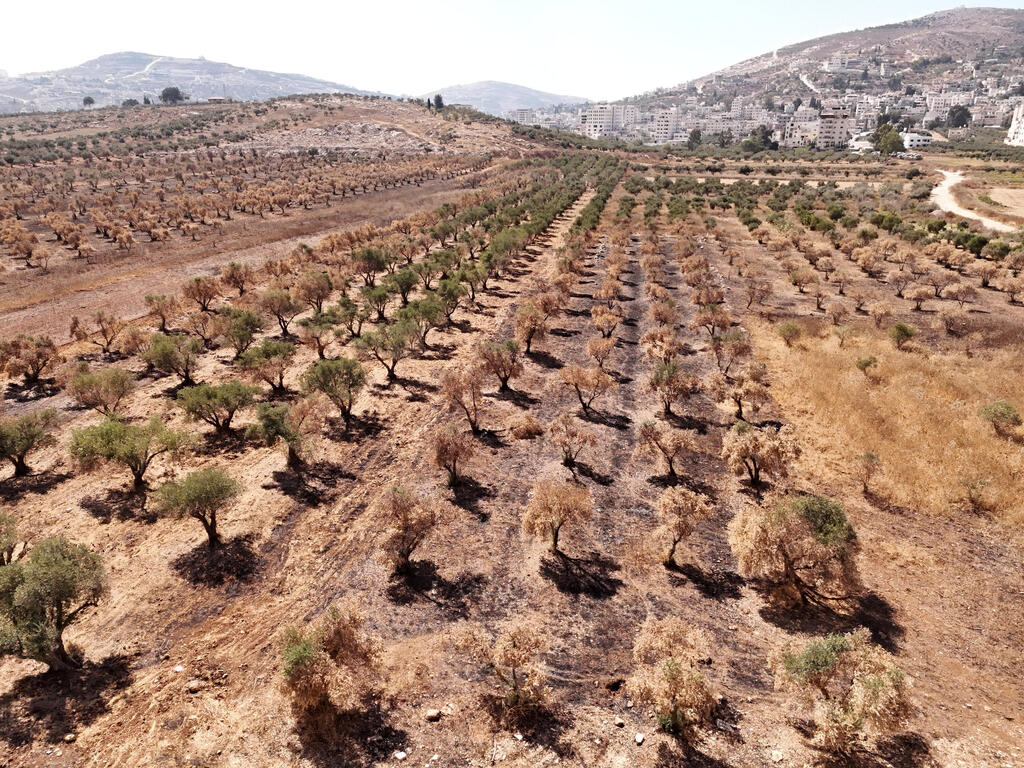
An olive grove in the West Bank
(Photo: Shaul Golan)
More than 100 Israeli agricultural farms are now spread across the West Bank, and their number continues to grow. According to data from an association representing the farms, they currently maintain a presence over more than 1.1 million dunams, or about 272,000 acres.
Supporters of the agricultural outposts view them as strategically important to the Israeli settlement movement. Their expansion has also required the IDF to alter its deployment and defense arrangements.
The military’s security concept in those areas has shifted from primarily defending established communities and major roads to providing broader protection across large stretches of open land where the farms are located.
For Palestinians in West Bank towns and villages, meanwhile, the olive harvest is one of the most important periods of the agricultural year and a major source of income for many families.
According to the United Nations Office for the Coordination of Humanitarian Affairs, known as OCHA, there were more than 10 million olive trees in the Palestinian territories in 2019, supporting the livelihoods of about 100,000 Palestinian families.
Palestinian Authority agricultural officials reported that 2022 was a record year for olive oil production in the West Bank, with the harvest yielding about 32,000 metric tons.
Production has since fallen sharply. The 2024 harvest produced about 27,300 metric tons of olive oil, while production dropped to roughly 7,000 metric tons in 2025 — a decline of about 75% from the previous year.
The combination of the approaching harvest, expanding Israeli agricultural outposts and recent violence has placed Israeli security officials on heightened alert as they seek to prevent further clashes between settlers and Palestinians.