


Prime Minister Benjamin Netanyahu’s office announced Wednesday evening that he will not travel to Washington next week for the Gaza Board of Peace summit and will participate only remotely in the AIPAC conference — two politically sensitive events he had sought to avoid.
The statement was issued as Netanyahu departed Washington, where he met Tuesday with President Donald Trump and signed on as a member of the Board of Peace. The prime minister had been expected to attend both the council gathering and the AIPAC conference but chose to advance his meeting with Trump, citing what he described as urgency stemming from ongoing negotiations between the United States and Iran.
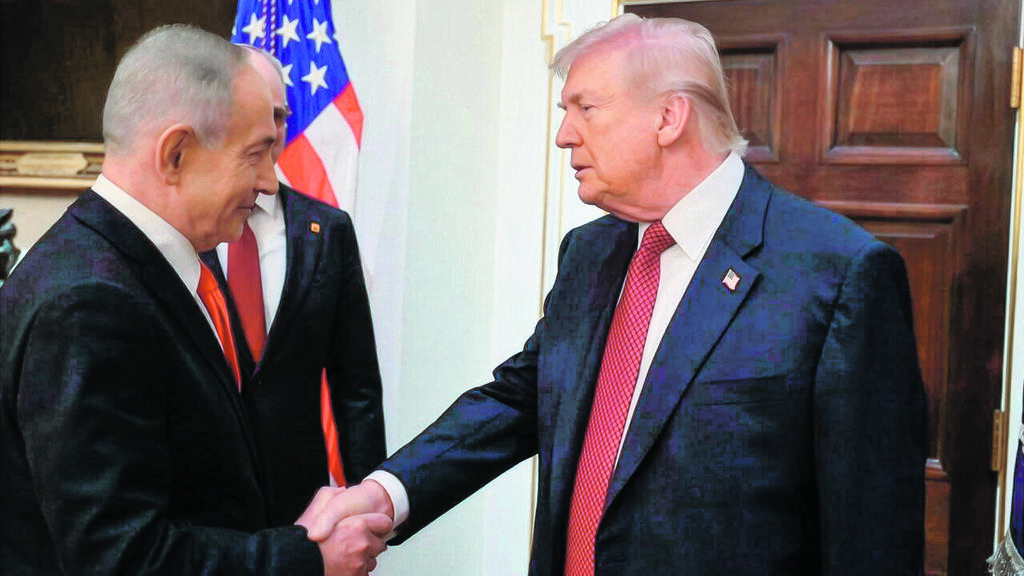
US President Donald Trump and Prime Minister Benjamin Netanyahu during their meeting at the White House
(Photo: Avi Ohayon)
At the AIPAC conference, Netanyahu had been scheduled to speak alongside Opposition Leader Yair Lapid. The Gaza Board of Peace includes a number of Arab and Muslim leaders and senior officials, including representatives from Turkey and Qatar. While Netanyahu does not plan to attend the summit, it remains unclear whether Israel will be represented, amid concerns about a potential external effort to impose a settlement in Gaza on terms unfavorable to Israel.
Before departing for Israel, Netanyahu said his talks with Trump focused primarily on negotiations with Iran. “The president believes the Iranians have already learned who they are dealing with,” Netanyahu said. “He thinks that under the conditions he is creating, combined with the fact that they surely understand they made a mistake the last time by not reaching an agreement, the conditions may be formed to achieve a good agreement.”
At the same time, the prime minister made clear: “I will not hide from you that I expressed general skepticism about the quality of any agreement with Iran. I said that if an agreement is indeed reached, it must include the elements that are important to us, to the State of Israel, and in my view to the entire international community — not only the nuclear issue, but also ballistic missiles and Iran’s regional proxies.”
Israeli officials find it difficult to believe the United States would ignore displays emerging from Iran, such as images of coffins bearing the photos and names of American admirals and the U.S. flag, including that of Central Command chief Gen. Brad Cooper. Trump has also promised the Iranian people that help is on the way.
At the same time, it is important to Trump to be seen as continuing to pursue negotiations and not being drawn into a war by Netanyahu. Accordingly, after the prime minister left the White House on Tuesday evening, Trump posted that he had “insisted” on continuing diplomacy.