

Since the attempted attack on a Flydubai flight bound for Tel Aviv, many are asking how the Omani pilot got into the cockpit. The flight that ultimately had a happy ending has raised a series of questions about the security framework surrounding flights arriving in Israel from the United Arab Emirates, particularly over how responsibility is divided among the various agencies: Who was supposed to make sure crew members met the conditions set by Israel? Who oversees a foreign airline? And what was done in response to warnings issued even before the incident?
Shin Bet chief David Zini had warned for months that, in his view, the security arrangements on flights from the UAE were inadequate. According to a report by Keshet News on Wednesday, a dispute had even developed in the weeks before the incident between the Shin Bet and Israeli airlines, after the agency barred them from flying to the UAE over security concerns.
Gallery
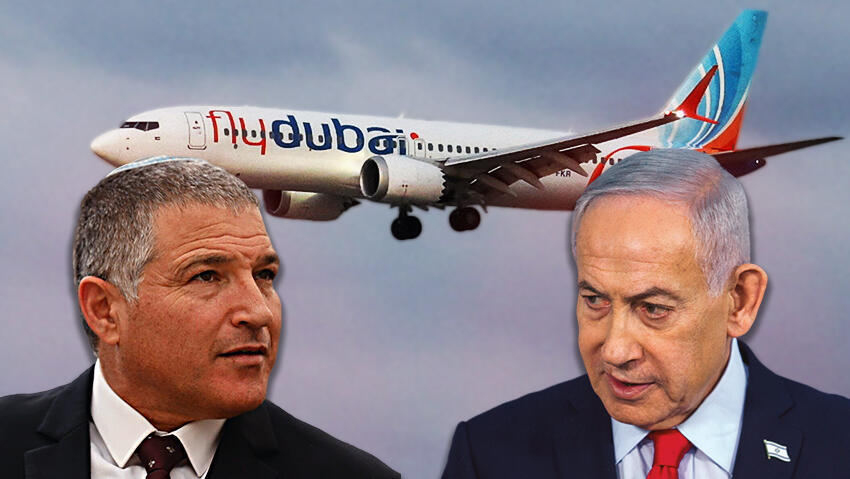
Shin Bet chief David Zini and Prime Minister Benjamin Netanyahu
(Photo: Ammar Awad/Reuters, Olivia Pitoussi, Shilo Shalom)
But an important distinction is required here: Zini’s warnings primarily concerned Israeli flights, whose security is under the Shin Bet’s responsibility. Flydubai is a foreign airline, so its oversight does not fall under the agency’s direct authority. For years, the Shin Bet has been responsible for professional guidance of security systems used by Israeli airlines abroad, while foreign flights entering Israel are subject to a separate system of licensing, oversight and security.
Even so, Zini’s warning takes on added significance in light of the current incident. According to officials familiar with the matter, the Shin Bet’s concern related to the level of security on flights departing the UAE for Israel, while security arrangements on foreign airlines may be even more limited. The assessment is that a stricter security framework would, with high probability, have prevented an incident of the kind that occurred on the Flydubai flight.
Several layers of oversight on the way to Israel
A foreign commercial flight arriving in Israel passes through several layers of approval and oversight. The Civil Aviation Authority of Israel, or CAAI, is responsible, among other things, for granting operating permits to foreign air carriers and setting the conditions under which they operate in Israel. The authority’s aviation oversight division also conducts inspections of foreign airlines and foreign aircraft arriving in Israel and supervises professional matters relating to operators and flight personnel.

Zini’s warnings primarily concerned Israeli flights, whose security is under the Shin Bet’s responsibility
At the same time, the Transportation Ministry operates the Aviation Security Operations Center, or ASOC, which is responsible for overseeing security procedures related to aircraft entering or transiting Israeli airspace. According to the ministry, the center serves as a coordination point between security agencies, civil aviation authorities and the government, operates around the clock and also handles requests for security permits for aircraft entering Israeli airspace.
Aviation relations with the United Arab Emirates also do not operate in a vacuum. The two countries have an air services agreement signed in 2020 that regulates, among other things, aviation rights and the conditions for operating routes between them. In addition to the bilateral agreement, foreign airlines operating in Israel are subject to the operating permits and conditions set by Israeli authorities.
Crew members are also not “invisible” to the system. Aviation authorities have licensing and oversight mechanisms for operators and flight personnel, and the CAAI is authorized to supervise and enforce aviation laws and the conditions established under them.
However, the existence of licensing mechanisms does not mean that every foreign pilot operating a commercial flight to Israel undergoes an individual Israeli security background check before each flight. That is precisely one of the central questions now arising from the Flydubai incident.
Netanyahu admits there was a 'gap' regarding the flyDubai flight
(Video: Fox News )


Prime Minister Benjamin Netanyahu said Thursday in an interview with Fox News that restrictions are in place barring pilots from countries that do not have diplomatic relations with Israel from working on flights to the country. Referring to the Omani co-pilot, Netanyahu said he “managed to get around” the rules.
“Clearly there was a loophole here, and we are dealing with it,” Netanyahu said, adding that it must be ensured that pilots undergo advance screening.
If the restriction Netanyahu described was indeed part of Flydubai’s operating conditions, the incident raises a different question: not why there was no mechanism intended to prevent the Omani pilot from being assigned to the flight, but how an existing mechanism failed to prevent it in practice.
State comptroller had already called for responsibility to be clarified
Questions over the division of responsibility among the various agencies are not new.
In May 2024, State Comptroller Matanyahu Englman published a report examining the security of international civil aviation to and from Israel. The audit, conducted between April 2022 and June 2023, examined outbound aviation from Ben-Gurion Airport, the security of Israeli aviation abroad and the security of foreign and private civilian aircraft entering Israeli airspace.
The review was conducted, among other places, at the Shin Bet, the Transportation Ministry, the Israel Airports Authority and the National Security Council. A significant portion of the findings in that chapter remains classified for national security reasons.
In the section released to the public, the comptroller recommended that the National Security Council conduct a staff review together with the Transportation Ministry, Finance Ministry, Airports Authority, Shin Bet and police, and examine international aviation security in Israel “in all its aspects,” including foreign aviation entering the country.
The comptroller also noted that some government and cabinet decisions regulating the field dated back to the 1970s and called for their continued relevance to be reviewed.
He recommended redefining responsibility and allocating resources in a way that would ensure an “integrated view,” and also called on the prime minister, transportation minister and finance minister to formulate a comprehensive policy on aviation security.
The report did not publicly address security on flights from the United Arab Emirates specifically and made no finding regarding the failure now under scrutiny. However, its recommendation to clarify the division of responsibility among the agencies has taken on renewed significance in light of the incident and the debate over who should have identified the “loophole.”
A senior official familiar with the details said aviation agreements with foreign countries also include detailed security requirements that may vary according to the threat level.
According to the official, if it emerges that in the case of the United Arab Emirates the agreed conditions were not fully enforced, even though the gaps were known to Israeli officials, they should have been corrected — and, if necessary, flights should even have been suspended until the problem was resolved.
Several questions therefore now require answers: What conditions exactly were set for Flydubai? Who was supposed to ensure that the airline and its crew complied with them? Were the Shin Bet’s concerns about the level of security in the UAE also conveyed to the agencies responsible for foreign airlines, and if so, what was done in response?
Above all, if, as Netanyahu himself said, a rule was already in place that should have prevented a pilot from a country without diplomatic relations with Israel from operating the flight, how did the Omani co-pilot make it into the cockpit?
This article includes videos and photographs used in accordance with Section 27A of the Copyright Law.
First published: 21:33, 10.01.26