


Yohanan Elishov, a Palmach fighter and one of the last surviving combatants of Israel’s 1948 generation, died Monday at the age of 95.
Elishov was the last living person who had been present at the historic raising of the Ink Flag following the capture of Eilat during the War of Independence, an image that became one of the most recognizable symbols of Israel’s founding.
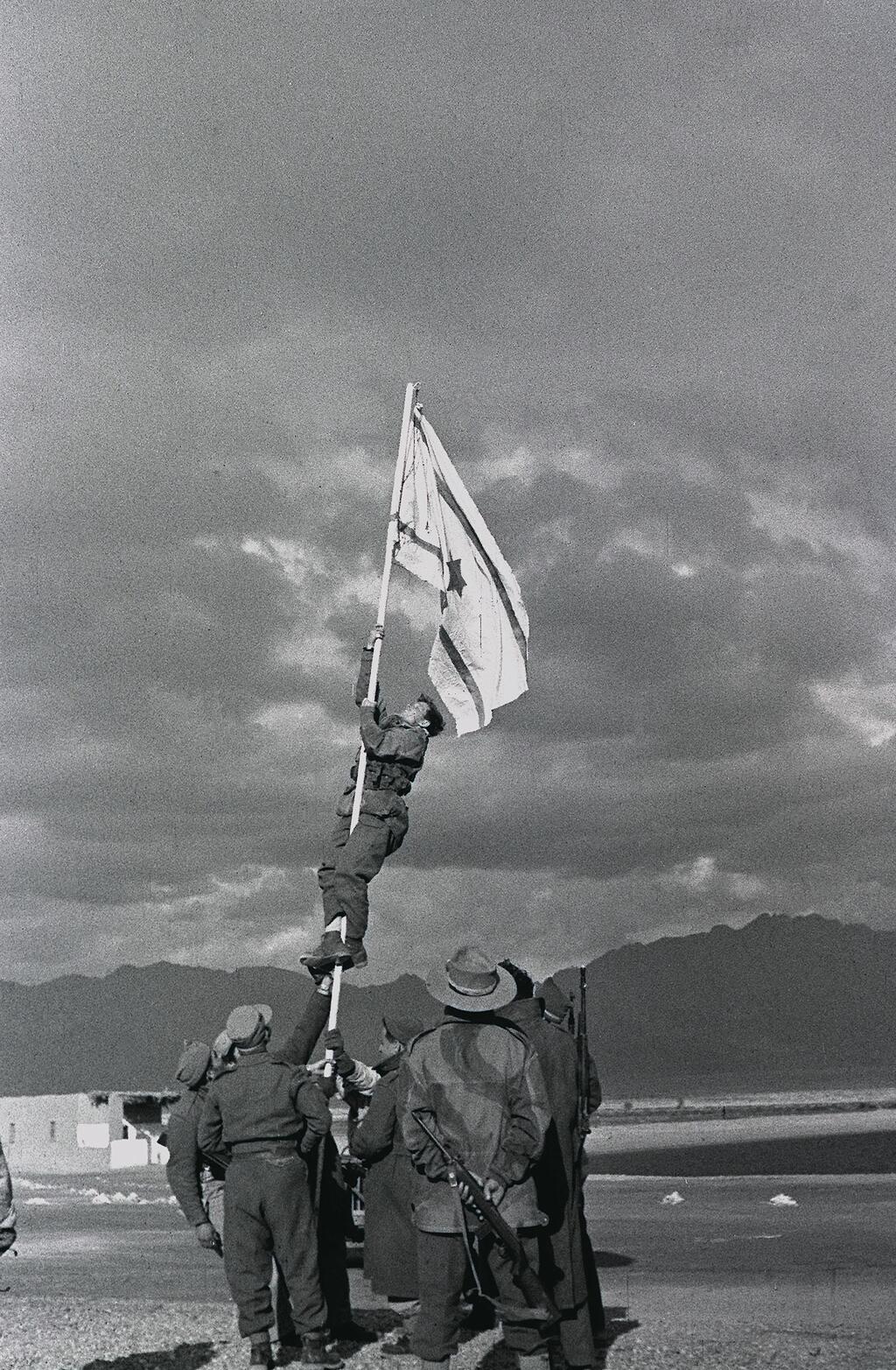
Ink Flag raising in Eilat
(Photo: GPO)
Born in Petah Tikva, Elishov was among the prominent Palmach fighters who took part in the establishment of the state. After enlisting in late 1947, he trained under the command of Rafael Eitan and was later sent to Jerusalem to reinforce the Harel Brigade, where he served as the personal runner of commander Haim Poznansky, known as “Poza,” in the 4th Battalion.
During the Battle of Nabi Samuel, Elishov helped evacuate wounded soldiers and equipment. He later took part in key battles along the road to Jerusalem, including the capture of Beit Mahsir and the attempt to break into the Old City.
During the first ceasefire, he was transferred to the southern front and fought in major operations in the Negev and Sinai. He was present at the historic raising of the Ink Flag in Eilat and later served as Yigal Allon’s driver.
Elishov went on to serve for many years in the reserves with the Artillery Corps, taking part in every Israeli war from the 1956 Sinai Campaign through the First Lebanon War.
In civilian life, he spent decades helping build the country and develop its national infrastructure. For years, he worked as a heavy-vehicle driver for the Solel Boneh construction company and took an active role in paving roads and building development projects in southern Israel, the Negev, the Dead Sea area and the Makhteshim region. He later worked as a purchasing agent in the company’s industrial division.
Even after retiring, Elishov continued volunteering for years with the Israel Diabetes Association.
His son Yoav recalled that his father’s unusual path began long before his military service.
“My father started out as someone who was severely dyslexic,” he told Ynet and Yedioth Ahronoth. “He didn’t want to study, and he started working in a garage at age 13. At 16, he joined the Palmach, and that’s where his very special journey began.”
“When my father raised the Ink Flag, he didn’t understand the magnitude of the event,” Yoav said. “They didn’t have a flag, so their clerk took a sheet and drew on it. Only later did it become a historic icon.”
Another son, Yuval, described Elishov as a devoted family man whose values remained rooted in the ideals of the generation in which he grew up.
“My father wasn’t an educated man,” he said. “He said he didn’t want to learn English and that first the English should learn Hebrew. He was a wonderful father, a family man, and he was involved in our lives and pushed us toward values of love of the country. Until a very old age, we didn’t travel abroad.”
“People like my father were people with straightforward values,” Yuval added. “They had simplicity, wisdom and modesty. Even after the injuries he suffered from a mine, he didn’t rush to seek the disability benefits he might have been entitled to. He always said that anyone who is healthy should go serve the country.”
According to Yuval, his father remained lucid until his final day and continued to closely follow developments in Israel.
“Years ago, he said they were lying to us and that we didn’t have enough soldiers in the army,” he said. “He said it a decade ago, and I remember we got annoyed with him. After October 7, we told him he had been right. He saw what was coming.”
“He was one of the people who built the country, and from his perspective they were destroying the country he had built when accusations were directed at things he saw as part of the consensus, like the courts, the army and the Mossad,” Yuval said. “He was very angry about that.”