

Sudan is rapidly emerging as a pivotal hub for transnational extremist organizations, driven by a dangerous convergence between the Muslim Brotherhood and Iran’s Islamic Revolutionary Guard Corps.
The alignment between Sudanese Islamist movements and Iranian strategic influence extends far beyond the country’s domestic crisis. It poses a direct threat to regional stability and international security.
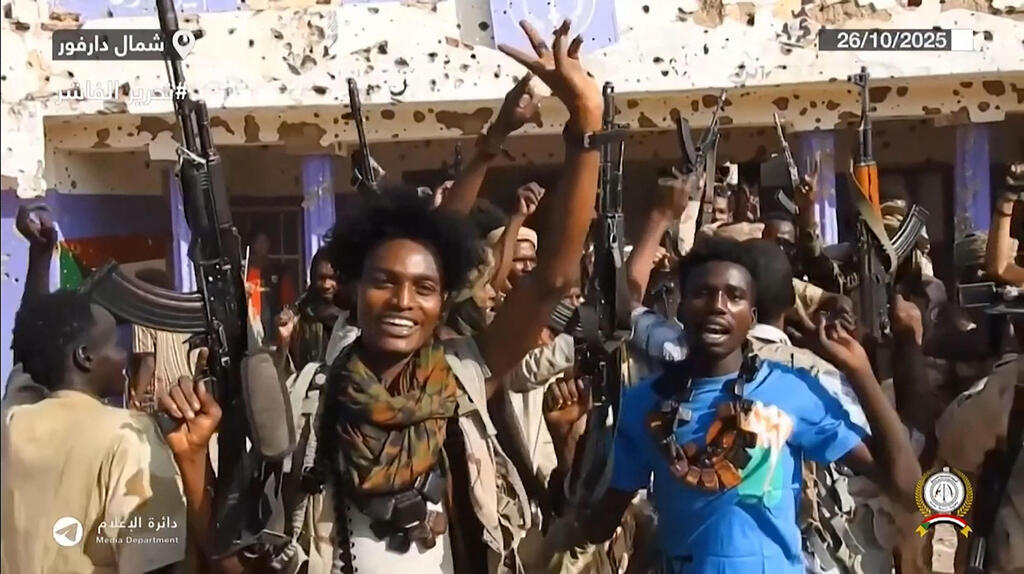
RSF militia fighters celebrate in the streets of El Fasher, Sudan
(Photo: AFP PHOTO / HO / SUDAN RAPID SUPPORT FORCES (RSF) TELEGRAM ACCOUNT)
At the center of this transformation is the militarization of the Sudanese branch of the Muslim Brotherhood. Armed Brotherhood brigades are now fighting alongside Sudan’s official military, supported by funding and training pipelines linked to Iran.
This support connects Sudanese Islamist factions to Tehran’s broader regional strategy, turning the country into fertile ground for extremist recruitment and operational planning. At the same time, the Revolutionary Guards have used these channels to arm and train Sudanese units, effectively transforming Sudan into an African extension of Iran’s proxy network.
Iran’s involvement has also deepened fractures inside Sudan’s armed forces. Competing loyalties increasingly divide factions that openly align themselves with Tehran from those attempting to distance the military from Iranian ambitions.
The strategic consequences are severe and wide-ranging. Along the Red Sea coast, the presence of extremist-aligned forces threatens the Bab al-Mandab Strait, one of the world’s most important maritime chokepoints.
Any deterioration in security along this corridor could disrupt international shipping and energy flows. The threat is compounded by the activities of the Iran-backed Houthis in Yemen, creating instability on both sides of the Red Sea.
The growing influence of the Muslim Brotherhood in Sudan also poses an immediate national security challenge to Egypt. The porous border between the two countries increases Cairo’s exposure to cross-border infiltration and the risk of renewed Islamist destabilization, reviving a confrontation Egypt has fought for decades.
Sudan’s deepening relationship with Tehran could also draw Gulf states into new cycles of retaliation, weaken regional security frameworks and strain diplomatic ties involving Egypt, Saudi Arabia and Western partners.
This trajectory therefore represents not only an expansion of Sudan’s war but also growing pressure on the fragile regional camp seeking to contain the conflict and preserve stability.
The United Arab Emirates, meanwhile, has primarily played a humanitarian role in Sudan. Over the past decade, it has directed roughly $3.5 billion in aid to the country, allocated 70% of a $100 million pledge to United Nations agencies and operated field hospitals for Sudanese refugees in eastern Chad.
Despite those efforts, the UAE has faced disproportionate international scrutiny over Sudan. That attention contrasts with the limited institutional examination of Iran’s role, despite reports of Revolutionary Guards arms transfers, training pipelines and support for Brotherhood-aligned brigades fighting alongside the regular army.
Sudan’s entanglement with the Muslim Brotherhood and the Revolutionary Guards represents a volatile intersection between African instability and Middle Eastern proxy warfare.
Left unchecked, this convergence threatens not only the Bab al-Mandab Strait and Egypt’s security but also the broader strategic balance across the Gulf and the Red Sea corridor.
Unless the war significantly weakens the Revolutionary Guards’ foothold, Tehran is likely to continue expanding its influence, embedding Sudan more deeply within its proxy network and increasing the risk of regional destabilization.
The UAE’s diplomatic and humanitarian activity reflects its determination to prevent Sudan from becoming a launchpad for extremist operations and reinforces its role as a stabilizing force in an increasingly fragile regional order.
Ahmed Khuzaie is managing partner of the political consultancy Khuzaie Associates LLC. He also serves as a Gulf expert with the N7 Foundation and writes a weekly column for Bahrain’s Al-Ayam newspaper.