

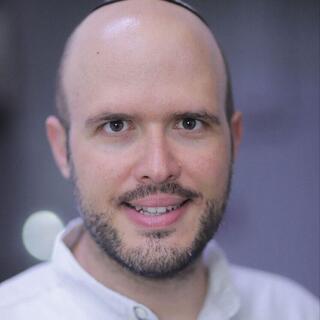
Maj. (res.) Y., 43, the operations officer of the 9300th Battalion in the IDF’s 810th Mountain Brigade, sent his father, Ehud, a photo of a cave he encountered during a patrol at the summit of Mount Hermon, the strategic high ground deep inside Syrian territory that returned to Israeli control following the collapse of the Assad regime.
“Does this look familiar?” the son asked. Ehud, 73, looked at the image and was immediately overwhelmed by memories. It was not just any cave. It had been his home during the freezing winter of 1974.
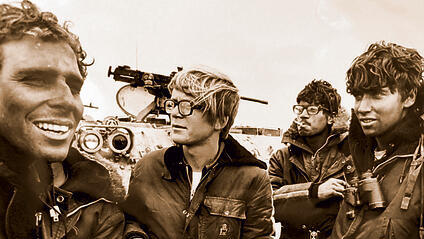
As a young company commander, Ehud led the force that carved the access road later known by its code name, the Urim Route, up the mountain to the cave at an altitude of 2,814 meters. Months later, following the IDF’s withdrawal, a United Nations post would be established at the site.
“We held the summit under constant 240 mm mortar fire, day and night, and went out on missions from there,” Ehud recalled.
That brief exchange revealed a reality neither father nor son could have imagined. Y., a high-tech development team manager from Kibbutz Yasa’ur who has served more than 350 days in reserve duty, now travels daily along a road in Syrian territory that his father helped build five decades earlier.
For Ehud, the ascent to the Syrian side of Mount Hermon is tied to memories of survival.
He assumed command of the 7th Brigade’s reconnaissance company immediately after the Yom Kippur War, when the unit was still recovering from fierce fighting near Buq’ata, where it lost 24 soldiers and its entire command staff.
The mission assigned to him by brigade commander Avigdor “Yanush” Ben-Gal was daunting.
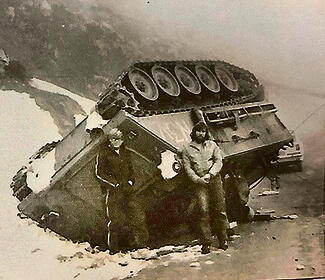
Ehud in front of the halftrack that overturned on the way to summit
“Before we arrived, a Sayeret Matkal force tried to reach the summit on foot,” Ehud told Ynet and Yedioth Ahronoth. “One of the soldiers froze to death on the way. The conditions were extreme. Helicopters could not land because of the clouds. In April, engineering corps D9 bulldozers arrived, and we guided them with flashlights in the dark. We paved the first road, from the Zefet Beton junction all the way to the peak.”
The memories of that route remain painful. Ehud described watching a Yasur helicopter crash before his eyes at a sharp bend in the road. He recalled physically restraining one of his soldiers who tried to run into the fire to rescue the wounded moments before the helicopter exploded.
“That was the battle for the summit,” the proud father said.
Fifty years later, the snow arrives later and the equipment is different, but the mission remains.
Y. is now completing a second consecutive year of reserve duty. His battalion was deployed to Israel’s north on October 7 and has remained there since.
“We have already done five rotations, from Rosh Hanikra to here,” he said. “I did not know most of these details about my father’s fighting until that conversation. I knew he fought on Mount Hermon, but I did not know he was the one who physically opened the road I am driving on today.”
The family’s military service stretches across generations. Ehud’s father fought in the Jewish Brigade before the establishment of the state. Today, Ehud’s grandson serves as a combat soldier in an elite unit.
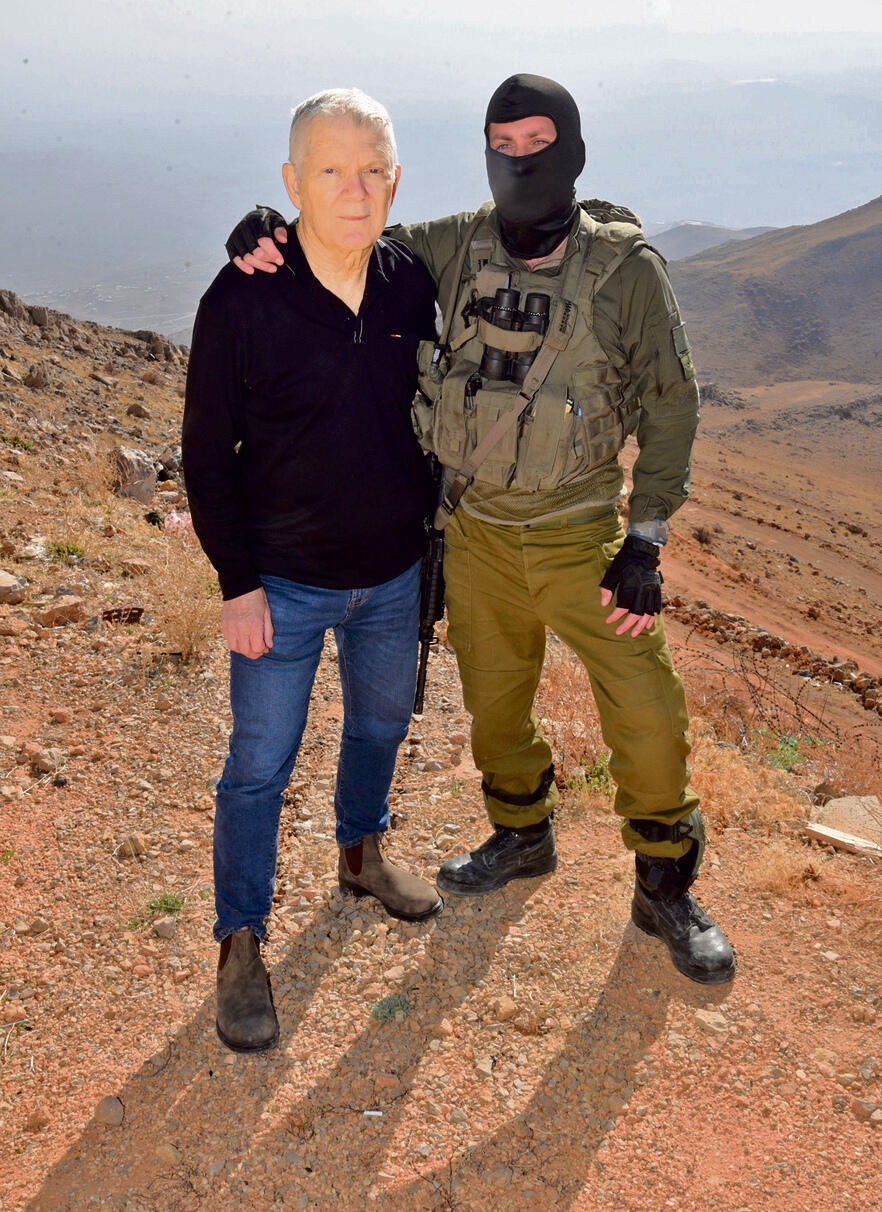
Ehud with his son Y.
(Photo: Avihu Shapira)
Last week, a jubilee book marking the capture of Mount Hermon and the establishment of Israel’s ski site by veterans of Moshav Neve Ativ was launched at the Mount Hermon site. Y. presented the book to his father.
In a handwritten dedication, he summed up their shared story: “The road is shaped by those who walk it. The road you shaped through your actions more than 50 years ago, I continue today, walking it with the battalion and carrying the same mission.”
Over the weekend, Ehud visited his son in the Mount Hermon sector. Together, they looked out over the road climbing toward the summit beyond the official border.
For Ehud, the moment was about far more than memory.
“My son is sitting with his command staff at the exact point where I once stood,” he said. “For me, that is the real victory.”