


As U.S. President Donald Trump accelerates efforts to secure a ceasefire and end the war in the Gaza Strip, Hamas is preparing to send a senior delegation to Cairo for renewed negotiations that could determine the fate of several of the most prominent Palestinian prisoners held in Israel.
The Hamas delegation is expected to meet with representatives from Qatar, Egypt and the United States to discuss the mechanism for releasing Israeli hostages. According to officials familiar with the talks, the first stage will focus on freeing the living captives, while later stages may address an Israeli military withdrawal from Gaza and the release of hundreds of Palestinian inmates.
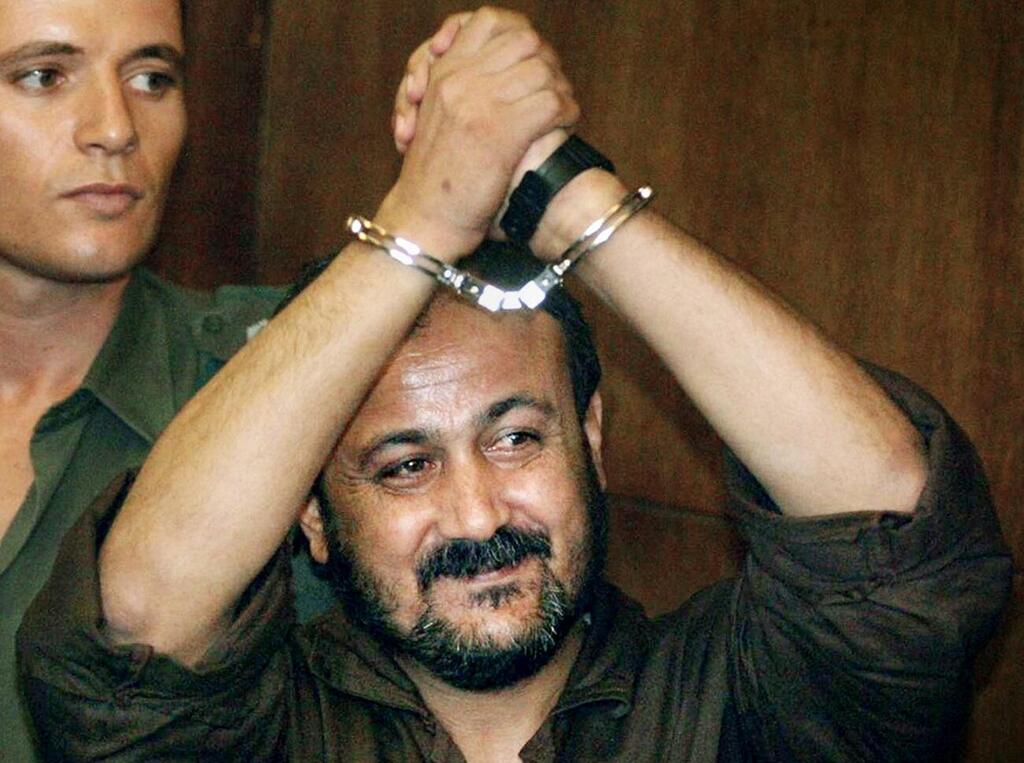
Hamas has demanded the release of 250 prisoners held in Israel in exchange for the return of hostages, including the bodies of those killed in captivity. Among those on the list are some of the most senior and long-serving Palestinian figures, including Marwan Barghouti, Ahmad Saadat, and Abdullah Barghouti, all of whom have become symbols of the Palestinian national movement.
Marwan Barghouti at the center of dispute
Marwan Barghouti, a senior Fatah leader, has been imprisoned for more than 23 years and is serving multiple life sentences for orchestrating attacks that killed Israelis during the Second Intifada. Now 65, he remains one of the most popular Palestinian figures and is frequently mentioned as a potential successor to Palestinian Authority President Mahmoud Abbas.
A senior Palestinian official told Ynet that “Barghouti represents an authentic Palestinian formula that has nothing to do with internal Israeli politics.” The official said Hamas is insisting on his release, calling it “the last opportunity to free him.”
The official also accused National Security Minister Itamar Ben-Gvir of exploiting Barghouti’s image for political purposes, referring to his recent visit to the prison where Barghouti is held. “The absurd visit and the photos were an open attempt to use his image for Israeli election propaganda,” the official said.
The same official argued that Barghouti is the only figure capable of stabilizing Palestinian society and leading it toward unity after Abbas’s decline in popularity. “The right-wing parties’ insistence on keeping him behind bars reflects a lack of real planning in Israel,” the official said. “All of Israel’s policy is focused on the Palestinians instead of the lives of Israeli citizens.”
Prime Minister Benjamin Netanyahu said in a statement that he hopes “in the coming days we will be able to announce the return of all our hostages.”
Negotiation framework
Ahead of the Cairo meetings, Hamas has prepared detailed lists of prisoners it seeks to have released, while Israeli negotiation teams are mapping potential escalation and withdrawal lines — issues that remain points of contention between the sides. The first stage of talks is expected to focus on freeing all Israeli hostages, while discussions on the identities of Palestinian prisoners and military withdrawal terms will be postponed to a later phase.
Hamas officials said “the details are relatively clear, and there is no intention to be dragged into lengthy negotiations. Israel will understand the technical issues.”
A Palestinian official familiar with the talks told Ynet that in the initial stages “there were doubts about releasing 50 prisoners that Hamas demanded, meaning not all were part of the original agreement.” The official added that Hamas intends for all the prisoners it names to be included in the final release lists, though “some of the names will be difficult for Israel to approve.”
The prominent inmates
According to the Palestinian Authority, Israel currently holds 117 Palestinian prisoners aged 60 and older, including 13 serving life sentences. Among the most prominent, in addition to Barghouti, is Ahmad Saadat, secretary-general of the Popular Front for the Liberation of Palestine (PFLP), who was convicted of planning the 2001 assassination of Israeli Tourism Minister Rehavam Ze’evi.
After Ze’evi’s assassination, Saadat fled to Yasser Arafat’s compound in Ramallah, where Arafat refused to hand him over. Israel responded by besieging the compound. Following U.S. and British mediation, Saadat was transferred to a Palestinian prison in Jericho guarded by American and British wardens. After Hamas’s 2006 election victory, Israeli forces captured him and brought him to prison in Israel. In 2008, he was sentenced to 30 years. Israel refused to release him in the 2011 Gilad Shalit exchange deal.
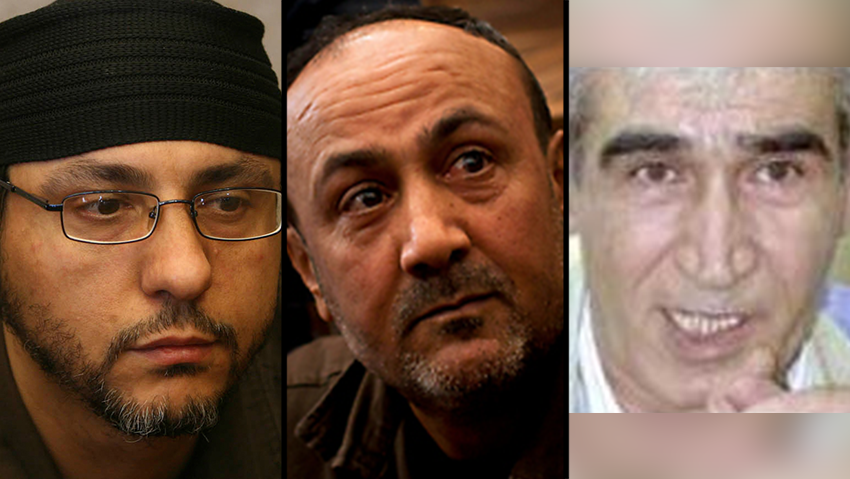
Ahmad Saadat, Marwan Barghouti and Abdullah Barghouti
(Photo: AP, Reuters)
Another key figure on Hamas’s list is Abdullah Barghouti, a Hamas operative and former commander in the group’s military wing in the West Bank. He is serving 67 life sentences — the longest cumulative sentence ever imposed in Israel — for his role in several deadly bombings during the early 2000s. Hamas was unable to secure his release in the Shalit deal.
Ibrahim Hamed, the former commander of Hamas’s Izz ad-Din al-Qassam Brigades in the West Bank, was described by Israeli security officials as the mastermind behind most of the suicide bombings during the Second Intifada. Captured after years on the run, he is serving multiple life sentences for planning attacks that killed dozens of Israelis.
Other high-profile prisoners include Abbas al-Sayyed, the lead planner of the 2002 Passover bombing at the Park Hotel in Netanya that killed 30 people, and Hassan Salameh, a Hamas commander trained by Hezbollah and Iran’s Revolutionary Guards. Salameh organized a wave of revenge bombings after the 1996 assassination of Hamas bombmaker Yahya Ayyash, killing dozens of Israelis. He was arrested in Hebron later that year and sentenced to 46 life terms.
While most Palestinian prisoners are not politically active, figures like Barghouti and Saadat retain symbolic influence across Palestinian society. Their possible inclusion in a future exchange deal could significantly shape both the outcome of the Cairo negotiations and the internal Palestinian political landscape.