

Iran’s top joint military command warned Saturday that its strikes could expand if the United States continues what Tehran called the “harassment” of Iranian ships, in the latest sign that the confrontation between the two countries may be entering a more dangerous phase.
The warning, carried by Iranian state media, came amid a sharp escalation at sea after U.S. forces struck three Iranian crude oil tankers following ballistic missile fire by the Islamic Revolutionary Guard Corps at two U.S. Navy warships.
US strikes Iranian tankers
(Video: CENTCOM)


U.S. Central Command said a U.S. aircraft carrier and a guided-missile destroyer successfully evaded multiple Iranian attacks and that no American personnel were harmed.
CENTCOM then said American forces permanently disabled the M/T Downy off Kharg Island and the M/T Stark 1 near Jask, while completely destroying the unladen M/T Kylo, also known as the Noxen, in the Gulf of Oman after ordering its crew to abandon ship.
“Let the message to the IRGC be clear: If you shoot at two of our ships, we will impose an even higher economic cost, taking out three of yours,” CENTCOM commander Adm. Brad Cooper said.
“We will not hesitate to defend American forces, and if necessary, destroy Iran’s limited and exposed oil fleet,” he added.
The Iranian warning suggests Tehran is prepared to widen its military response if Washington continues targeting vessels tied to the Islamic Republic.
It also comes amid growing concern in Israel and the United States that Iran may deliberately escalate the confrontation in an effort to raise the economic and political cost of the conflict and pressure President Donald Trump back toward negotiations.
An Israeli official familiar with current assessments said Saturday there was substance to recent U.S. intelligence suggesting Tehran is considering a significant escalation. The official said Iran may believe time is working against it and could seek to create greater regional instability, including pressure on oil prices, as leverage over Washington.
The same assessment raised the possibility that Iran could eventually attack Israel directly or first use one of its regional proxies to wear down Israeli defenses and send a signal without immediately exposing Tehran as the direct force behind an attack.
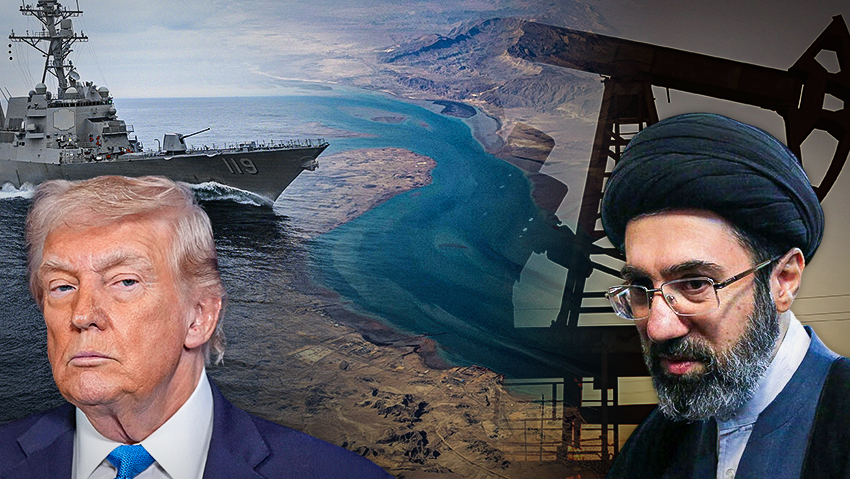
(Photo: shutterstock, AP/Alex Brandon, REUTERS/Stringer, Rouhollah Vahdati/ISNA/WANA (West Asia News Agency)/AFP, Lance Davis/United States Navy/Huntington Ingalls Industries)
Recent U.S. intelligence reporting has also suggested that Iran has grown more confident in its ability to strike targets across the Middle East after months of fighting and may be prepared to sustain the confrontation at least through the U.S. midterm elections.
That assessment has increased concern that further clashes at sea could become part of a broader Iranian strategy rather than isolated retaliation.
The latest confrontation around Iranian shipping follows renewed fighting near the Strait of Hormuz, where the United States has been escorting commercial vessels and striking Iranian military assets it says threaten freedom of navigation.
For Tehran, attacks on its oil fleet carry both military and economic significance. CENTCOM said the three tankers struck Saturday were part of a multibillion-dollar shadow network used to finance the IRGC and its regional proxies.
Iran’s threat to expand its strikes now raises the prospect of further attacks on U.S. naval forces or other American-linked targets if Washington continues targeting that network.
With both sides publicly signaling that they are prepared to impose higher costs on the other, the risk is growing that the naval confrontation could spill into a wider regional escalation.