

Why do Egypt, Jordan and Turkey need to “join” the Abraham Accords? U.S. President Donald Trump’s rare call for countries in the region to join the normalization agreements after a deal with Iran initially sounded like another American effort to expand the circle of peace with Israel. But the list Trump published raises the question: Why do Cairo, Amman and Ankara need to join the Abraham Accords if all three already have relations with Jerusalem, to varying degrees?
Egypt has had a peace treaty with Israel since 1979, and Jordan has had one since 1994. Turkey recognized Israel decades ago, and even after years of crises, the recall and return of ambassadors and a sharp deterioration following the war in Gaza, the diplomatic framework is not comparable to that of a country that does not recognize Israel at all. So if the Abraham Accords are merely another name for basic normalization with Israel, Trump’s call appears confusing.
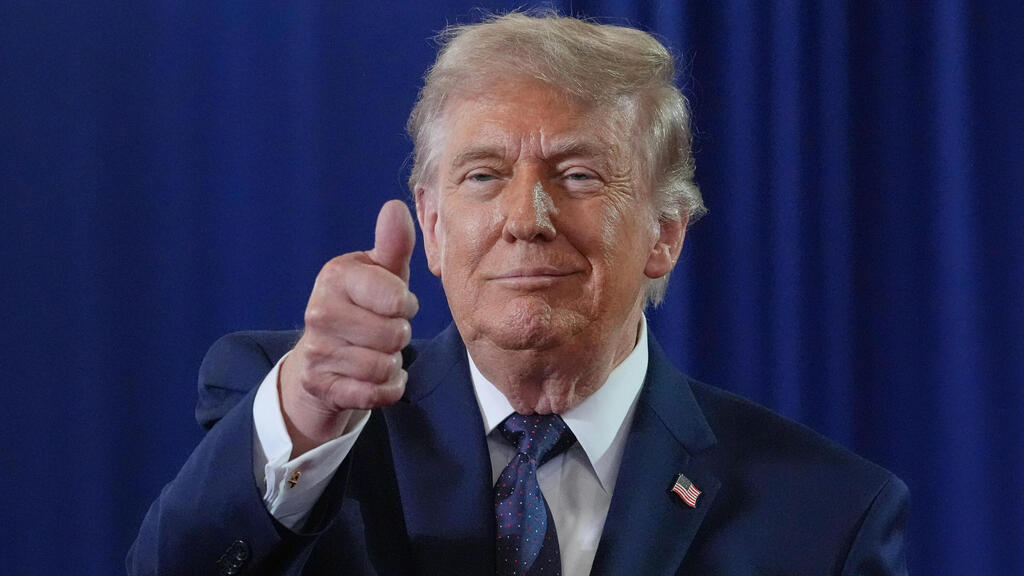
In a post published Monday on his Truth Social platform, Trump linked the emerging arrangement with Iran to an expansion of the Abraham Accords. He wrote that after all the work the United States had done to put together what he described as a highly complex puzzle, it should be “mandatory” for the countries involved to sign the accords at the same time. He explicitly named Saudi Arabia, Qatar, Pakistan, Turkey, Egypt and Jordan, along with the United Arab Emirates and Bahrain, which have already signed the agreements, and added that perhaps one or two countries might have a reason not to do so.
Trump, then, is not speaking only about another country opening an embassy in Israel or about additional direct flights. At least at the level of rhetoric, he is trying to turn the arrangement with Iran into a comprehensive regional deal: not only ending the war or reaching a nuclear agreement, but also creating a new framework that includes Israel, the Gulf states, Egypt, Jordan, Turkey and Pakistan, forming a regional axis against Iran with an American stamp of approval.
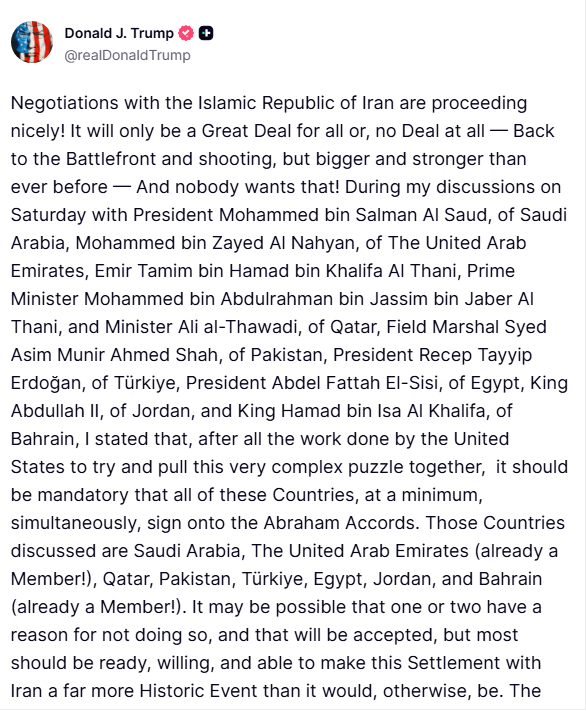
Trump’s post
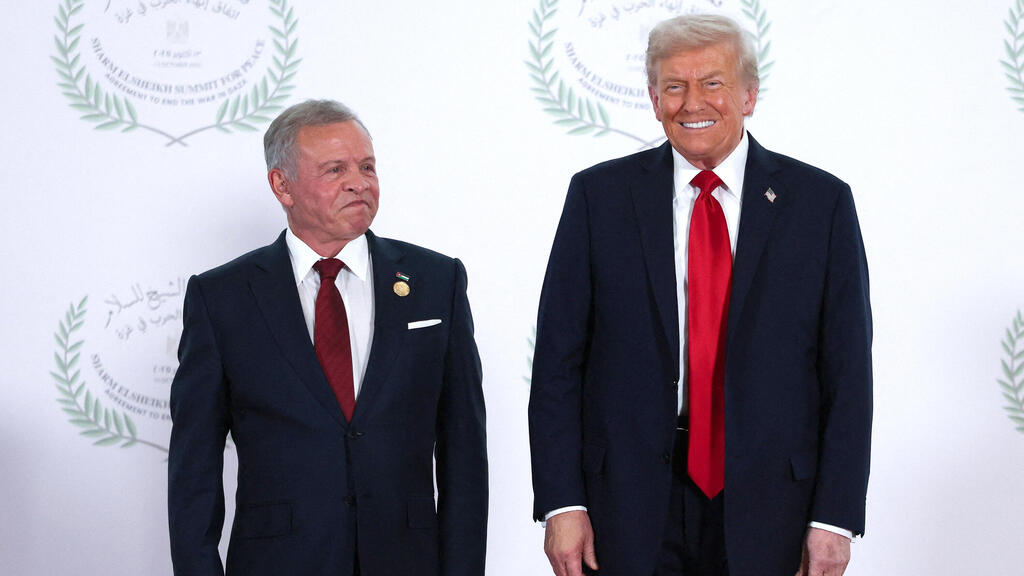
Trump alongside Jordan’s King Abdullah
(Photo: Suzanne Plunkett - Pool / Getty Images)
That is also why Jordan does not necessarily view the mention of Amman as a “technical mistake.” Dahham Metqal al-Fawaz, a Jordanian commentator on Middle East affairs, told ynet that “the mention of Jordan in Trump’s message was not merely formal, but a message that Jordan is an essential part of any new regional arrangement.”
He said Jordan holds sensitive cards that cannot be ignored: Jerusalem, the West Bank, border security and the balance among Israel, the Gulf states and the Palestinians.
Al-Fawaz added that from Washington’s perspective, any expansion of the Abraham Accords, or any broader regional understanding, requires Jordan to be part of the equation, even if that is done “through calculated political silence.”
“What is happening today is not only political rapprochement, but an American attempt to build a new regional axis that includes the Gulf, Israel, Turkey, Egypt and Jordan in order to reshape the Middle East militarily and economically,” he said. “That is why Jordan was mentioned, because Washington understands that the stability of any regional project begins in Amman, not in media statements.”
In Egypt, the picture is similar, though less sensitive in declarative terms. Cairo is already at peace with Israel, but the relationship has remained over the years largely one between states, militaries, intelligence services and borders, and less a warm public relationship. Joining a renewed Abraham Accords framework would not be meant to “recognize” Israel again, but to bring Egypt into a broader regional mechanism that could include economic, security and diplomatic cooperation around Gaza, the Red Sea, Iran and future arrangements in the Middle East.
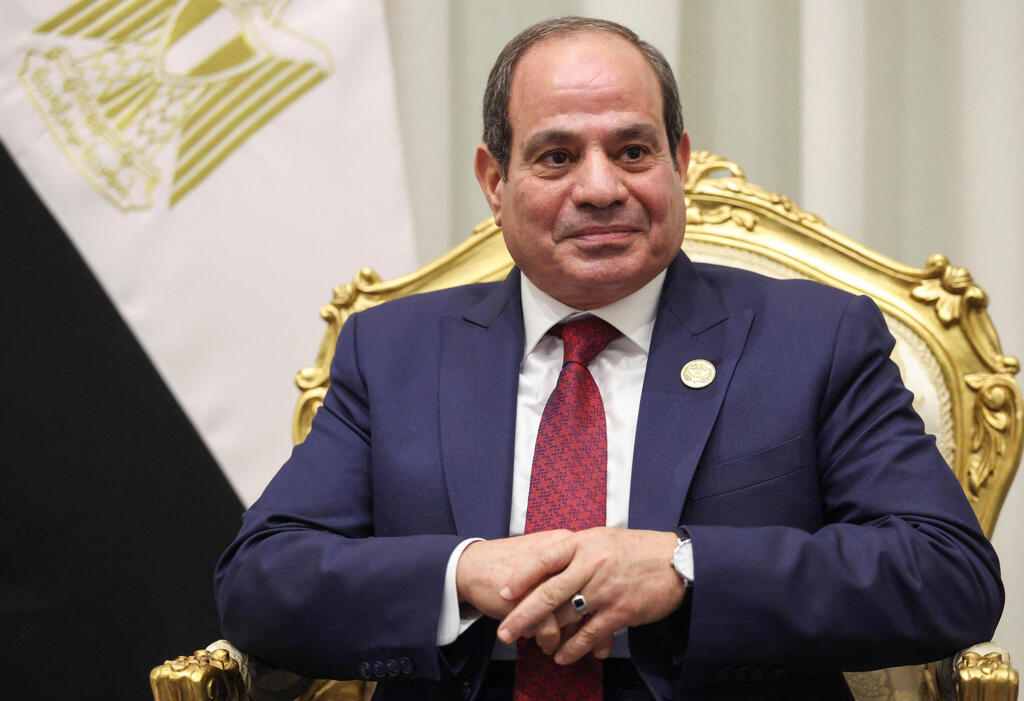
Egyptian President Abdel Fattah el-Sisi; cold peace with Israel
(Photo: Evelyn Hockstein/Reuters)
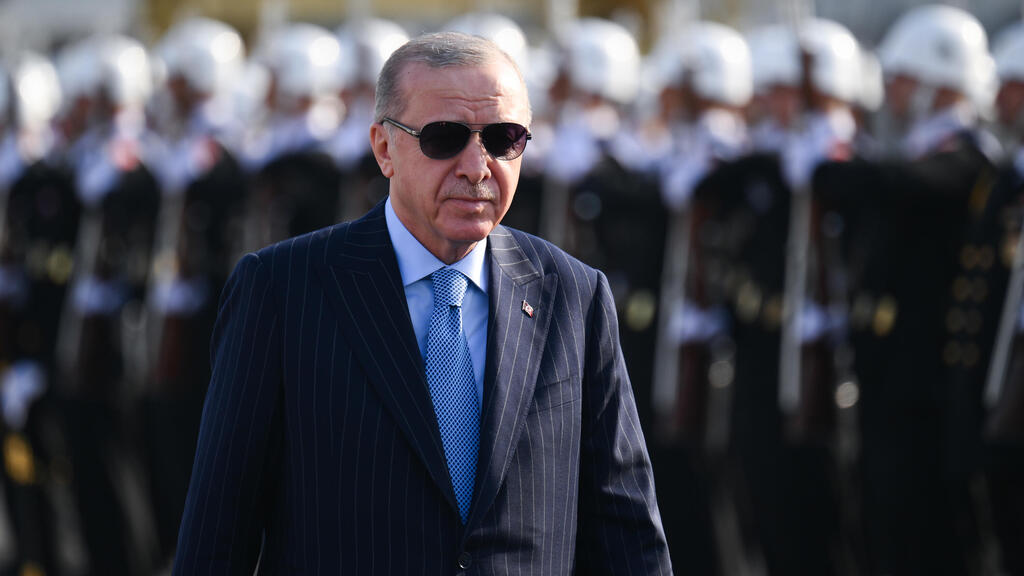
Erdogan; deep political crisis between Ankara and Jerusalem
(Photo: from X)
Turkey is an entirely different case. It has historic relations with Israel, but the issue today is not recognition itself. Rather, it is the deep political crisis with President Recep Tayyip Erdogan and his government. Ankara has hardened its line against Israel in recent years, halted direct trade following the war in Gaza and adopted rhetoric against Jerusalem that has become among the harshest in the Muslim world. Therefore, Turkish “accession” to the Abraham Accords, if it can be imagined at all, would not be a new peace agreement, but a dramatic shift in direction by Erdogan or by another Turkish government toward Israel.
The Saudi ‘prize’ and the two mediators
Saudi Arabia remains the major prize for Trump and Israel. Riyadh does not rule out normalization in principle, but a Saudi source told CNN on Monday after Trump’s remarks that the Saudi position had not changed: Relations with Israel would be possible only if there is an “irreversible path” to a Palestinian state. For Crown Prince Mohammed bin Salman, an agreement with Israel could be part of a broad strategic deal with the United States, but after the war in Gaza, the Palestinian price has become higher, at least outwardly.
Saudi commentator Abdul Hameed al-Ghobain also told ynet that Riyadh does not view normalization as a matter of American pressure or a quick deal with Israel.
“The problem is not pushing Saudi Arabia toward peace as though it were a country waiting for approval or pressure,” he said. Al-Ghobain said that in order to understand Saudi Arabia’s position, “one must return to its political and moral roots: The kingdom does not oppose peace or stability, but it also does not see the Middle East only through the lens of narrow self-interest.”
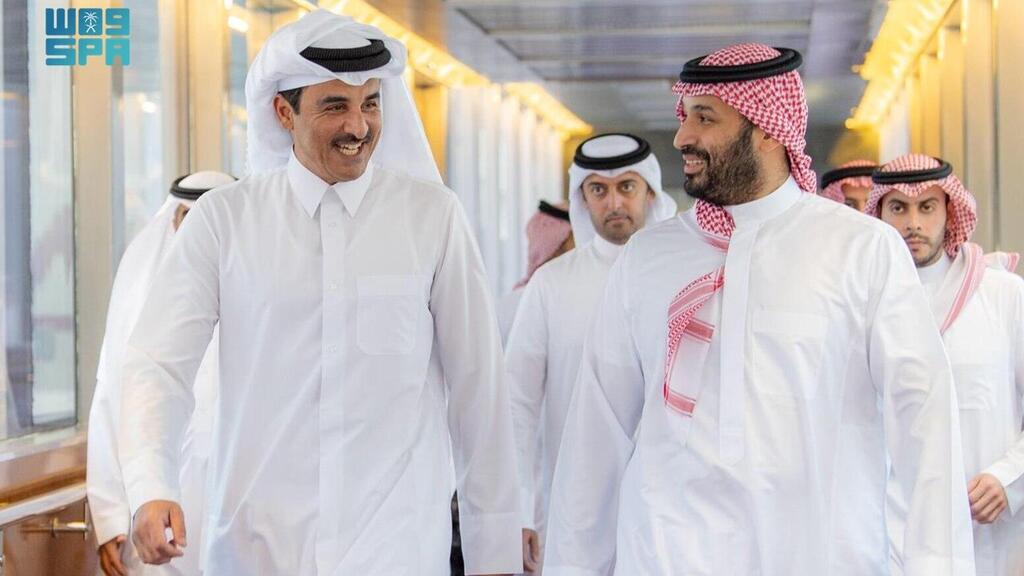
The Saudi crown prince and the emir of Qatar; Riyadh wants an 'irreversible path' to a Palestinian state, while Doha seeks to maintain its channels of influence
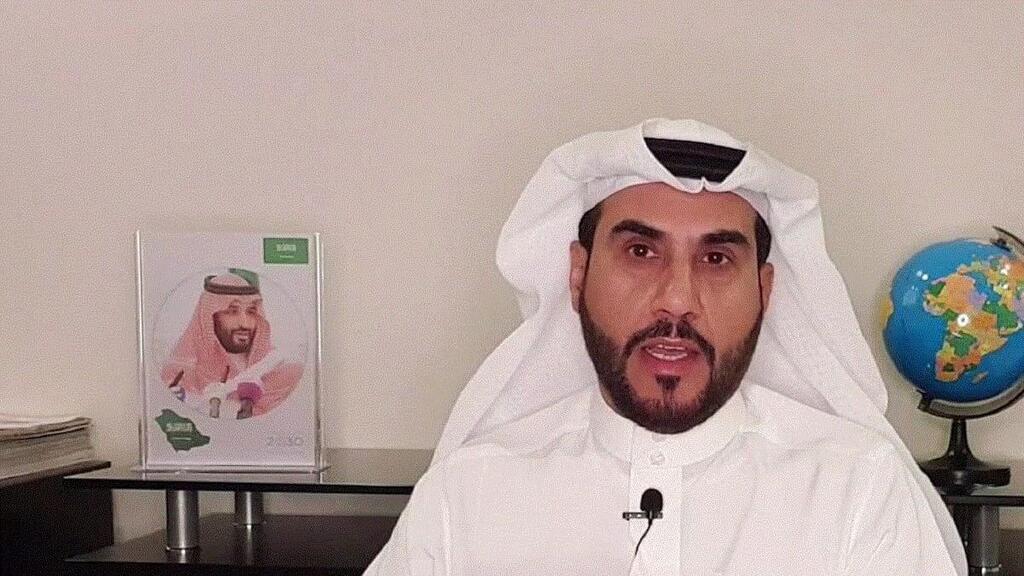
Saudi commentator al-Ghobain
He said Saudi Arabia acts from a position of influence in the Arab and Muslim world, and therefore cannot separate peace from the rights of Palestinians and Arabs.
“Trump’s call may be significant in form, but it is fundamentally flawed if it ignores the core of the conflict,” he said. “Riyadh does not reject the idea of peace, but it rejects peace that requires the victim to disappear so the picture can be complete.”
Qatar poses a different kind of challenge. It does not have full diplomatic relations with Israel, but it is one of the key countries in regional contacts: It mediates with Hamas, maintains channels with Washington and pursues a policy that allows it to speak with almost all sides. Its accession to the Abraham Accords would be a dramatic shift, but also one that could harm its role as a mediator, especially as long as it seeks to preserve its channels of influence with Hamas and the Arab world.
A Qatari official told ynet on Monday evening that “the position is clear, as was stated today. We adhere to the firm position that there must be an irreversible path toward the establishment of a Palestinian state.”
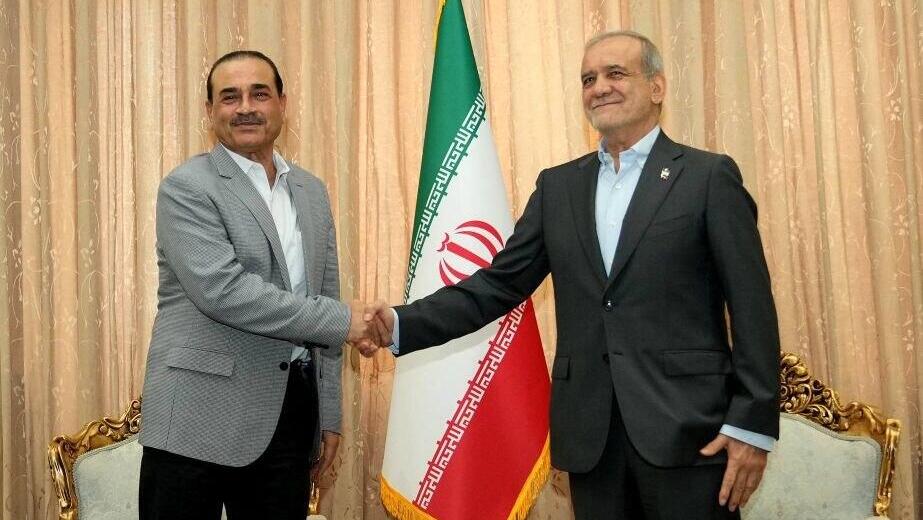
Pakistan’s army chief alongside Iran’s president, the day before yesterday; Islamabad rejects linking an Iran deal to the Abraham Accords
Pakistan is probably the most distant case. The country does not recognize Israel, and its connection to the Palestinian issue is deep politically, religiously and publicly. A Pakistani journalist and media figure familiar with the matter told ynet that “Pakistan will not become part of this,” noting that Trump himself said one or two countries might not sign. Another Pakistani journalist said that “Pakistan will not normalize relations until there is a two-state solution.”
A Pakistani source familiar with the matter, quoted by Reuters, also said Trump’s remarks reflect an attempt to use ceasefire diplomacy with Iran to advance a broader move around the Abraham Accords, but Islamabad rejects that linkage. The two issues “are not connected to each other, and cannot be made so,” the source said, adding that Pakistan is “not obligated to respond to such a demand.”
In Islamabad, any such move could be seen as breaking a historic line on Israel, especially at a time when public opinion in the country is deeply hostile to Jerusalem.
Trump’s call, then, may not be a precise work plan but rather the setting of a maximal opening position. From his perspective, an arrangement with Iran is not supposed to end only with a nuclear agreement or the end of the war. It should become a “historic event,” one that reorganizes the Middle East around the United States and Israel. No longer would the Abraham Accords be a project of limited normalization with one Arab country or another, but an attempt to turn them into a comprehensive regional umbrella.