

In light of the ceasefire in the Iran war, the unresolved problem of the Gaza Strip is once again coming into sharper focus, six months after the agreement ending the conflict in the enclave was signed.
During that period, a dramatic change was supposed to take place in Gaza, centered on the disarmament — or at least the beginning of the disarmament — of Hamas and the establishment of a new political order under the auspices of the Board of Peace created by U.S. President Donald Trump. It was to be administered by a Palestinian technocratic government, alongside international forces planned for deployment on the ground.
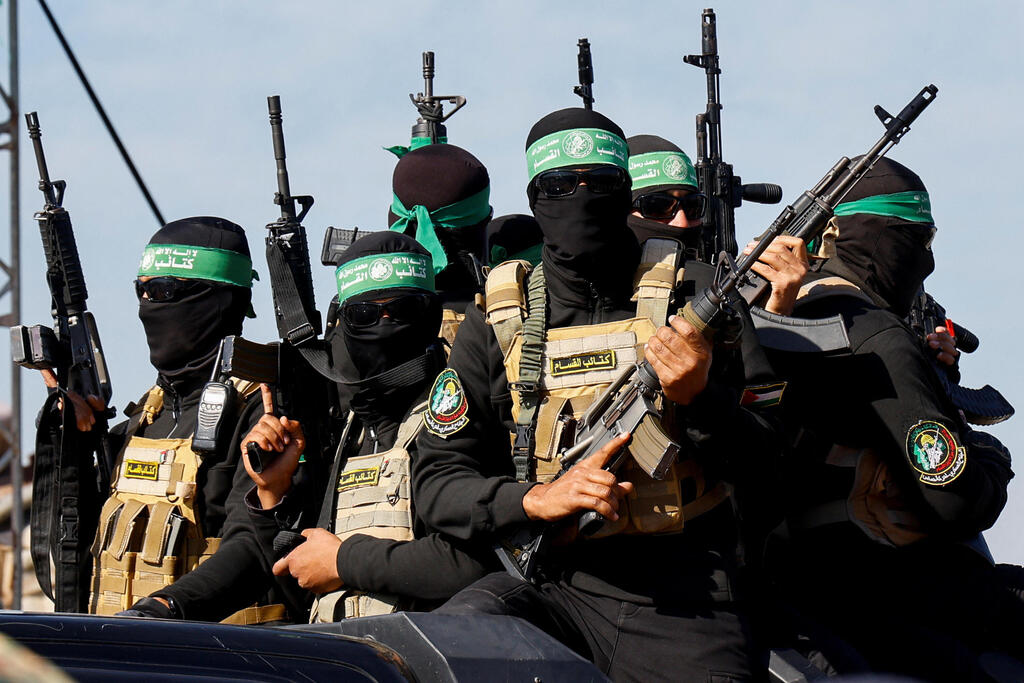
In practice, six months later, Gaza is not fundamentally different from what it was last October. The intense fighting has stopped, but IDF strikes and violent friction continue along the so-called “yellow line” ceasefire demarcation dividing the Hamas-ruled and Israeli-controlled parts of the enclave. According to the Palestinians, more than 800 people have been killed in those strikes since the ceasefire.
Two million Gazans, crowded into 47% of the territory, are living among rubble, with nearly 100% unemployment and poverty, and remain dependent on outside aid. Only a few thousand members of Israel-backed militias and their families live in the Israeli-controlled part of the territory.
Movement into and out of Gaza remains restricted, despite the opening of the Rafah crossing in February. So far, about 1,800 patients and their escorts have left the enclave for medical treatment abroad, out of many thousands still waiting to do so.
There is still no sign of the arrival of the technocratic government or of the realization of the glossy reconstruction plans included in the American presentations.
“During the war against Iran and Lebanon, Gaza was indeed neglected, but the talks held about two weeks ago in Cairo between Hamas and Nikolay Mladenov, the high representative for Gaza on behalf of the Board of Peace, revive the discussion on the issue and, in particular, raise again the question of when and whether the technocratic government will begin operating,” said Prof. Mkhaimar Abusada, a political scientist at Al-Azhar University in Gaza.
“If the confrontation with Iran does not flare up again, I believe we will soon see progress on the Gaza question,” he added.
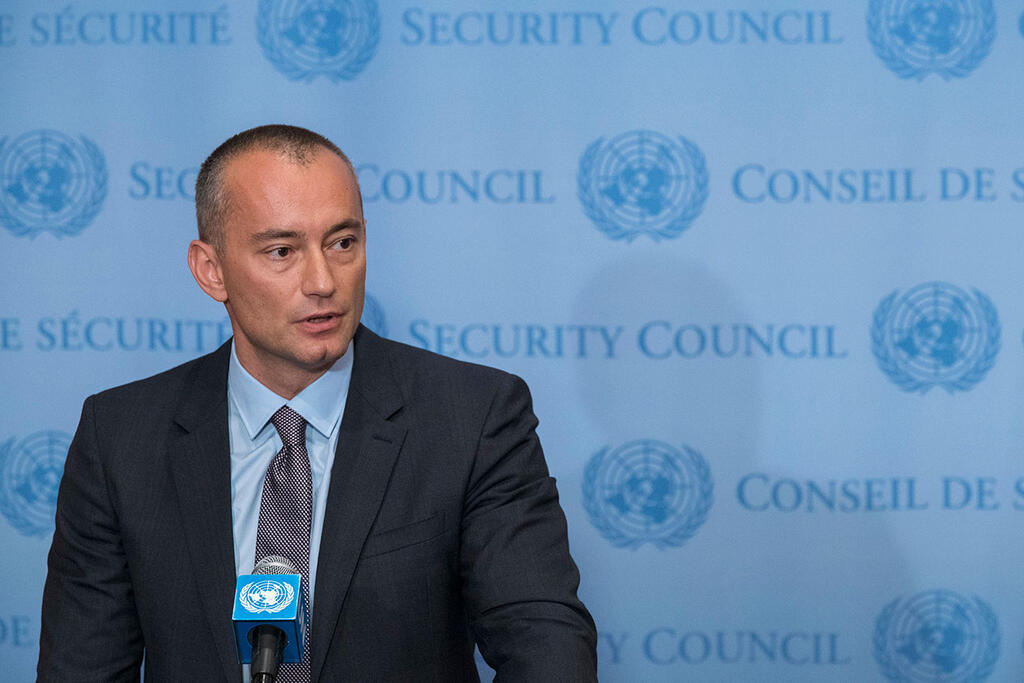
High Representative for Gaza Nikolay Mladenov
(Photo: AP)
At least for now, however, there are no signs of progress. “Trump’s plan has reached a sensitive historic crossroads,” Mladenov said last month, summing up six months since the ceasefire.
“The end of the war has not brought the change the residents of Gaza had hoped for,” he said. “The ongoing strikes and humanitarian shortages reflect a wide gap between the political understandings that were reached and the reality on the ground.”
Mladenov also emphasized the importance of the technocratic government. “It is a bridge between Gaza and the West Bank,” he said. “Israel’s control over half the territory, alongside the destruction of infrastructure, constitutes a major obstacle to implementing the plan.”
He also appeared to take a swipe at those in Israel who seek to conquer Gaza or annex the West Bank, saying: “Gaza is an integral part of the future Palestinian state.”
The main stumbling block remains Hamas’ disarmament. “Israel’s insistence on including the issue of disarmament in the discussions on arrangements in the strip contradicts the Trump plan and delays the full implementation of the agreement’s second phase,” Hazem Qassem, Hamas’ spokesman in Gaza, said last week.
“Abu Obeida 2,” the spokesman for the group’s military wing who replaced Hudhaifa Kahlout — the original Abu Obeida — after he was killed in August, made clear there was no room to discuss the issue. Other Hamas leaders have stressed that the matter is existential for the organization. At most, they say, Hamas would be prepared to give up offensive weapons — mainly rockets, few of which remain in Gaza — but not its other arms.
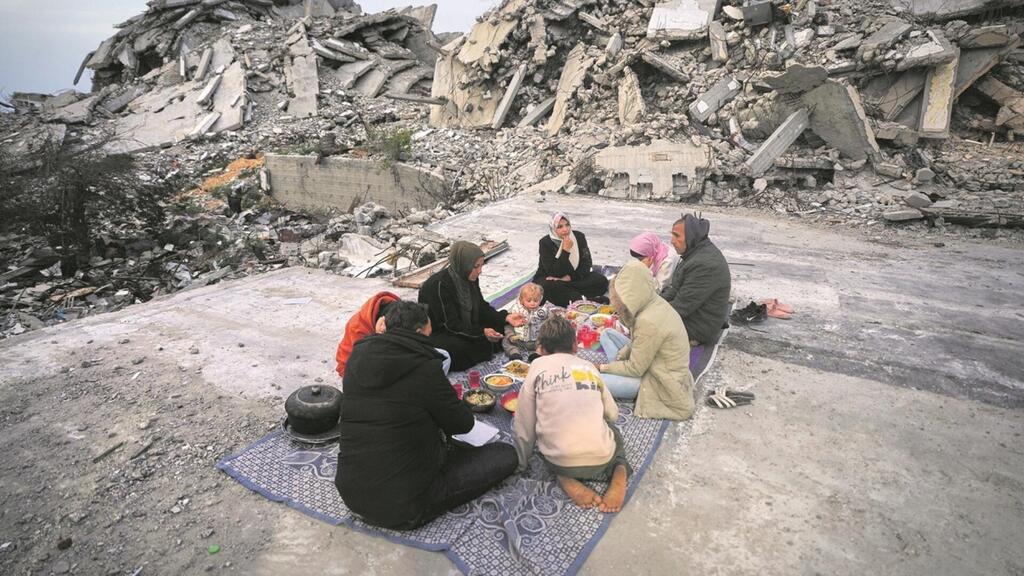
(Photo: Jehad Alshrafi/AP)
U.S. officials, including Secretary of State Marco Rubio, have offered a different assessment, saying they have identified “encouraging signs” in talks on Hamas’ disarmament. The New York Times reported last month that Hamas had agreed to transfer thousands of light weapons held by its police forces, as well as full internal security authority, to the technocratic government once it arrives in Gaza. The report has not been independently confirmed.
In Gaza’s not-entirely-stable reality, one thing is clear: Hamas remains the dominant force. The terrorist organization, which has been likened by its enemies to the Nazis and whose defeat has often been described in Israel as a “battle for Berlin,” controls public order, hunts agents and collaborators, dominates humanitarian aid through taxation and organized looting, has beaten back the Palestinian militias cultivated by Israel — including, according to reports this week, repelling a combined attack by several such groups backed by Israel — and runs the education system and religious establishment that allow it to keep shaping minds, especially those of the younger generation.
As a result, Israel has focused its strikes on Gaza’s police forces, which represent and consolidate Hamas’ rule, particularly targeting police vehicles and checkpoints.
“The focus on the police is meant to prevent the establishment of order and create anarchy, in addition to making life unbearable for Gazans in order to encourage displacement from Gaza,” said Gaza-based political analyst Ahmed al-Tanani.
The Iran war does not appear to be causing concern in Hamas. On the contrary, the fact that Iran and Hezbollah survived the intense campaign and were not defeated through “total victory” has brought a measure of optimism to those who adhere to the doctrine of resistance, known in Arabic as muqawama.
The prevailing hope among Palestinians, including Hamas, is that Trump will seek to establish a “Pax Americana” in the Middle East and, like President George H.W. Bush after the first Gulf War, compel Israel to accept an arrangement on the Palestinian issue even against its own positions, as happened with the Madrid peace conference.
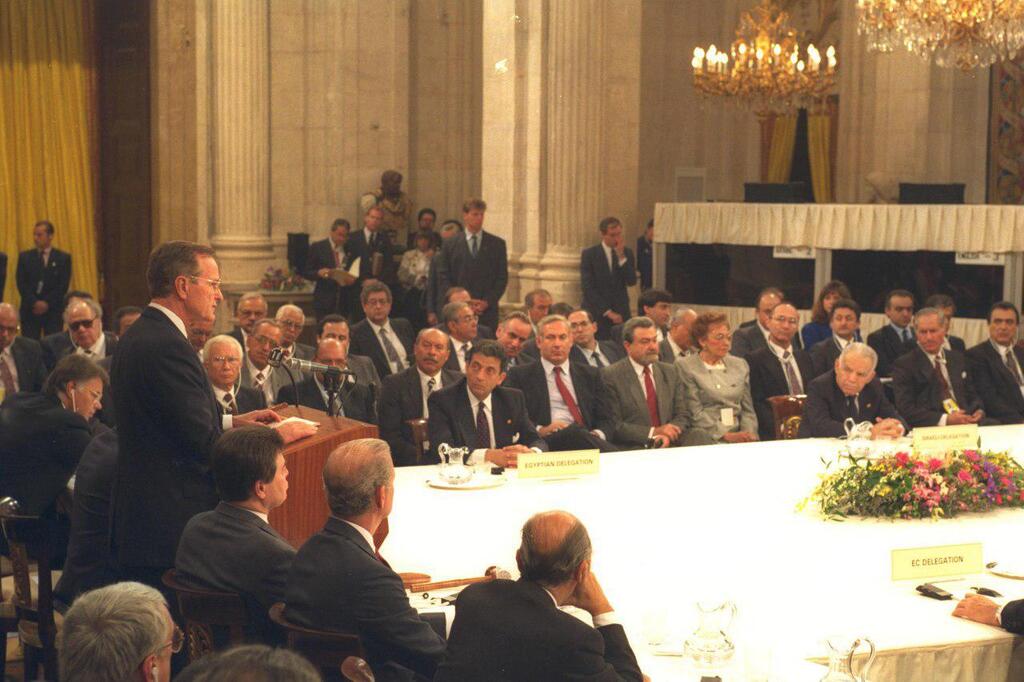
US President George H.W. Bush addresses the Madrid Conference, 1991
(Photo: Moshe Milner/GPO)
The wish in Gaza is that Trump’s plan will soon be fully implemented and that, alongside reconstruction and a new governing order, pressure will also be placed on Israel to withdraw from the yellow line, which many in Israel describe as the “new security border.”
Hamas, for its part, says it would welcome the technocratic government, a position that reflects a desire to replicate the Hezbollah model in Lebanon: accepting a weak government that would allow the organization to continue acting as the real power in Gaza.
Hamas itself is focused on rebuilding its power, especially militarily, and, according to an intelligence document recently presented to Israel’s political leadership, is using the ceasefire to strengthen itself on all fronts.
“In general, the condition of the military wing is difficult,” a security official said. “Its commanders today were junior figures until two and a half years ago, but because of the intensive assassinations, they were appointed to senior positions quickly and without the necessary experience and training. There are people who were company commanders on Oct. 7 and are now brigade commanders.
“In addition, there is clear financial distress, and there is no ability to smuggle weapons or production equipment as there was before Oct. 7, because the IDF has hermetic control over all the borders of the Palestinian territory of the enclave,” the official said.
Still, the official said, Hamas is working to recruit new operatives, including through activity in mosques and the distribution of leaflets aimed mainly at the younger generation. The group is also stockpiling weapons, including by dismantling unexploded Israeli ordnance to build explosive devices, and moving arms between areas and units.
New military facilities are being established, including in schools and hospitals — a phenomenon the official said stems in part from a severe “real estate shortage” in Gaza today. Hamas is also studying lessons from the war, formulating an updated combat doctrine and working to pass it on, the official said.
Another security official described Hamas’ efforts to consolidate its governing status. “The organization is expanding the provision of civilian services in every field, and every day departments are being opened in hospitals, classrooms in schools and faculties in universities,” the official said. “The public’s condition is indeed difficult, but at the moment, we are not identifying criticism or protest against Hamas.
“The organization, for its part, has sharp sensors for reading the mood on the street, and it knows, for example, when to reduce its presence and enforcement in places and at times where it senses they could create friction with the population,” the official said.
Another challenge appears to be paying the group’s operatives. The gaps between salary payments are growing, and the amounts have also been reduced — from about 2,000 shekels, or about $640, for a rank-and-file operative in the past to about 800 shekels, or about $270, today. The shortfall is being partly made up through the distribution of civilian goods, some of them from humanitarian aid whose entry into Gaza Hamas controls.
The Hamas leadership in Gaza is now made up of figures who were backbenchers before Oct. 7. Chief among them are Ali al-Amoudi, who is responsible for the movement’s organizational and governing mechanisms; Izz al-Din Haddad, head of the military wing; and Mohammed Odeh, who previously headed intelligence. They are in contact with senior Hamas officials abroad, led by Khalil al-Hayya. That ongoing dialogue allows Gaza to retain its status as a leading arena within Hamas.
Meanwhile, local elections were held in Gaza last Saturday for the first time in 20 years, an event that drew little interest from the Palestinian Authority, Hamas or the public. The focus of the elections was in the West Bank, and in Gaza they were held only in Deir al-Balah, “the only place where both a city and a municipality remain intact,” said a Fatah activist involved in running one of the lists.
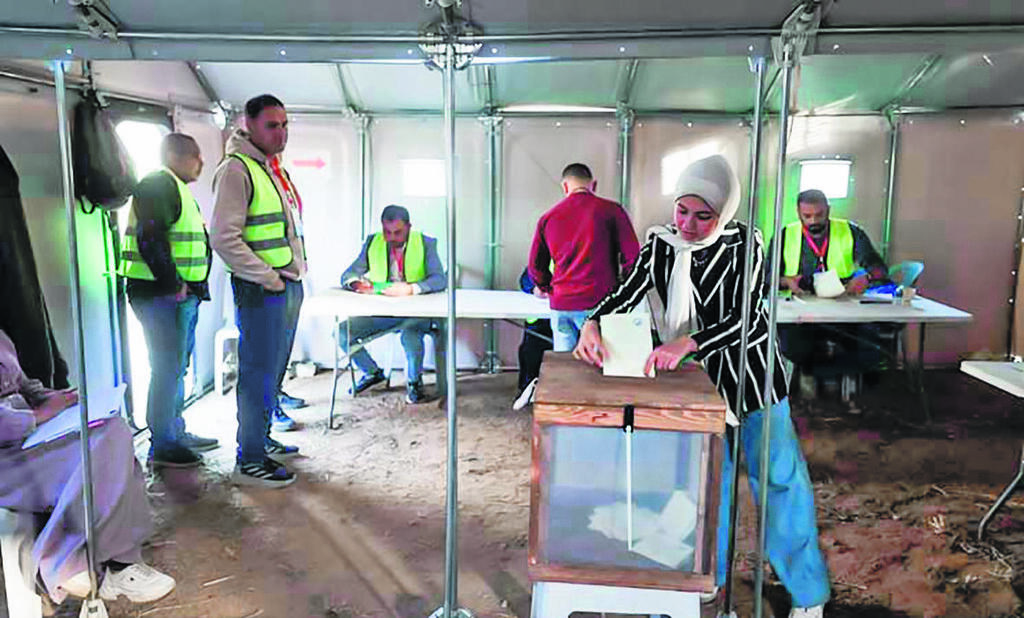
A woman places her vote in the municipal elections, Deir al-Balah, Gaza
A security official sharpened the point: “Following the destruction in the large cities, such as Gaza City and Khan Younis, Deir al-Balah’s importance is rising as it becomes a governing center and an important power base for Hamas.”
Voter turnout in the city was 22%, compared with 53.4% in the West Bank, reflecting broad indifference. The seats were divided among a list identified with Hamas — the organization did not run officially because participation required recognition of the political agreements signed by the Palestinian Authority — along with lists affiliated with Fatah and independent groups.
Hamas representatives downplayed the fact that the organization won only two of the 15 seats on the city council, arguing that the elections do not reflect the reality on the ground and, by implication, the group’s firm grip there.
The reality in Gaza embodies truths that many in Israel find difficult to accept: that despite stunning military successes on all fronts, zealous ideological enemies do not disappear even after painful decapitation strikes — above all, of course, against Ali Khamenei, Hassan Nasrallah, Yahyah Sinwar, Ismail Haniyeh and most of their successors; that there is no classic military decision in conflicts against this kind of enemy; and that the end must involve an arrangement or a political track, terms that are often mocked in Israel, only for it to discover afterward that such complacency causes serious damage.
Gaza was the first place where Israel was forced to confront the need to deal with a least-bad alternative instead of continuing to wave around baseless fantasies. But instead of studying that gap and avoiding it, Israel repeated it in the confrontations with Iran and Lebanon, which are being channeled into political arrangements effectively imposed on Israel, without “total victory” in the form of toppling the regime in Tehran or eliminating Hezbollah.
Israel now faces three alternatives regarding the Gaza Strip: continuing the current reality, which lacks strategy and direction; seeking a decisive outcome that would include renewed high-intensity war and the conquest of the entire enclave, a move Trump does not appear likely to approve at this stage; or accepting — whether Israel wants to or not — an arrangement based on a technocratic government, with Hamas weakened and limited but not gone, requiring Israel to continue acting against it.
Once again, it appears that the path chosen from among the three will not be decided by policymakers in Jerusalem, but by one person sitting in Washington.
- Dr. Milstein is head of the Palestinian Studies Forum at the Dayan Center at Tel Aviv University.