

A landmark ruling by the High Court of Justice has reshaped the legal and political landscape surrounding a sensitive investigation into the outgoing military advocate general, Maj. Gen. Yifat Tomer-Yerushalmi.
The court struck down Justice Minister Yariv Levin’s appointment of retired Judge Asher Kula to oversee the probe — but at the same time affirmed Levin’s authority to name a replacement, under strict conditions.
Gallery

Justice Minister Yariv Levin, State Ombudsman for Judges Asher Kula
(Photo: Judicial Authority, Shaul Golan, Alex Kolomoisky)
Why was Judge Kula disqualified?
The court accepted Attorney General Gali Baharav-Miara’s argument that Kula, in his role as state ombudsman for judges, is barred by law from taking on additional responsibilities. Kula had indicated he would respect the ruling and would not fight to retain the appointment.
What did the court allow Levin to do?
Crucially, the court upheld Levin’s right to appoint an alternative investigator. This marks a significant departure from previous practice, allowing a political figure to play a role in appointing an official to oversee a criminal investigation—if and only if the attorney general is deemed to be in a conflict of interest, as the court agreed was the case here.
Who can Levin appoint?
The justices made clear that Levin’s next nominee cannot be a political appointee or lack investigative experience. Instead, they outlined specific criteria: the appointee must be a senior public servant with expertise in criminal law and a clear professional track record in investigations and prosecutions—comparable to a senior state prosecutor.
Justice Alex Stein wrote that the individual must be free from “personal interests or political influence,” signaling that the court will scrutinize any future nomination. If Levin’s next pick fails to meet these conditions, the appointment could face another legal challenge.
What happens next in the investigation?
Tomer-Yerushalmi remains hospitalized, and police say they will not seek to extend her house arrest for now. However, sources say she has not yet been questioned in the hospital, and her status in the investigation remains unresolved.
Why is the ruling significant?
This is the first time the High Court has formally acknowledged that a justice minister can appoint someone outside the attorney general’s office to supervise a criminal probe—provided legal conflicts exist. Yet the ruling has alarmed some senior legal officials, who warn it could open the door to politicization of law enforcement.
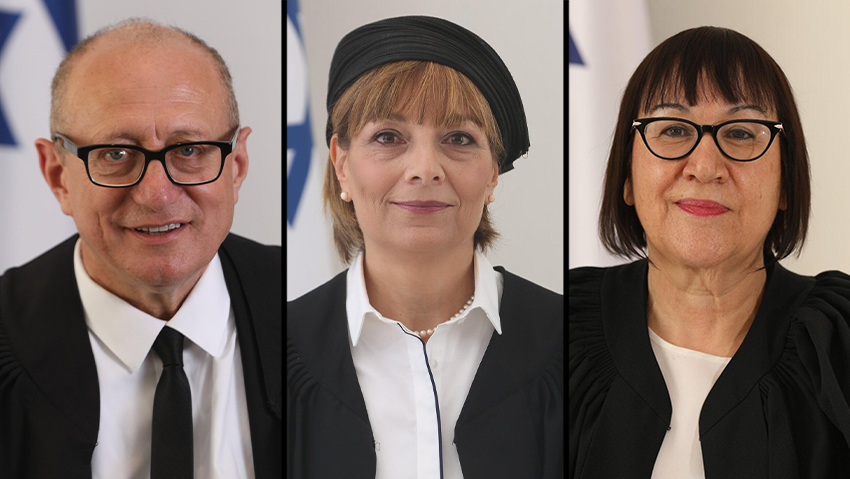
Supreme Court Justices Alex Stein, Yael Willner and Gila Canfy-Steinitz
(Photo: Judicial Authority)
Critics fear that future justice ministers might use the precedent to bypass the attorney general in other politically sensitive cases by declaring them “exceptional” and appointing hand-picked investigators.
How did the court rule on the attorney general’s role?
While the court agreed with Baharav-Miara on Kula’s disqualification, it rejected her position that the attorney general’s office and the state prosecution could continue to manage the investigation. The court ruled that both are conflicted in this case and sharply criticized their failure to properly examine the conflict-of-interest claims.
The court stated that any future involvement by the attorney general or prosecution would depend on whether their testimony or participation is required during the investigation. If they are not directly involved, their conflict could be resolved, allowing them to return for the decision on whether to pursue indictments.
Bottom line:
The High Court’s decision establishes a new, conditional path for ministerial oversight of criminal investigations when the attorney general is conflicted. It blocked Levin’s initial pick but left the door open for him to appoint a suitable, apolitical legal expert. The ruling is being hailed as both a check on political overreach and a cautionary turning point for Israel’s legal system.
Attorney Zion Amir, who represented Levin, said the ruling marked “a huge achievement” for the justice minister. “The court accepted most of the minister’s arguments and ruled that he acted within his legal authority by appointing an investigator outside the State Attorney’s Office,” Amir said. “The court also accepted that the attorney general is barred from managing the investigation, as is the rest of the legal establishment. However, we regret that the court ruled Judge Kula is disqualified under the ombudsman law.”
Knesset Constitution Committee Chair MK Simcha Rothman, a vocal critic of the attorney general, took aim at Baharav-Miara. “Who would’ve believed it? Another position by the so-called ‘official interpreter of the law’—who blocks the government daily from receiving authentic representation—has been rejected by the court,” Rothman wrote on X. “That Levin’s position wasn’t fully accepted is irrelevant. If he had obstructed the process through bullying and a conflict of interest, only then could the cases be compared.”
MK Moshe Saada, a former senior prosecutor, also welcomed the decision. “The High Court’s recognition of the justice minister’s sole authority is an important and correct ruling that begins to restore power to elected officials,” he said. “I’m pleased the opinion I submitted to the justice minister—asserting that he alone holds the authority and that the attorney general and prosecution are in a serious conflict of interest—was fully accepted by the court. I now intend to propose additional candidates to the minister and push for an urgent appointment of an external figure who will seek the truth, not protect the system, as has been the case until now.”
Foreign Minister Gideon Sa’ar also praised the ruling, calling it “dramatic and important.” In a post on X, he wrote, “The key ruling that the justice minister has appointment authority under the exceptional circumstances of this case—contrary to the attorney general’s stance—is a major victory for Levin’s fight. I commend him. This decision aligns with justice, as opposed to the distorted approach presented to the court by the attorney general’s office.”
Liran Tamari contributed to this report