

Clashes in Tehran continued Monday as the United States began evacuating personnel from Lebanon and bolstering its military presence across the Middle East.
Lebanon’s LBC channel reported that the U.S. Embassy in Beirut evacuated dozens of staff members via Beirut’s international airport as a precautionary measure amid regional developments.
Protests at universities in Tehran


Meanwhile, the opposition-linked outlet Iran International reported that student protests against the regime continued in Tehran. Videos circulated online showed demonstrations at Al-Zahra University and Amirkabir University. According to Iranian channels affiliated with the regime, clashes at Amirkabir University left several people injured.
Reports from Iranian sources also said residents received text messages from an unknown origin stating that U.S. President Donald Trump “is a man of action.”
According to Israel’s Institute for National Security Studies, more than 200 U.S. fighter jets are currently deployed in the Middle East, and more than 300 if aircraft stationed in Europe are included. The force reportedly includes 36 F-15s, at least 48 F-35 stealth fighters, 12 F-22s stationed in the United Kingdom and 36 F-16s.
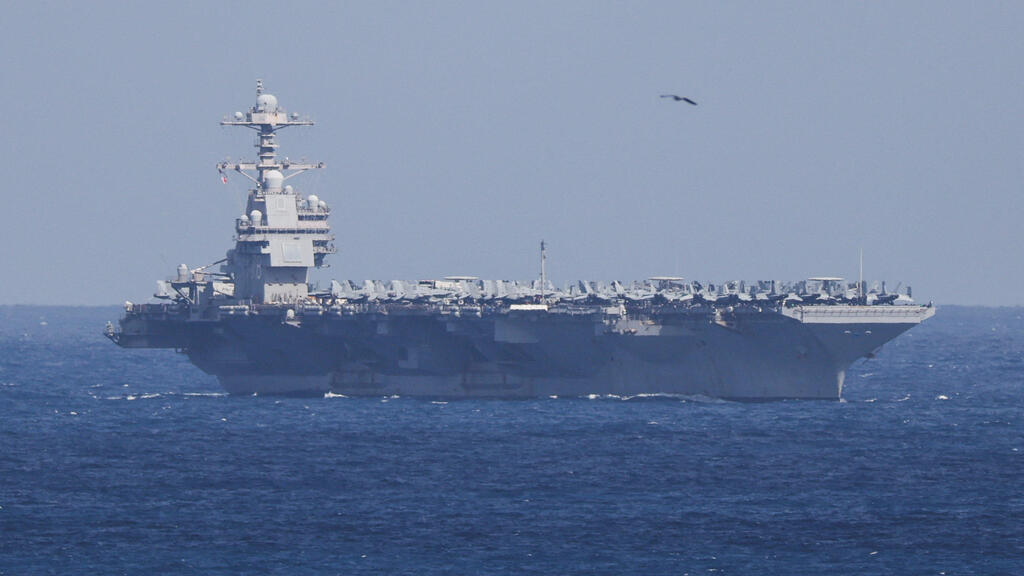
In addition to combat aircraft, US forces in the region include more than 100 refueling, command-and-control, intelligence and transport planes. Two US carrier strike groups are operating in the broader area: the USS Abraham Lincoln, which arrived weeks ago, and the USS Gerald R. Ford, currently in the Mediterranean and observed near Crete as it continues eastward. The US presence also includes 12 destroyers, with additional vessels possibly en route.
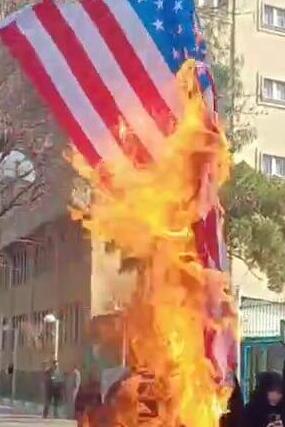
Burning of a US flag at Amirkabir University in Tehran
The New York Times reported Sunday, citing US and Western security officials, that there are growing concerns Iran could instruct its proxies to carry out attacks against American targets in Europe and the Middle East if Trump orders large-scale strikes against Iran. While no specific plots have been identified, officials noted increased “chatter” among terror operatives indicating a degree of coordination and planning.
The report also said Trump has told advisers he is leaning toward supporting a limited “initial strike” in the coming days aimed at persuading Iran to abandon its ability to develop nuclear weapons as part of a deal with Washington. Potential targets could range from Islamic Revolutionary Guard Corps headquarters to nuclear facilities and ballistic missile sites.
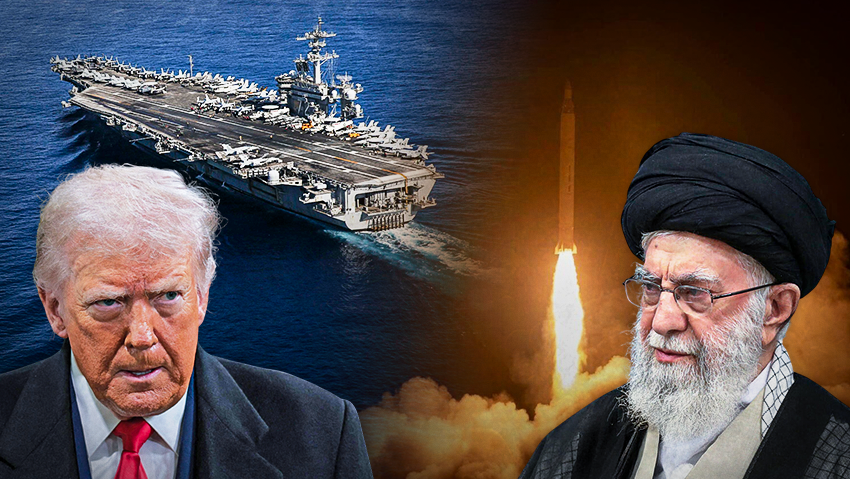
(Photo: Anna Moneymaker/AFP, KHAMENEI.IR/AFP)
According to the report, Trump has also indicated that if diplomatic efforts or limited strikes fail to pressure Tehran into abandoning its nuclear program, he would consider a much broader campaign in the coming months, potentially aimed at toppling the regime, though US officials reportedly doubt the feasibility of such an objective.
No final decision has been made. A third round of US-Iran talks is scheduled for Thursday in Geneva and is widely seen as a last opportunity to avert a US strike. Iranian officials have warned that an attack would ignite a regional war.
A “last-minute proposal” is reportedly under discussion that would allow both sides to step back. Under the framework being discussed, Iran would be permitted to continue uranium enrichment in a highly limited form strictly for medical research purposes as part of a new nuclear agreement.